

History · NBA
Why the NBA Chose a 24-Second Shot Clock in 1954
A 48-minute game and a benchmark of 120 shots produced the number. The new rule put a deadline on possession.
The NBA’s 24-second shot clock came from a straightforward calculation. A regulation game lasted 48 minutes, or 2,880 seconds. Using a benchmark of about 60 shots for each team meant 120 attempts between them. Dividing 2,880 by 120 produced 24 seconds.
The practical problem was stalling. Before the clock, a team with a lead could keep possession without attempting a shot, leaving the opponent to chase the ball or foul. The game clock kept running even when the offense stopped trying to score. A possession deadline changed that incentive.
The Syracuse Proposal
The proposal came from Syracuse Nationals owner Danny Biasone and general manager Leo Ferris. The NBA’s account of the 1954–55 season names both men, as does Le Moyne College’s archive of the Nationals. The Naismith Basketball Hall of Fame’s Biasone biography emphasizes the owner’s role in persuading the league to adopt the idea.
The 120-shot benchmark represented a pace the designers wanted to preserve. WBUR’s later reporting on Ferris describes them examining box scores from games they considered competitive and entertaining.
What the Early Rule Required
The NBA approved the rule in April 1954 and put it into effect for the 1954–55 season. That chronology appears in the Detroit Pistons’ 1957–58 media guide, a period source explaining the still-new rule to spectators.
The guide identified “sustained action” and the “elimination of the stall” as reasons for the change. Its description started the special clock when a team established possession and required an attempt within 24 seconds. Failure to do so meant giving the ball to the opponent.
That period wording also defined an attempt as a shot hitting the backboard or rim. It is evidence of how the early rule was explained and enforced, rather than a substitute for the NBA’s later rules. The essential change was the deadline itself: possession carried an obligation to attempt a score.
The Change in Scoring
The scoring change was substantial. The Naismith Hall’s profile reports that teams averaged 79.5 points per game before the clock and 93.1 in its first season. Those are team averages, an increase of 13.6 points per team per game between the two seasons.
The clock was part of a wider set of rule changes. The Pistons’ guide also discussed additional penalties after a team’s foul allowance, while the NBA’s season history identifies the accompanying team-foul limit. The scoring increase therefore describes what happened across that changing league; it does not isolate the clock’s contribution from every other change.
Syracuse won the 1955 championship in the first season with the clock. The more lasting consequence of its leaders’ proposal was a repeatable rule for every team: after gaining possession, the offense had a limited time to produce an attempt. The choice of 24 converted the desired shooting pace into a deadline that could be administered during a game.
Sources and Notes
- Detroit Pistons’ 1957–58 media guide, printed page 4. The period guide records April 1954 adoption and implementation the following season, explains the possession clock and states its anti-stalling purpose. Its backboard-or-rim wording describes the rule of that period.
- Le Moyne College’s shot-clock archive. Explains the 2,880 ÷ 120 calculation and identifies Biasone and Ferris. Its photographed museum object is distinct from proof of which clock was used at a particular game.
- Danny Biasone’s Naismith Hall of Fame biography. Supplies the 79.5 and 93.1 scoring averages and the 1955 Syracuse championship. The figures are per team per game.
- NBA review of the 1954–55 season. Credits Biasone and Ferris and records the accompanying team-foul change.
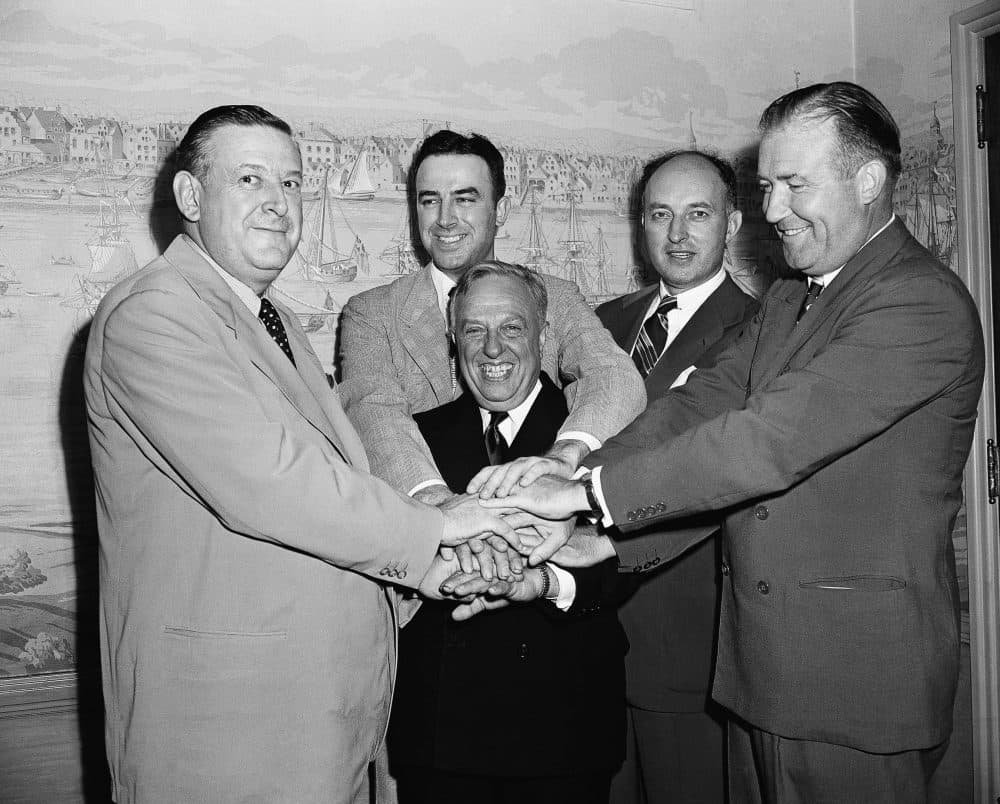
- WBUR’s reporting on Leo Ferris. Traces Ferris’s role through Sean Kirst’s reporting and historical newspaper clippings. Accounts differ in emphasis on individual credit; the institutional sources cited here identify both Syracuse officials. The text dates the cover photograph to August 3, 1949.
Related coverage: Bob Pettit, the First MVP Who Made the Hawks Champions.
Sources and notes
- https://library.sfo2.cdn.digitaloceanspaces.com/publications/basketball/yearbooks/KDETPMG-1958.pdf
- https://resources.library.lemoyne.edu/c.php?g=1251716&p=9172875
- https://www.hoophall.com/hall-of-famers/danny-biasone
- https://www.nba.com/news/history-season-review-1954-55
- https://www.wbur.org/onlyagame/2018/04/06/leo-ferris-nba-founder-shot-clock-hall-of-fame