Bob Pettit, the NBA’s first Most Valuable Player and the man whose 50-point performance brought the St. Louis Hawks their 1958 championship, died September 23 at his home in Metairie, Louisiana, aged 93. His family said he passed peacefully.
Pettit gave the Hawks a lasting place in basketball history. He led them to four Finals in five seasons, all against Bill Russell’s Boston Celtics, and delivered the championship that interrupted the league’s greatest dynasty. The photographs and newspaper reports in The Sporting Page’s archive trace his progress from LSU to a scoring record that Wilt Chamberlain would eventually have to break.
From LSU to an $11,000 rookie contract
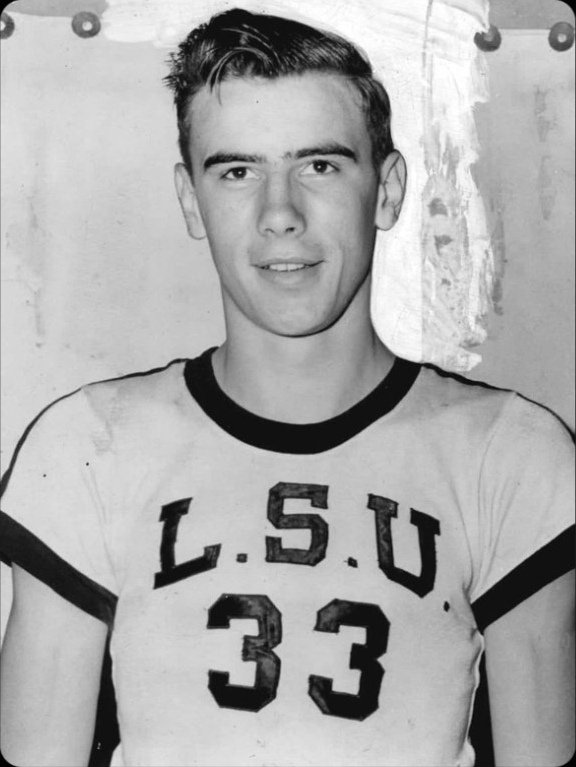
The LSU portrait belongs to the college years in which Pettit helped take his hometown university to its first Final Four in 1953. Born in Baton Rouge on December 12, 1932, he averaged 31.4 points and 17.3 rebounds as a senior. In 1954, his No. 50 became the first jersey number retired in any sport at LSU.
The Milwaukee Hawks selected him second overall in the 1954 NBA draft and signed him for $11,000, then a record salary for an NBA rookie. Pettit later recalled having only $100 in the bank when he graduated, making the contract a considerable opportunity for a young man beginning his working life.
The move into professional basketball also required a change of position. Pettit had played centre at LSU, but under coach Red Holzman he moved to forward. In an April 1957 SPORT interview, he described the adjustment from playing with his back to the basket in college to facing it in the NBA. He had to become more comfortable operating outside and handling the ball while meeting the defensive demands of the professional game.
The 6-foot-9 forward averaged 20.4 points and 13.8 rebounds as a rookie, earning Rookie of the Year and his first All-Star selection. When the Hawks moved to St. Louis in 1955, they arrived with the player around whom they would build their championship years.
The first name on the MVP list
The NBA introduced its regular-season MVP award in 1955–56, and Pettit became its first winner. He also led the league in scoring at 25.7 points per game, reaching that distinction in only his second professional season.
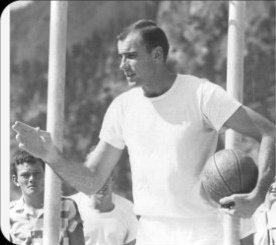
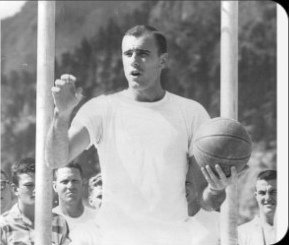
The paired photographs show a less formal Pettit, in a plain white shirt with a basketball tucked against his side, gesturing as people look on. Their precise date and setting are unidentified.
In a recollection preserved by LSU, Pettit described offensive rebounds and free throws as the foundation of a productive scoring night. Putbacks rewarded his pursuit of missed shots, and trips to the line supplied points while putting opponents in foul trouble. His jump shooting added to opportunities he was already creating through physical effort.
Bill Russell recognised that persistence in the opponent he repeatedly faced for championships. As the NBA’s profile records, Russell later said: “Bob made ‘second effort’ a part of the sports vocabulary.”
The newspaper that announced a championship
In 1957, the Hawks took Boston to a seventh game that required two overtimes. Pettit finished with 39 points and 19 rebounds in a 125–123 defeat, according to the NBA’s Game 7 record. St. Louis returned to the Finals the following spring with another opportunity against the defending champions.
Russell sprained his ankle in Game 3 of the 1958 series, missed Games 4 and 5, and returned for 20 minutes in Game 6. Boston’s injury mattered to the series, and Pettit’s performance decided its final game.
The newspaper headline captures the result directly: “PETTIT HITS 50 AS HAWKS BEAT CELTICS FOR TITLE.” Beneath it, the next line records a 110–109 St. Louis victory in the sixth game and a 4–2 series win. The basketball sidebar gives the performance its most revealing detail: Pettit scored 19 of the Hawks’ last 21 points.
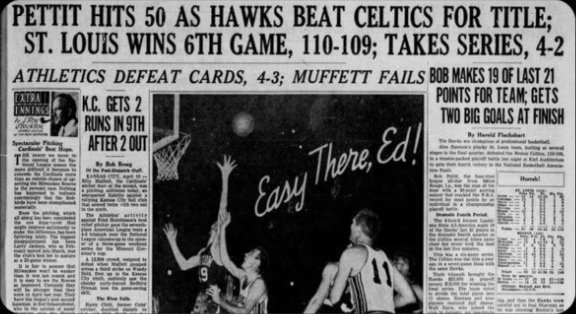
On April 12, 1958, he finished with 50 points and 19 rebounds. The sidebar’s late scoring tally explains how much St. Louis needed from him: with Boston still close enough to win, almost every Hawks point came from Pettit. His final basket was a tip-in in the closing seconds, putting St. Louis ahead by three. Boston scored again, but Pettit’s work on the offensive glass had supplied the winning margin.
The Hawks’ place in the Celtics years
Pettit made the Hawks a recurring championship opponent for Boston. St. Louis returned to the Finals in 1960 and forced another Game 7, which the Celtics won 122–103. They met again in 1961, with Boston winning in five.
During Russell’s thirteen-year career, Boston lost only two postseason series. Pettit’s Hawks won the 1958 Finals; Wilt Chamberlain’s Philadelphia 76ers won the 1967 Eastern Division finals. St. Louis was the only team to beat Russell’s Celtics in a championship series, and remained the only team to eliminate them from the playoffs until Philadelphia did it nine years later. Alex Hannum coached both victorious teams.
Without Boston, Pettit might have finished with several championships. His Hawks lost three other Finals, two in seven games, which makes the possibility worth considering even though different opponents would have posed different challenges. The record we have is substantial enough: he made the Hawks champions and kept them among the teams with a credible chance to win again.
19,215 points, and a presentation from Stan Musial
The next newspaper clipping moves the story to February 8, 1964. Its headline reads: “Pettit Takes Over As Highest Scorer With 19,215 Points.” The UPI report underneath records 18 points against the San Francisco Warriors, enough to move Pettit past Dolph Schayes into first place on the NBA’s career scoring list.
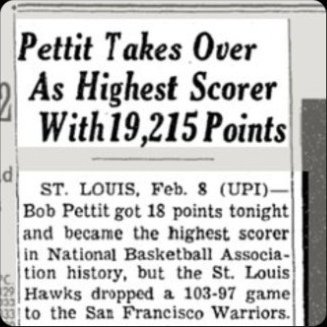
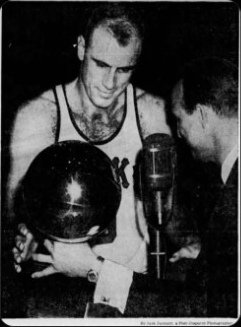
St. Louis lost 103–97, but play stopped to recognise the new record holder. Stan Musial, recently retired from the St. Louis Cardinals, presented Pettit with a trophy and the game ball. The accompanying photograph preserves Pettit holding the objects from that ceremony, when one of the city’s great baseball players honoured its basketball star.
Pettit subsequently became the first NBA player to reach 20,000 points. By his retirement in 1965, he had scored 20,880, averaging 26.4 points and 16.2 rebounds across eleven seasons. He had been an All-Star in every one of those seasons, with ten All-NBA First Team selections and a Second Team selection in his final year. He also won a second regular-season MVP and scoring title in 1959, averaging 29.2 points, and finished with four All-Star Game MVP awards.
The record Wilt had to pass
The final pair of photographs places Pettit in a Hawks jersey beside an official, then Chamberlain holding a basketball marked 20,884. The precise occasion of the Pettit photograph is unidentified, but the number on Wilt’s ball records the next change at the top of the NBA scoring list.
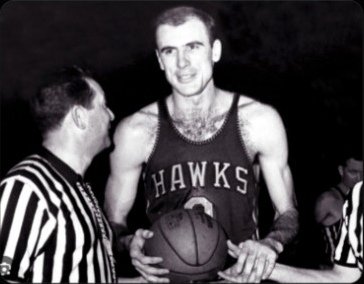
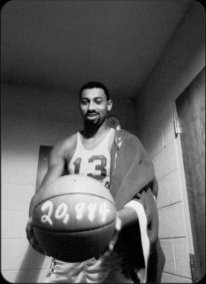
On February 14, 1966, Chamberlain scored 41 points in Philadelphia’s 149–123 victory over Detroit. His career total stood four points beyond Pettit’s 20,880. The following day’s newspaper report records the score and the milestone. Pettit had set the mark that Chamberlain, already one of basketball’s most extraordinary scorers, had to surpass.
Pettit also helped establish the model of a power forward who could score away from the basket while doing the rebounding work inside. As one of the early big men to play facing the hoop, he helped expand the position’s possibilities, providing a bridge to the later stars who define today’s greatest-power-forward discussions.
He entered the Naismith Memorial Basketball Hall of Fame in 1971. The achievements preserved in these clippings explain why his place there was assured, while his family’s remembrance of “the most kind, humble and gentle soul” speaks to the man they knew beyond basketball. The Sporting Page extends its condolences to the Pettit family.