
NFL
How Seattle Kept Patrick Mahomes and the Chiefs Out of the End Zone
Run containment, Nick Emmanwori’s coverage and pass-rush work, and Seattle’s possession advantage explain how the Chiefs went without a touchdown. Two missed kicks also shaped the final score.
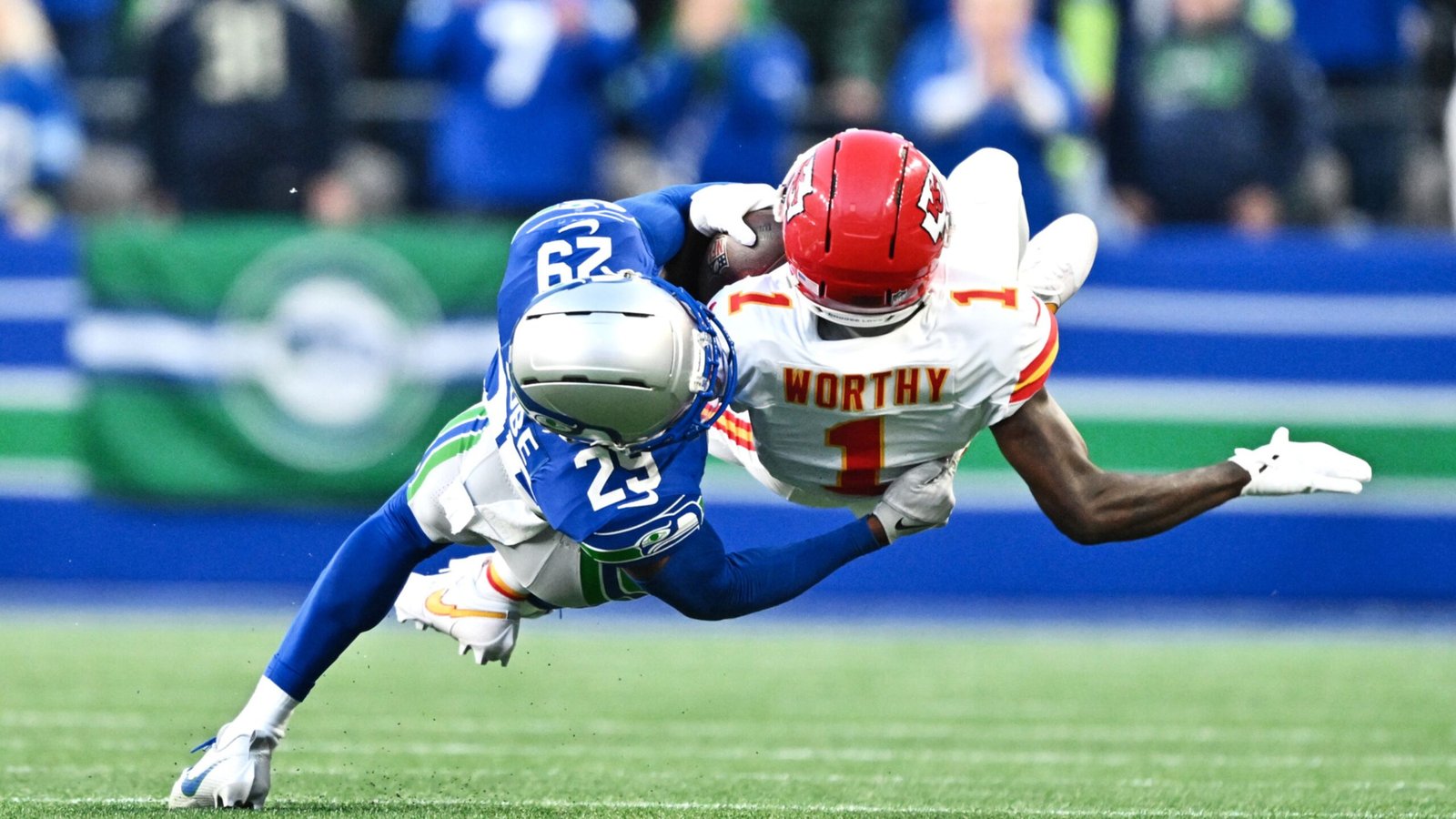
The Seattle Seahawks kept Patrick Mahomes and the Kansas City Chiefs out of the end zone by winning several connected parts of Sunday night’s game: limiting Kenneth Walker III, disrupting throws and keeping their own offense on the field. The 20–3 result was more complete than the one sack credited to Seattle might suggest.
Kansas City finished with 213 yards on 50 plays, converted three of 11 third downs and never reached the red zone on eight possessions. Those figures, recorded in the final box score, explain how the Chiefs could go through an entire game without creating a close-range touchdown chance. Seattle improved to 4–3, rebounding from its 17–14 overtime loss to Denver, and handed Kansas City its first defeat.
Walker’s return produced little on the ground
Walker had rushed for more than 100 yards in four of his first five games before returning to Seattle with the Chiefs, according to the Seahawks’ game report. Sunday, he gained 36 yards on 14 carries. That works out to 2.6 yards per attempt, rounded from 36 divided by 14.
The consequence was visible in Kansas City’s full rushing total: 50 yards on 16 attempts. Walker remained involved as a receiver, but the Chiefs could not repeatedly use his carries to advance downfield. Seattle made a runner who had supplied large weekly totals contribute through a much smaller rushing output.
That is a useful comparison, not a prediction that Walker’s season has changed. His earlier games involved different opponents and situations. Sunday establishes that Seattle contained him in this matchup; it does not isolate how much credit belongs to a particular front or individual defender on every carry.
Mahomes completed 19 of 33 passes for 165 yards, and Kansas City’s longest reception gained 19. With no 20-yard completion to accelerate a possession, the Chiefs needed to sustain more successful plays in sequence to get near the end zone. Their three third-down conversions limited how often they could do so.
Emmanwori could cover and rush
Nick Emmanwori’s deployment provides a more specific explanation for the passing defense. The team’s report describes him staying with Xavier Worthy on a crossing route and a deep attempt, then chasing Mahomes as the quarterback moved left. Emmanwori hit him as he threw, and Ty Okada intercepted the resulting pass.
The play connected pressure with a possession-ending result without becoming a sack. It also illustrated the value of a defender who can handle different responsibilities. A defense can threaten pressure with the same player it trusts to run with a receiver, adding uncertainty to the offense’s decisions about protection and where to throw.
Next Gen Stats figures reported by NFL.com credited Emmanwori with two pressures on 10 pass rushes and two catches allowed for 26 yards on seven targets. The rushes and targets describe different assignments; they should not be combined into a single coverage or pressure rate.
Those figures support his dual contribution. They do not, on their own, identify the Chiefs’ protection call or establish that every incompletion resulted from his coverage. The observed interception sequence and the reported assignment-level totals offer a narrower, supportable conclusion: Seattle obtained value from both his rush opportunities and his work away from the quarterback.
The offense helped keep the defense’s task small
Seattle converted 11 of 16 third downs, ran 69 plays and held possession for 35:51. Kansas City had the ball for 24:09. The time difference was 11:42. Each team had eight possessions; Seattle’s advantage came in their duration and number of plays.
Jaxon Smith-Njigba’s nine catches for 150 yards and a touchdown were part of that help, as were two Sam Darnold scrambles that converted third-and-long. Seattle accumulated 410 yards and 24 first downs while punting twice. That offensive contribution helped it control the game even when its own scoring opportunities ended without a touchdown.
What the three points leave out
The score also needs context. Kansas City missed two field-goal attempts, and Seattle’s own three red-zone possessions produced no touchdowns. The Chiefs’ scoring total therefore reflects kicking outcomes as well as Seattle’s ability to stop drives. Seattle created a substantial yardage advantage without converting every opportunity into points.
The strongest defensive finding is the combination: restricted rushing production, limited passing gains, an interception created under pressure and no Chiefs possession reaching the red zone. That is a fuller explanation than attributing the win to sacks alone. The statistical sample is Week 7. These results identify what Kansas City failed to produce; they cannot establish the coverage call or protection assignment on every snap, or predict whether the same results would recur in another meeting.
Sources and notes
- https://www.seahawks.com/news/rapid-reactions-seahawks-defense-shines-in-dominant-20-3-victory-over-chiefs
- https://www.espn.com/nfl/boxscore/_/gameId/401873022
- https://www.nfl.com/news/seahawks-put-on-a-clinic-shutting-down-kenneth-walker-iii-patrick-mahomes-in-blowout-win-over-chiefs
- https://thesportingpage.com/lutzs-53-yard-field-goal-gives-broncos-17-14-overtime-win-over-seahawks/
- https://www.seahawks.com/photos/photos-must-see-game-action-shots-from-seahawks-vs-chiefs-in-week-7