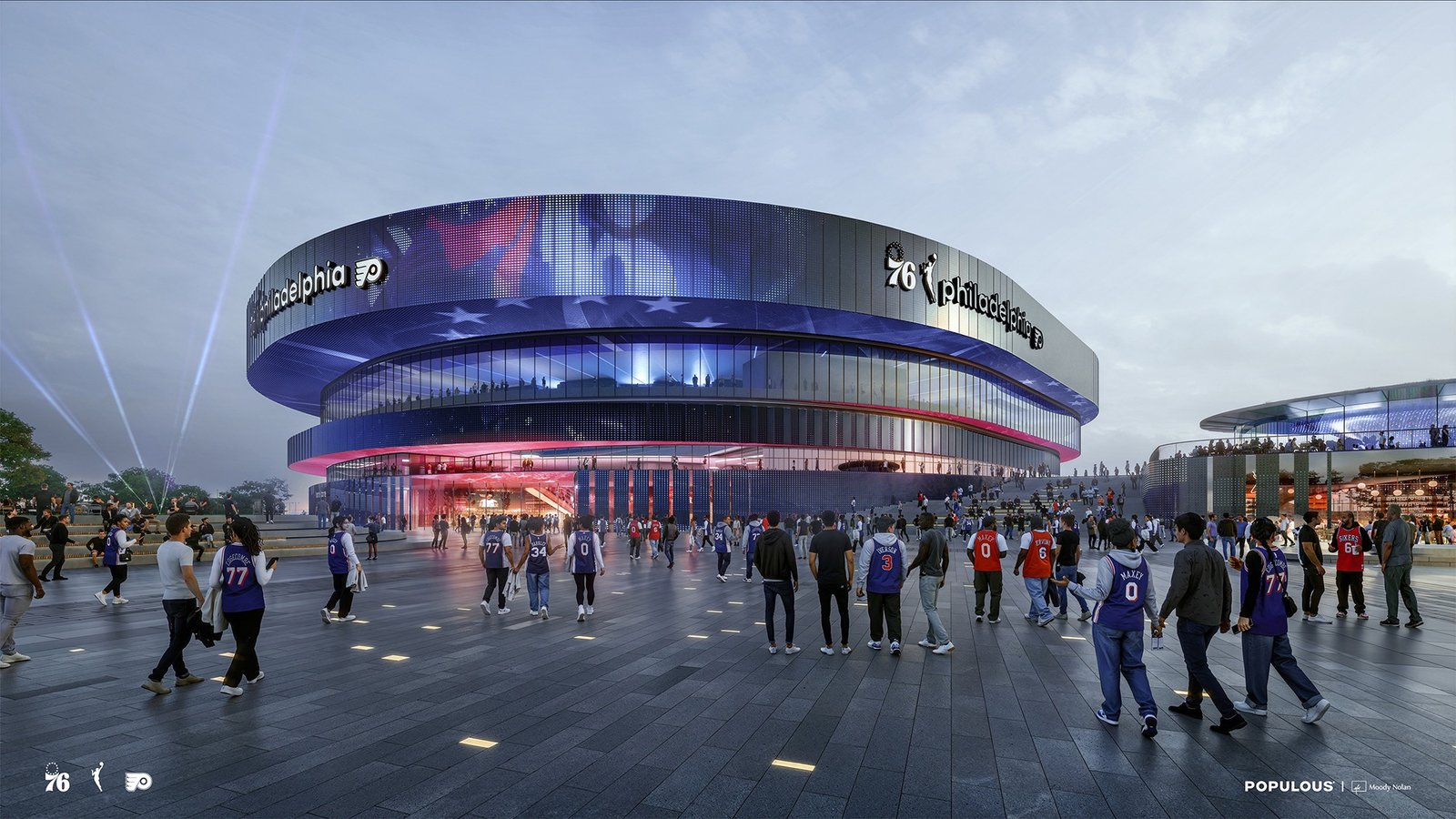
The Philadelphia 76ers and Flyers have unveiled the first exterior renderings of their proposed South Philadelphia arena, a Spectrum-inspired building targeted to open in 2030 before the inaugural season of the city’s WNBA expansion team.
“We loved the look of it; it’s different. We really hope Philly likes it,” Sixers managing partner Josh Harris told 6abc after the September 8 unveiling.
The response has already extended beyond whether the building looks good. For residents living near the sports complex, a new arena also raises questions about the effects of game-day crowds. For supporters, the more consequential test will be whether the experience of attending a game improves along with the surroundings.
A new building on familiar ground
The arena is planned for the former Spectrum grounds beside Xfinity Mobile Arena, the teams’ current home. Groundbreaking is targeted for early 2027, subject to city approvals. The current building will remain standing until its replacement opens, 6abc reported. The 2030 opening remains a target rather than a guaranteed date.
Alongside NHL and NBA games, the arena is planned to host concerts and other live events. The WNBA awarded Philadelphia an expansion franchise on June 30, 2025, with play scheduled to begin in 2030. Its name has not yet been announced.
Populous is designing the arena with Moody Nolan. Its exterior uses stacked horizontal bands that project outward, drawing on the shape of the Spectrum. A broad entrance staircase is intended to echo the steps at the Philadelphia Museum of Art, according to the teams. The resemblance is deliberate: the project is being presented as a continuation of the city’s sporting history, rather than a departure from it.
The proposed outdoor areas cover more than half an acre, with space for fan gatherings and food-and-beverage pavilions. The renderings also show a large exterior screen, extending the plans for the game-day experience beyond the arena walls.
The designers say fan consultation will continue through the design and approval process. The project website also makes clear that the visuals are for presentation purposes and remain subject to change.
Enthusiasm, with concerns closer to home
In 6abc’s reporting from South Philadelphia, resident Ellen McCrossen welcomed the proposal. Jason Vanarsdale raised concerns about existing game-day behavior, describing people sitting on his steps and leaving behind beer cans and bottles of urine.
The arena will be judged by people who live nearby as well as those who arrive for an event, and an attractive gathering space would not, by itself, resolve the problems Vanarsdale described.
In an unrepresentative Axios poll of 83 readers, 48% loved the design, 51% rated it just OK and 1% hated it.
The promotional image that was changed
One criticism produced a visible response within the launch week. By Thursday, September 10, a rendering showing fans arriving for a Flyers game had been revised after observers questioned the apparent absence of women among the prominently depicted supporters. The Philadelphia Inquirer reported that Populous accepted responsibility for the oversight and said it acted quickly to update the image.
Rashida Ng, an architecture professor at the University of Pennsylvania, told The Inquirer she would not assume the omission was intentional. “But something can be unintentional and still be meaningful,” she said.
The image does not establish an intention to exclude anyone, but promotional material still communicates who is imagined using a space. The issue matters for a hockey audience in its own right, not only because the building is also intended to house a WNBA franchise.
Private funding, and the arena next door
Sixers owner Harris Blitzer Sports & Entertainment and Flyers owner Comcast Spectacor will own the new arena 50-50 under their January 2025 agreement.
The existing arena opened in 1996 as the CoreStates Center at a reported cost of US$210 million. It was largely privately financed, although city and state money supported local infrastructure.
The arena also recently underwent an extensive overhaul. Comcast says the privately funded renovation of the then-Wells Fargo Center, now Xfinity Mobile Arena, cost more than US$400 million, with the final phase unveiled in April 2024. If the replacement opens in 2030 as planned, it would arrive about six years after that work was finished. That makes the recently renovated arena, rather than memories of the Spectrum alone, an important benchmark for judging what the new building will offer fans.
The partners describe the proposed arena as Philadelphia’s largest fully privately funded project. They forecast nearly 15,000 jobs and almost $6 billion in economic activity over a decade, along with hundreds of millions of dollars in additional tax revenue benefiting the city and its school district, WHYY reported. The figures should be treated as the developers’ projections, not as a guaranteed return for the city.
A construction budget was not disclosed with the first renderings, The Inquirer reported. The US$1.3 billion estimate attached to the Sixers’ abandoned Center City proposal should not be treated as a confirmed price for the South Philadelphia arena.
For supporters, private construction funding is separate from affordability: it does not establish what a family will pay to attend a game or whether ordinary seats will remain within reach.
What happens beyond the renderings
The Sixers unveiled 76 Place at Market East in July 2022, proposing an arena at the Fashion District shopping center near Chinatown. City Council approved the plan in December 2024; the team abandoned it in January 2025 in favor of the South Philadelphia partnership. The proposal had faced opposition from Chinatown residents concerned about displacement and disruption.
The arena also awaits a permanent name, with Comcast holding the naming rights. The future of the wider stadium-district redevelopment remains unclear, with The Inquirer reporting that the immediate focus is the arena. The building’s renderings do not resolve how the rest of the surrounding district will develop.
The next stage should make it easier to judge the arena as a place to watch a game, including the view from an ordinary seat and the accessibility of the route to reach it. Those details will tell supporters more about the value of the project than another image of the front steps.