
 Business
Scores

NFL
How Joe Burrow and the Bengals Scored 30 in Four Straight Wins
Cincinnati scored touchdowns on 16 of 20 red-zone trips during its four-game winning streak. How it got there changed from week to week.
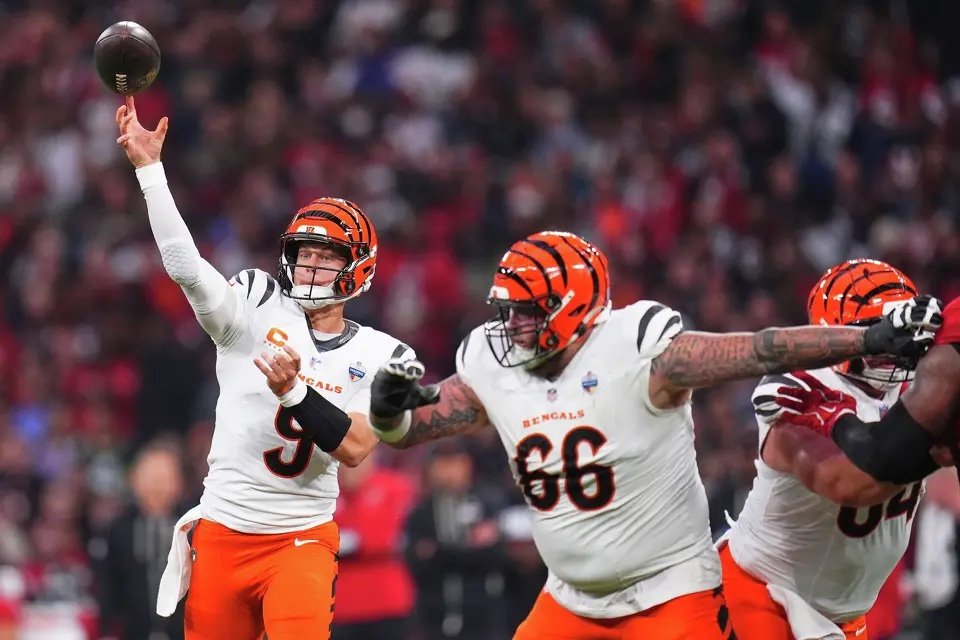
Atlanta scored on its opening drive in Madrid. Five plays into Cincinnati’s answer, Joe Burrow found Ja’Marr Chase for a 47-yard touchdown. The Bengals needed 2 minutes, 23 seconds to go 75 yards. Their next three first-half possessions took them 70, 88 and 45 yards, and every one ended in points. Atlanta led 7–0 and 10–7. Cincinnati led 24–10 at halftime.
The 34–17 win gave Cincinnati four straight games with at least 30 points, tying a franchise record. The Bengals also won all four, a first for the franchise in a stretch of that kind, according to NFL.com. They went from 2–2 to 6–2 and scored 143 points along the way. Burrow completed 107 of 139 passes for 1,215 yards and 16 touchdowns. All three of his interceptions came in the same game.
The four scores suggest a steady climb. The games were less orderly. Cincinnati needed a short field to get started in Miami, scored all 35 points after halftime in Baltimore and went to overtime against a one-win Tennessee team. Madrid was the first of the four games in which the Bengals reached 30 points before the fourth quarter. The common thread was what they did with their chances near the goal line.
Four Wins, Four Different Games
| Opponent | Final | Burrow pass yards | Burrow pass TDs | Team rush yards | Red-zone TDs/trips |
|---|---|---|---|---|---|
| at Miami, Oct. 11 | 31–24 | 190 | 4 | 117 | 3/5 |
| at Baltimore, Oct. 25 | 35–13 | 292 | 4 | 73 | 5/5 |
| vs. Tennessee, Nov. 1 | 43–36 OT | 462 | 5 | 75 | 5/6 |
| vs. Atlanta in Madrid, Nov. 8 | 34–17 | 271 | 3 | 123 | 3/4 |
| Total | 143–90 | 1,215 | 16 | 388 | 16/20 |
Rushing yards are team totals. Red-zone figures count touchdowns and trips inside the opponent’s 20, including overtime.
The Change Was Inside the 20
Cincinnati scored touchdowns on six of 12 red-zone trips in its first four games. It went 16 for 20 in its next four. The Bengals reached the red zone eight more times in the second stretch and finished 80% of those trips with touchdowns, up from 50%. At their early-season rate, 20 trips would have yielded 10 touchdowns. They got 16. In four games they scored 10 more touchdowns in the red zone than they did in their first four.
There was still room for a big gain to change a game before the Bengals got anywhere near the 20. Through five weeks, Higgins had 13 explosive receptions, second among receivers in the league’s Next Gen Stats count. Chase had the longest touchdown in Miami, and Higgins had the bigger yardage day in Baltimore. In Madrid, their lines split again. Chase supplied the yards downfield, while Higgins turned two short passes into touchdowns.
Miami Showed What Field Position Could Do
Burrow threw for 428 yards against Jacksonville on Oct. 4. Cincinnati scored 17 points and lost. A week later, he threw for 190 in Miami and finished with four touchdown passes. The difference starts with where the Bengals got the ball and what happened when they came within reach of the end zone.
Dohnte Meyers returned the opening kickoff 81 yards. Burrow hit Mike Gesicki from 4 yards out. Later in the half, Samaje Perine caught a 6-yard touchdown on third-and-goal to finish a drive that took more than seven minutes. Safety Jordan Battle intercepted Malik Willis on consecutive Miami possessions, and Cincinnati turned the second takeaway into a 2-yard touchdown pass to Tanner Hudson. Burrow had thrown three touchdown passes before halftime, all to a tight end or running back.
Chase supplied the longest score of the afternoon, a one-handed catch for a 45-yard touchdown. That was the only one of Burrow’s scoring throws longer than 6 yards. Miami ran for 217 yards and outgained Cincinnati overall. The Bengals converted nine of 13 third downs, though, and made enough of their shorter fields to score 31.
Baltimore Forced Cincinnati to Find an Answer at Halftime
The Bengals went into their bye after Miami. They came out of it with 43 first-half passing yards from Burrow and a 13–0 deficit at Baltimore. The first drive after halftime changed the game. Burrow completed all six of his passes, including a third-down conversion to Tee Higgins and a 6-yard touchdown to Gesicki. Higgins caught the go-ahead touchdown later in the third quarter. Perine scored on the ground, and Chase and Drew Sample caught the final two touchdowns.
“We let our big-time players go out and make big-time plays,” Burrow said afterward. Higgins finished with 148 receiving yards and Burrow threw for 249 after halftime. Cincinnati scored a touchdown on all five red-zone visits. Its defense shut out Baltimore after halftime, giving Burrow enough possessions to turn the game around. The Bengals managed 73 rushing yards, their lowest total of the streak.
Tennessee Tested What Happened When Cincinnati Gave the Ball Away
Tennessee intercepted Burrow three times and recovered a fumble. Cincinnati also gained 510 yards, with Higgins and Chase combining for 296 receiving yards. Those two facts explain why the Bengals needed overtime despite moving the ball so well. The Titans got extra possessions and answered often enough to keep Cincinnati from controlling the game.
Cincinnati’s defense shortened one drive itself. Boye Mafe stripped Cam Ward, Dexter Lawrence recovered and the Bengals took over at the Tennessee 17. Burrow hit Higgins for a touchdown on the next snap. Later, Gesicki caught a 25-yard touchdown up the seam, his fifth straight game with a scoring catch. Higgins tied the game at 36 with an 18-yard catch late in the fourth. In overtime, Burrow finished a 70-yard drive with a 9-yard scramble.
Burrow was blunt about the four turnovers. “It’s hard to win that way,” he said. The Bengals scored touchdowns on five of six red-zone trips against Tennessee, the same number they scored in Baltimore. They needed every one against a team that put up 36.
What Madrid Added Before the Pittsburgh Rematch
Cincinnati gained 123 rushing yards against Atlanta, the most of the four wins. Chase Brown had 57 yards on nine carries, and Burrow scored from the 1. Chase’s 47-yard catch showed how quickly the Bengals could score from outside the 20. Higgins’s two touchdown catches, from 4 and 8 yards, showed how they finished when the field got shorter. With Atlanta back within seven in the third quarter, the second Higgins touchdown capped a 73-yard drive and restored a two-score lead.
Chase accounted for 142 of Burrow’s 239 first-half passing yards in Madrid. Cincinnati converted four of five third downs in that half and stayed on the field long enough to turn two drives of at least 70 yards into short touchdowns. On its fourth possession, it went 45 yards in 33 seconds for Evan McPherson’s 57-yard field goal. The offense had time to play patiently on the earlier drives and still moved quickly enough to add points before halftime.
The rushing improvement came late in the streak. Cincinnati gained 73 yards on the ground in Baltimore and 75 against Tennessee. What held up across the four games was Cincinnati’s ability to finish close to the goal line. Burrow had options at running back and tight end as well as his top two receivers. Cincinnati could score through Chase on a long pass or finish a drive through Perine, Hudson or Higgins.
Pittsburgh saw the same passing threats in September. In that game, Burrow threw for 282 yards and three touchdowns, including a 25-yard pass to Gesicki on fourth-and-2 that put Cincinnati ahead in the fourth quarter. Pittsburgh came back to win 30–27. Derrick Harmon knocked the ball out of Burrow’s hands with 44 seconds left, ending Cincinnati’s last possession. The rematch is Nov. 15 at 8:20 p.m. ET at Paycor Stadium.
Cincinnati averaged 35.8 points during the winning streak, up from 24.3 in its first four games. The rematch will test the part of the turnaround that the Bengals can take from one opponent to the next. They already found a way to score against Pittsburgh. The question is whether they can finish enough drives and keep the ball long enough to make those points stand up.
Sources and notes
- Box scores and gamebooks
- Tampa Bay · Houston · Pittsburgh · Jacksonville · Miami (SI) · Miami (Football Database) · Baltimore · Tennessee · Atlanta
- Game reports and quotes
- Pittsburgh recap · Jacksonville recap · Miami recap · Baltimore recap · Baltimore quotes · Tennessee recap · Tennessee quotes · Madrid postgame notes · NFL Week 9 analysis
- Stats and schedule
- Burrow game log · Bengals bye-week notes · NFL schedule
- Related coverage
- Bengals–Falcons final and gamecast · Bengals–Titans overtime recap