Week 1 is where draft price stops mattering and actual usage begins. TSP breaks down the lineup calls that deserve a decision before the 2026 season opens.
Reading this after the opener? This guide records TSP’s September 8, 2026 advice for 12-team, one-quarterback PPR leagues. The player calls below reflect that pre-opener assessment. For subsequent injury and lineup reporting, see Fantasy Pulse and check the latest official game-status reports before setting a lineup.
The first fantasy lineup of the season is where months of assumptions finally meet an actual game plan.
That matters more than usual in Week 1. There is no 2026 snap data yet, no route participation from games that count and no reliable red-zone distribution. Managers are working with last season’s production, current depth charts, training-camp usage and the injury report. The goal is not to pretend that uncertainty has disappeared. It is to identify which uncertainty matters.
This guide assumes a 12-team, one-quarterback PPR format. The obvious weekly superstars are not the focus. The decisions that swing Week 1 usually sit in the middle of a roster, where two players can look similar by reputation but very different by expected role.
The calendar also changes the normal routine. New England visits Seattle on Wednesday, September 9 at 8:20 p.m. ET, and San Francisco faces the Rams in Melbourne on Thursday. Most of the league does not play until Sunday. That means Patriots and Seahawks decisions must be made before fantasy managers receive the information they are used to having by Sunday morning.
The rule for this week is simple: trust the role before the name.
A difficult matchup can lower efficiency, but volume can keep a player useful. A favorable matchup cannot rescue a player whose touches are uncertain. An injury designation can matter more than draft capital. A committee can turn an exciting player into a flex instead of an automatic starter.
That is the standard behind the board below.
The TSP Week 1 Board
Established workload against Carolina.
Chicago’s 2025 receiving leader enters Year 2 with a trusted role.
Led Cleveland in receiving as a rookie.
Strong play if TreVeyon Henderson remains unavailable or clearly limited.
Scoring upside is real, target hierarchy still needs confirmation.
Explosive role, but Jacksonville has said the backfield is a committee.
Ankle injury and an early Wednesday deadline create unnecessary risk.
Playable in Superflex, but not a preferred one-QB Week 1 start.
Volume is useful, but Jacksonville’s run defense is a difficult opening draw.
D’Andre Swift, RB, Bears
START
Swift enters Week 1 with something fantasy managers should value in September: a role that already worked.
Chicago finished 2025 with 2,456 rushing yards, the third-highest team total in the league. Swift accounted for 1,087 yards and nine rushing touchdowns on 223 carries, then added 299 receiving yards and another score. Kyle Monangai was productive enough to remain part of the backfield, but Swift did not need a monopoly on touches to deliver a career year.
The opener is at Carolina. The Panthers allowed 2,096 rushing yards and 20 rushing touchdowns last season. That does not guarantee efficiency on every carry, but it gives Chicago little reason to abandon the part of the offense that was already a strength.
The important part is role security. Swift has the rushing work, receiving utility and goal-line history to remain useful even if Monangai takes a meaningful share. Week 1 is not the time to create a problem where the workload evidence is already strong.
Colston Loveland, TE, Bears
START
Loveland is no longer a speculative tight-end breakout.
As a rookie, he caught 58 passes for 713 yards and six touchdowns. Those numbers led Chicago in receiving, making him the first Bears rookie to lead the team in receiving yards since Willie Gault in 1983 and the first rookie tight end to do it since Mike Ditka in 1961.
The more important Week 1 evidence is that Chicago spent the summer building on that role instead of resetting it. Bears coaches have repeatedly described Loveland as one of Caleb Williams’ trusted targets, and the second-year tight end entered camp healthy after losing much of his first NFL offseason to shoulder rehabilitation. In an August 19 red-zone period, Williams opened the drill with a touchdown pass to Loveland.
Cole Kmet still matters. So do Rome Odunze and Luther Burden III. None of that changes the fact that Loveland already demonstrated a receiving role strong enough to lead the team over a full rookie season.
Harold Fannin Jr., TE, Browns
START
Cleveland’s passing game has questions. Fannin’s place in it is much easier to understand.
Fannin led the Browns in 2025 with 72 receptions for 731 yards and six touchdowns. Cleveland’s current roster lists him at the front of a tight-end group that also includes rookie Carsen Ryan and veteran Blake Whiteheart. The organization’s own camp coverage has emphasized how much faster and more confident Fannin looks entering Year 2.
This is exactly the kind of profile worth trusting in Week 1. The offense does not need to be elite for its most established receiving option to matter. Fannin already produced through instability as a rookie, and his current role gives him a cleaner path to targets than many tight ends being drafted in the same range.
Jacksonville is not a defense to dismiss, but the matchup is secondary here. Fannin’s value comes from his position in Cleveland’s target tree.
Rhamondre Stevenson, RB, Patriots
CONDITIONAL START
Stevenson is the player on this board whose recommendation depends most directly on the next injury report.
New England’s first official Week 1 report listed TreVeyon Henderson as a non-participant Sunday because of an ankle injury. The Patriots open Wednesday night, which compresses the recovery window and forces fantasy managers to make this decision earlier than usual.
If Henderson is inactive or clearly limited, Stevenson becomes a strong volume play. New England’s initial 53-man roster carried Stevenson, Henderson and Corey Kiner at running back. Stevenson also produced 948 scrimmage yards and nine total touchdowns in 14 regular-season games last year, including 345 receiving yards.
Seattle is a difficult opponent. The Seahawks allowed only 1,563 rushing yards and nine rushing touchdowns during the 2025 regular season. That limits the ceiling. It does not erase the value of concentrated touches if Henderson cannot handle his normal work.
Rome Odunze, WR, Bears
FLEX
Odunze belongs in the middle category because the upside is clear and the target hierarchy is not.
He played 12 regular-season games in 2025 and caught 44 passes for 661 yards and six touchdowns. His best production came early in the season, and he showed again this summer that Chicago still views him as a scoring-area weapon. During the Bears’ August 19 red-zone period, Williams connected with Odunze for two touchdowns.
The complication is the number of legitimate receiving options around him. Loveland is already a trusted middle-of-the-field and red-zone target. Burden is another player Chicago can feature. The Bears have enough options that Week 1 route participation and targets will matter more than offseason assumptions.
That does not make Odunze a sit. It makes him the kind of receiver who fits better in a flex spot than in a lineup built around guaranteed volume.
Bhayshul Tuten, RB, Jaguars
FLEX
Tuten has a real opportunity. Jacksonville has also been unusually clear that opportunity does not mean a one-man backfield.
As a rookie, Tuten ran 83 times for 307 yards and five touchdowns and added two receiving scores. Travis Etienne is gone, which opens work, but the Jaguars have listed Tuten and Chris Rodriguez Jr. as co-starters. Offensive coordinator Grant Udinski described the running game as a committee and said the backs can contribute across normal downs, third down and two-minute situations.
That is useful information because it keeps the recommendation grounded. Tuten is explosive enough to make a smaller workload matter, and Jacksonville has praised his progress in pass protection. At the same time, managers should not project a 70-percent snap share before the Jaguars give him one.
Cleveland allowed 1,979 rushing yards last season and 14 rushing touchdowns. The matchup is playable. The uncertainty is distribution.
TreVeyon Henderson, RB, Patriots
SIT
Henderson is a sit because the risk is concentrated in the two areas fantasy managers cannot afford to guess about: health and workload.
He was listed as a non-participant on New England’s first official Week 1 injury report with an ankle issue. The Patriots play Wednesday, so there is less time than usual for the situation to improve and less time for fantasy managers to react.
Even an active designation would not automatically answer the workload question. A player returning from missed practice time can be available without immediately returning to a normal touch count. That distinction matters against Seattle, which was one of the league’s stingier rushing defenses last season.
This is not a season-long downgrade. Henderson rushed for 911 yards and nine touchdowns as a rookie and remains central to New England’s backfield when healthy.
Trevor Lawrence, QB, Jaguars
SIT
Lawrence’s offseason has been encouraging, but a standard one-quarterback league does not require managers to chase every encouraging signal in Week 1.
Jacksonville reported better timing between Lawrence and receivers such as Parker Washington and Brian Thomas Jr. during August camp. The receiving room is deep, and that can help the offense over the course of the season. It can also make Week 1 target concentration harder to predict.
The opponent adds another reason for caution. Cleveland allowed 3,220 passing yards in 2025 and recorded 53 sacks. The Browns have changed personnel since then, but the underlying point remains useful: this is not an opening matchup that forces fantasy managers to gamble on Lawrence before the 2026 version of Jacksonville’s offense has shown itself in a regular-season game.
There is also a format distinction. Lawrence remains completely viable in Superflex and two-quarterback leagues because replacement value changes the decision.
Quinshon Judkins, RB, Browns
SIT
Judkins had enough volume as a rookie to remain relevant, but Week 1 gives managers a difficult matchup and limited reason to force him into a flex spot.
He carried 230 times for 827 yards and seven touchdowns in 2025, averaging 3.6 yards per attempt. He added 26 receptions for 171 yards. That profile can work when Cleveland controls the game or creates repeated scoring opportunities, but it leaves less room for error when rushing efficiency is challenged.
Jacksonville led the NFL in 2025 by allowing only 85.6 rushing yards per game. The Jaguars gave up 1,455 rushing yards all season and held opposing runners under control consistently.
Cleveland also kept Dylan Sampson in the backfield, so Judkins enters the season as the lead option in a young room rather than as a player with every snap and touch guaranteed.
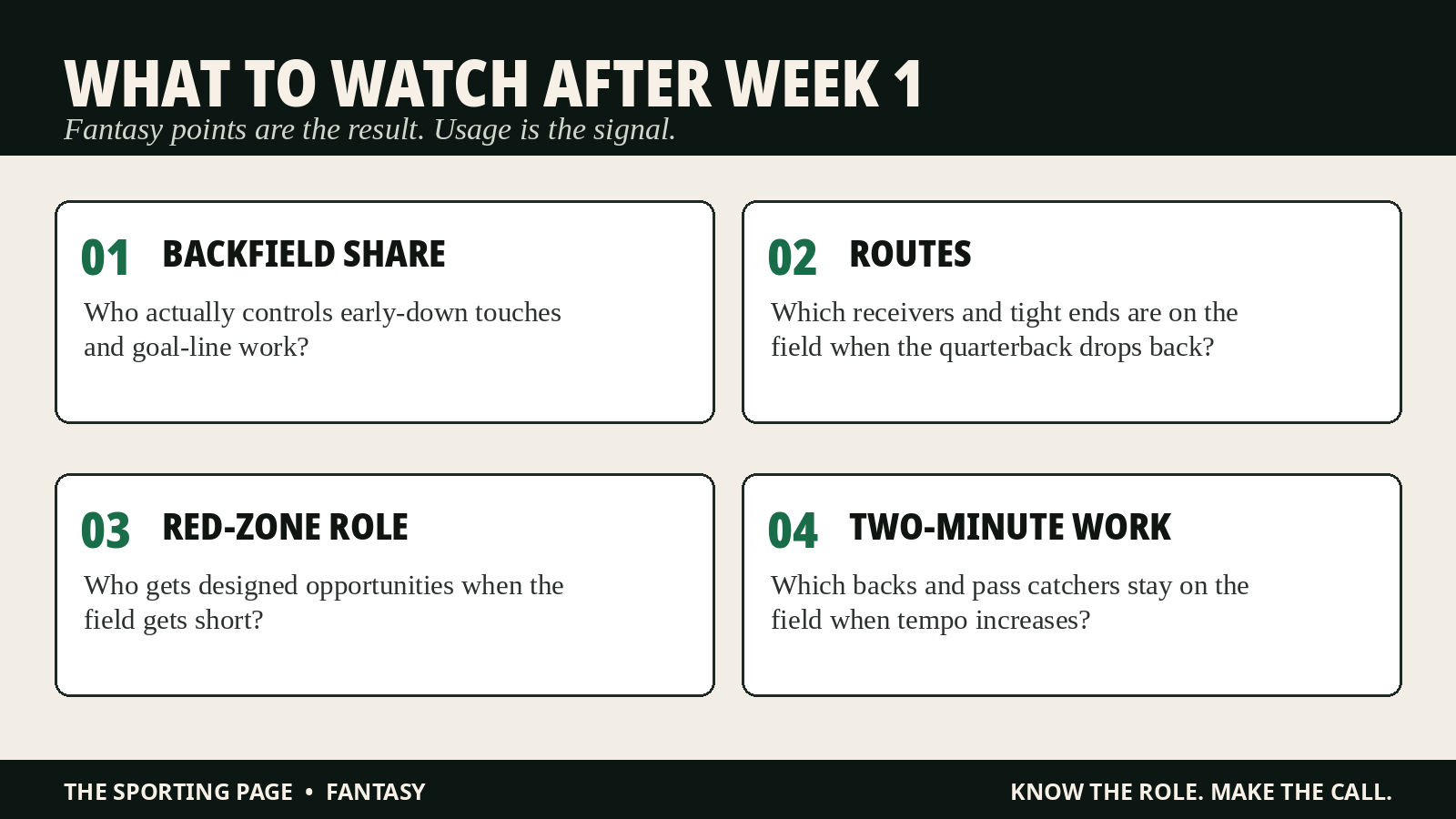
What Week 1 Should Teach Us
The first week is not only a scoring event. It is the first usable evidence of the season.
For running backs, the most important information is not simply carries. Watch who handles third down, who stays on the field in two-minute offense and who receives the ball near the goal line. A back can score fewer fantasy points than his teammate and still leave Week 1 with the better long-term role.
For receivers and tight ends, routes matter. A player who is on the field for almost every pass play but catches three balls can be a better Week 2 investment than someone who scores on two receptions while rotating in and out. Red-zone work matters for the same reason because it shows which players the offense is deliberately trying to feature when scoring opportunities are limited.
That is why the decisions in this guide are built around role.
Swift, Loveland and Fannin have already shown workloads that can be trusted. Stevenson becomes more attractive if Henderson’s injury concentrates New England’s backfield. Odunze and Tuten are playable, but their teams still have usage questions that make “flex” more honest than “must start.” Henderson’s ankle makes him a bad Week 1 gamble unless the practice report changes materially. Lawrence and Judkins are players who can become useful quickly, but their opening matchups do not require fantasy managers to assume the best-case outcome.
Some of these calls will change by next week. That is the point.
Once the games start, camp language gives way to snap counts. Depth-chart labels give way to actual rotations. The first red-zone series will tell us things August could not.
Before locking any lineup, check the official injury report one final time. That is especially important for New England because the Patriots play Wednesday. The correct Week 1 decision is not the one that looked best when the week started. It is the one that still matches the evidence when the game begins.
Sources and Verification
- NFL Week 1 schedule
- Patriots Week 1 injury report
- Patriots initial 53-man roster
- Rhamondre Stevenson career statistics
- NFL 2025 rushing defense team statistics
- Bears 2025 running back review
- Colston Loveland Year 2 feature
- Bears Aug. 19 training camp report
- Rome Odunze career statistics
- Browns initial 53-man roster
- Harold Fannin Jr. career statistics
- Quinshon Judkins career statistics
- Browns 2025 team statistics
- Jaguars running back committee report
- Jaguars initial 2026 backfield/depth chart
- Bhayshul Tuten player statistics
- Jaguars 2025 team statistics
- Jaguars 2026 camp report on Trevor Lawrence
- Bears 2026 schedule
- Browns 2026 schedule