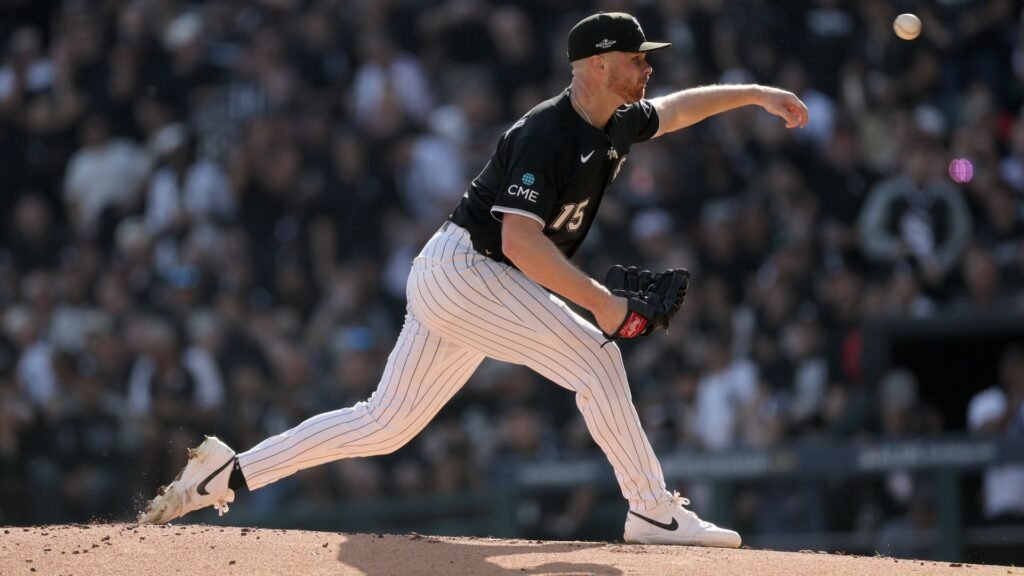
Kyle Teel swung through Daniel Espino’s first pitch, a 99.9-mph four-seamer, in the first inning. Two more fastballs went for balls. At 2–1, Teel drove a 91.4-mph slider for a double that scored Sam Antonacci and moved Miguel Vargas to third. The missed fastball had supplied a strike, but the count and the next pitch gave Chicago a different result.
Espino’s planned opener assignment ended after two outs and 20 pitches in Cleveland’s 9–3 win over the White Sox in ALDS Game 3 on Wednesday, October 7. He allowed two hits, one walk and one earned run, with two strikeouts. Foster Griffin stranded the two runners he inherited, keeping the short outing’s run total from growing.
Every recorded miss came against Espino’s four-seam fastball, while both hits came against his slider. That split explains this inning without turning three sliders or five batters into a broad verdict on either pitch.
Regular season and Game 3
Share of all physical pitches. Scale: 0–80%.
Four-seam
Slider
Curve
Sixteen fastballs in a five-batter sample
Espino threw 16 four-seamers, 80.0% of the outing, averaging 99.8 mph. His 273-pitch regular-season sample across 14 appearances was 61.9% four-seamers at 98.8 mph. His three starts, a separate and smaller 70-pitch sample, had a similar fastball share of 62.9%. The outing was more fastball-heavy than both comparisons, but its role and size limit the inference.
The four-seamer produced four misses in seven swings, including the final pitches of strikeouts against Munetaka Murakami and Chase Meidroth. None was put in play. His three sliders drew three swings, one foul and two hits; the single curveball was taken for a ball. All pitches remain in the selection denominator.
Kyle Teel: inning 1
The walk supplied the runner who scored
Antonacci took five consecutive fastballs in the opening plate appearance, reaching 3–0 before a called strike and a fourth ball. Vargas then singled on a 92.6-mph slider. Murakami’s three-pitch strikeout interrupted the rally, but Teel’s double brought the opening walk home.
Vargas’ single left the bat at 93.3 mph; Teel’s double reached 100.7 mph at a 21-degree launch angle. These are the outing’s only two balls in play, so their outcomes carry most of the contact story. Espino struck Meidroth out before leaving with Vargas on third and Teel on second, trailing 1–0.
Cleveland’s later comeback does not change what those 20 pitches showed. Espino had a fastball that hitters missed and an inning extended by a walk and two slider hits. More comparable opener appearances are needed to test whether he can preserve those fastball strikeouts while avoiding the counts that preceded the damaging contact.
Workload and four-seam speed by inning
| Inning | Pitches | Cumulative | Four-seam mph | Four-seam n | Outs recorded |
|---|---|---|---|---|---|
| 1* | 20 | 20 | 99.8 | 16 | 2 |
All 20 pitches
Filter the complete outing and select any pitch for its measurements. Pitch result and completed plate-appearance outcome are separate columns.
20 of 20 pitches
No pitches match these filters.
| Pitch | Inning | Hitter | Count before | Type | mph | Pitch result | PA outcome |
|---|---|---|---|---|---|---|---|
| 1 | Sam Antonacci | 0-0 | Four-seam | 100.9 | Ball | Walk | |
| 1 | Sam Antonacci | 1-0 | Four-seam | 100.0 | Ball | Walk | |
| 1 | Sam Antonacci | 2-0 | Four-seam | 99.9 | Ball | Walk | |
| 1 | Sam Antonacci | 3-0 | Four-seam | 100.8 | Called Strike | Walk | |
| 1 | Sam Antonacci | 3-1 | Four-seam | 100.7 | Ball | Walk | |
| 1 | Miguel Vargas | 0-0 | Four-seam | 100.4 | Ball | Single | |
| 1 | Miguel Vargas | 1-0 | Slider | 92.5 | Foul | Single | |
| 1 | Miguel Vargas | 1-1 | Slider | 92.6 | In play, no out | Single | |
| 1 | Munetaka Murakami | 0-0 | Four-seam | 99.6 | Called Strike | Strikeout | |
| 1 | Munetaka Murakami | 0-1 | Four-seam | 99.6 | Foul | Strikeout | |
| 1 | Munetaka Murakami | 0-2 | Four-seam | 99.9 | Swinging Strike | Strikeout | |
| 1 | Kyle Teel | 0-0 | Four-seam | 99.9 | Swinging Strike | Double | |
| 1 | Kyle Teel | 0-1 | Four-seam | 99.5 | Ball | Double | |
| 1 | Kyle Teel | 1-1 | Four-seam | 100.0 | Ball | Double | |
| 1 | Kyle Teel | 2-1 | Slider | 91.4 | In play, run(s) | Double | |
| 1 | Chase Meidroth | 0-0 | Four-seam | 99.5 | Swinging Strike | Strikeout | |
| 1 | Chase Meidroth | 0-1 | Four-seam | 98.0 | Foul | Strikeout | |
| 1 | Chase Meidroth | 0-2 | Curve | 75.0 | Ball | Strikeout | |
| 1 | Chase Meidroth | 1-2 | Four-seam | 98.8 | Foul | Strikeout | |
| 1 | Chase Meidroth | 1-2 | Four-seam | 99.5 | Swinging Strike | Strikeout |
Sources, definitions and limitations
The official MLB final record supplies the score, pitching line, play order and calls. Baseball Savant’s complete gamefeed supplies pitch tracking. Statcast Search supplies the pregame regular-season comparison. Reporting cutoff: October 7, 2026 at 8:58 PM Mountain Time. ALDS Game 3 was final.
All 20 physical pitches reconcile by unique ID, order, type, call and pre-pitch count, including any count-changing non-pitch events. The audit also reconciles 5 batters, 2 integer outs and 2 strikeouts. Baseball innings notation counts outs: .1 is one out and .2 is two. Automatic calls, intentional-walk records and non-pitch actions are excluded from physical-pitch totals.
The primary baseline contains 273 physical pitches in 14 regular-season appearances, including 3 starts, 2026-06-17 through 2026-09-25. Its game IDs and per-game totals reconcile to the official log. Postseason games are separate. Team and starter-only comparisons are identified in the prose. Small role samples do not establish stable trends.
Whiff rate means misses divided by swings. Swinging strikes, blocked swinging strikes and caught foul tips count as misses, matching Savant’s supplied summary. Fouls, balls in play and bunt attempts also count as swings. Called strikes and strikeout plate appearances are separate. Hard-hit means measured exit speed of at least 95 mph. Per-ball expected batting averages are Savant model estimates, not actual outcomes or an official aggregate.
Speed is mph, spin rpm, extension feet and induced vertical break inches relative to a gravity-only path. The pitch-detail panel distinguishes source zone flags, measured ball-center locations and official calls. The chart uses catcher-view locations in feet with the batter’s recorded zone boundaries. See Statcast field definitions. All outing pitches have speed, spin, extension, induced vertical break and plate coordinates. All 2 balls in play have measured exit speed and launch angle; non-contact fields remain blank on other pitches.
This is descriptive analysis of one completed outing. The measured record cannot establish intended targets, hitter expectations, fatigue or injury. Opponent handedness, count opportunities and short opener assignments can affect pitch selection. Photographs identify their source event; no comments or interviews have been inferred from tracking data.