OPINION
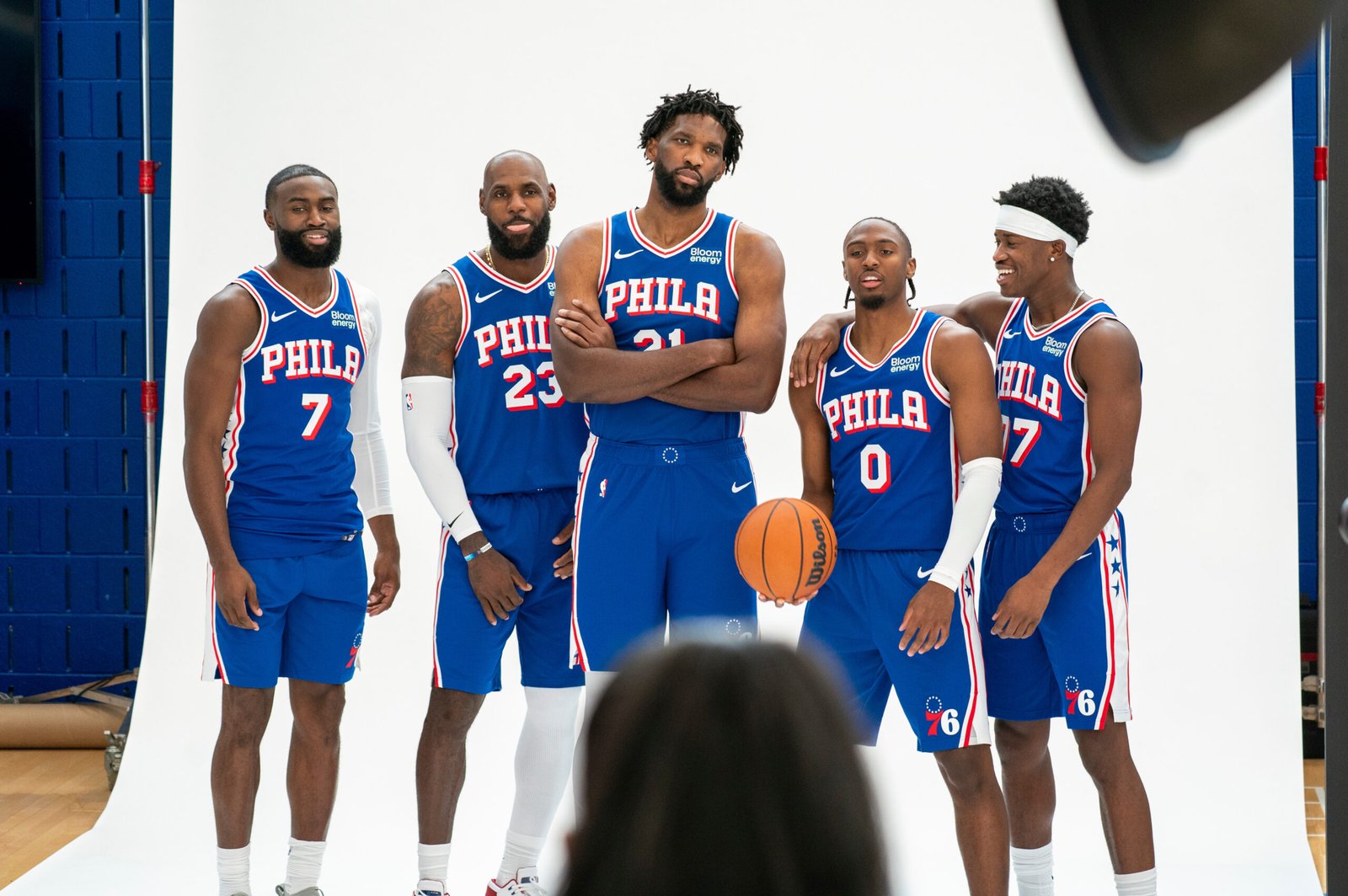
Tyrese Maxey had been trying to bring LeBron James to Philadelphia for years. When James finally arrived, Maxey had a message for the reporters who came with him.
“I wanted LeBron. I ain’t want all y’all,” he said. “Just playing.”
The question concerned the attention that follows James, something James himself had discussed before making the move. Maxey said he was focused on basketball and accustomed to the noise after playing at Kentucky and spending his NBA career in Philadelphia.
“That doesn’t really bother me, honestly.”
Read as reassurance, the answer leaves room for a less celebratory interpretation of the joke: Maxey got the teammate he wanted, and the accompanying attention was already something he had to address before the first game. He said he could handle it. How that feels over a season remains ahead of him.
Elsewhere at media day, Jaylen Brown was asked who would be the team’s alpha.
“Next question.”
Joel Embiid, meanwhile, stopped a question about Philadelphia’s previous star combinations before accepting its premise.
“I wouldn’t say it didn’t work out. Obviously, we didn’t win.”
Those moments are part of a broader contrast running through the four interviews. James and Maxey spoke about a relationship they had spent years building and a partnership they helped bring about. Brown spoke about leadership, shared defensive responsibility and approaching this group with an empty slate. Embiid spoke about continuity and what he had learned from the teams that came before it.
That is the basis for a tale of two teams: a LeBron–Maxey partnership arriving with an established understanding, and Brown and Embiid bringing their own ideas about how this should work. It is a reading of their public comments, rather than evidence that two factions have formed. The interest lies in how differently they described the same new beginning.
The relationship behind the move
Maxey traced his relationship with James to workouts before he entered the NBA. He was getting to the gym at 6 a.m., working alongside Rajon Rondo, when an opportunity came to join James later in the morning.
The sessions continued. What began before the bubble became a summer routine, with Maxey checking when James would be back and arranging to meet him in the gym.
“Every single summer we get back in the lab,” Maxey said.
Seeing James in Philadelphia was different. Maxey was used to those summer workouts; now James was in the team’s facility in Camden, wearing the same jersey.
“It’s cool. It was a cool experience.”
Asked whether they shared a similar mindset, Maxey answered with the admiration that had accompanied the relationship.
“I hope I have a similar mindset as him,” he said. “I hope so.”
He described James as someone who had surpassed the expectations placed on him, then contrasted that with his own experience of working his way up. Their starting points had been different, but Maxey returned to the work they shared.
“I believe in the work. He believes in the work.”
The possibility of becoming teammates had been on Maxey’s mind before this summer. During a previous free agency, he sent an invitation even though he expected James to stay in Los Angeles. Brown’s arrival made the possibility more interesting, Maxey explained, and he decided to reach out again.
James eventually called, and the two talked. From James’s account, those conversations went well beyond a recruiting pitch. He asked about Maxey’s future, his confidence in the franchise and where James would fit.
“Do we think it’ll be a plus or do we think it’ll be a negative?” James recalled asking.
He acknowledged that his presence brought more than basketball.
“Sometimes it could be a negative,” he said. “Some people maybe can’t handle what I may bring to the table.”
There was more than one conversation. When James explained how he narrowed his options, he returned to Maxey.
“He was one of the main deciding factors.”
For Maxey, the expectation was that James’s experience would reach beyond their partnership.
“He’s going to just uplift the whole entire team, entire organization.”
The enthusiasm was clear. So was the familiarity. Before this group had held its first practice, James and Maxey had already spent years working together and talking through the possibility of sharing a team.
Brown’s empty slate
Brown described his arrival differently. Asked whether the move had sunk in, he talked about the mental, emotional and physical sides of adjusting.
“It’s an adjustment. It’s new.”
Later, a reporter asked whether the championship experience shared by Brown, James and Kentavious Caldwell-Pope would help Brown settle into the proper role.
“I’m not so sure if that’s true,” Brown replied.
He described approaching the team with “an empty slate,” coming in each day and making the most of the opportunity. His answer stayed with the work the new group needed to do together.
“You just got to come in and be ready to work and get better every single day, build with your teammates, create a winning environment, and see where that takes you.”
Past experience might help, he allowed. It might also leave things unresolved.
“It may be some stuff you have to figure out and do differently as well. So, I’m ready for either.”
Alongside that answer sits James’s description of what he hoped to bring: experience, knowledge and “the blueprint” for players trying to accomplish things they had not yet done. James said that approach could also benefit teammates who had already won at the highest level.
Brown’s emphasis was on discovering what this group needed. His answer about the previous season explained why having a part in that process mattered to him.
“I think the opportunity to lead,” he said when asked what he had enjoyed most.
He talked about galvanizing teammates, setting their expectations internally and motivating them to compete every night. Leadership was the experience he chose to discuss when invited to reflect on his own game.
“Some of that is gonna be carried over, but this group looks different.”
The alpha question drew only “Next question.” The longer answers offered more to work with. Brown had enjoyed leading, wanted to build a winning environment and was leaving open what his new role would require. He did not use the occasion to name somebody else as the person around whom those decisions would revolve.
Embiid remembers what came before
Embiid’s opening answer about James was brief.
“I didn’t talk to him,” he said. “I didn’t recruit him.”
There was laughter, and a later question explicitly referred to the answer as a joke. His more substantial explanation came when he was asked about the previous arrivals of Jimmy Butler, James Harden and Paul George, and the suggestion that those combinations had not worked out.
“I wouldn’t say it didn’t work out,” Embiid interrupted. “Obviously, we didn’t win.”
He apologized for cutting in, then explained why he resisted the description. Teams needed time. Butler had been there for half a year; Harden for roughly a year and a half. Ben Simmons had been there longer, with other events disrupting that partnership.
He described the difficulty of trying to win with a group assembled for only a year or two.
Embiid pointed to teams that had spent years figuring things out together. His own experience had included repeated changes, and he returned to consistency as something Philadelphia needed.
“I haven’t done it,” he said of winning a championship. “Feel like I know what it takes.”
That distinction runs through his comments. Embiid acknowledged the missing championship without accepting that everything before James’s arrival should be dismissed. Asked about integrating players who had been stars elsewhere, he described the different roles Brown and Maxey had already played and referred to his own understanding of the game.
“I know how to play the game of basketball.”
His expectations for the season also began with work already underway. He said the conversations about his health had put everyone on the same page, that he wanted to play as much as possible and that there was a plan to follow.
The goal was to “make sure I stay healthy and then be at my best,” he said, discussing the later stages of the season.
James was separately asked how he could help Embiid with his daily routine and pursuit of a championship. He began by saying he needed to get there first and learn about Embiid’s process. He praised the work Embiid had done on his body, game and mental approach.
“Hopefully I can just give him resources,” James said, describing himself as the team’s elder statesman.
“I’m definitely in his corner.”
James was offering help. Embiid was explaining the experience and preparation he already possessed. In a summer centered on the arrival of another star, Embiid’s answers kept returning to what he believed Philadelphia had needed all along.
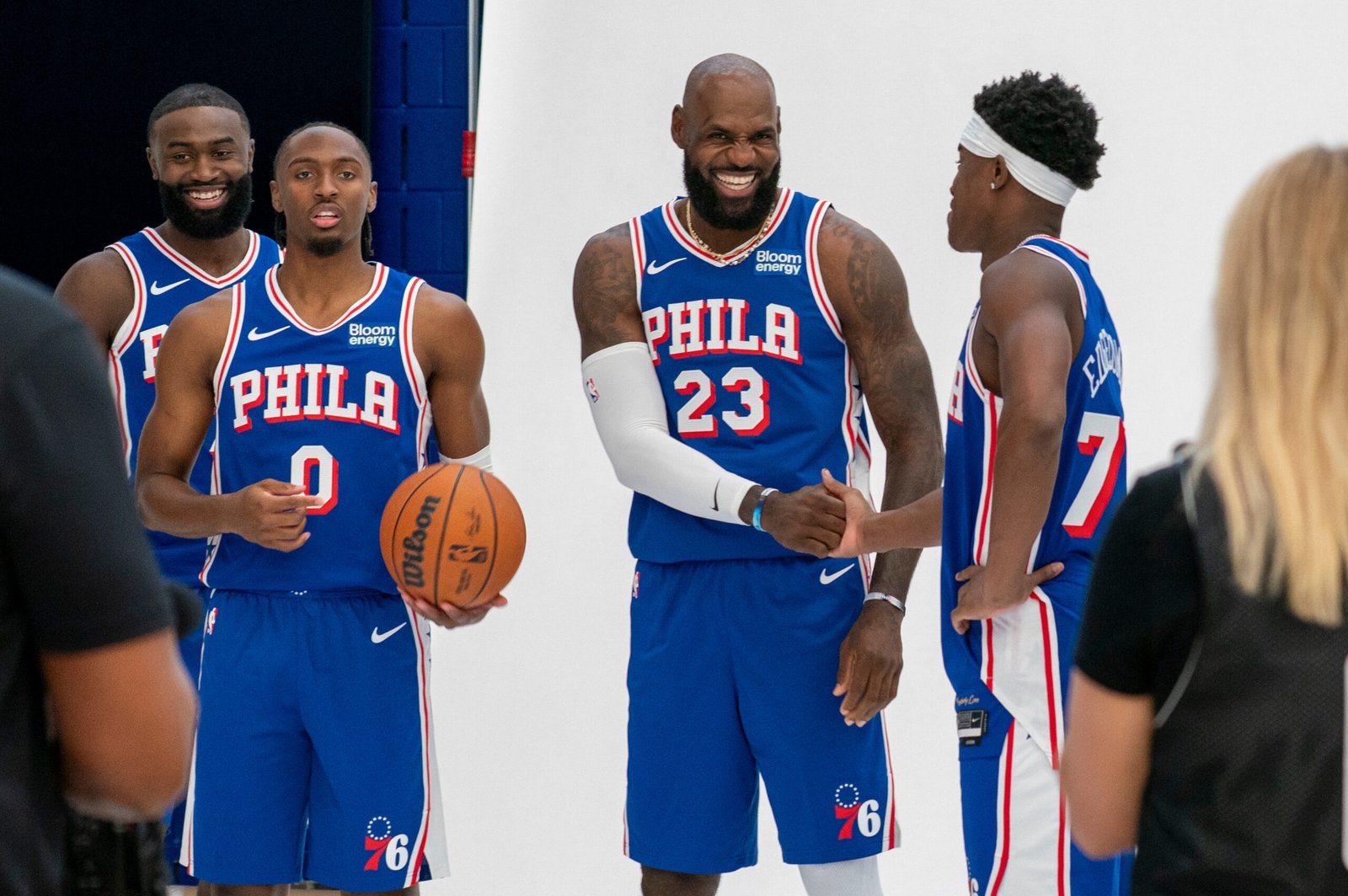
“All hold each other accountable”
The contrast becomes more specific when the discussion turns to defense.
Maxey was asked how Brown would fit. He described getting used to a former division rival becoming a teammate, recalled offering help after the trade and praised what Brown could bring to the community. On the court, he turned first to defense.
“I feel like he’s been talking about being a defensive monster this year.”
Maxey described the range of assignments he had seen Brown take.
“I’ve seen him guard me. I’ve seen him guard Joel. I’ve seen him guard wings.”
Philadelphia would need him at that end, Maxey said, while also needing his scoring. When Brown was asked about Maxey’s comments and his own defensive role, he broadened the answer.
“I think anchoring defense is important for all of us,” Brown said. “I think that should be where we should hang our hats as a team.”
Then came the shared obligation.
“Offensively we got a lot of firepower, but we got to all hold each other accountable on defense.”
Maxey described a player who could take on difficult assignments. Brown described a responsibility that belonged to everyone. That distinction gives the concern about the LeBron–Maxey pairing a basketball basis: how much of the defensive work will be shared, and how much will fall to Brown and Embiid?
Maxey said he intended to keep improving defensively and believed he had taken a substantial step the previous season. He was waiting to see what Nick Nurse would ask of the group. Brown also acknowledged that learning the system and its calls would take time.
Neither interview settles how those possessions will play out. Brown did, however, make his expectation explicit. The firepower was there. Accountability had to extend across the team.
What changes for whom?
Maxey had a clear picture of the opportunities the new roster could give him offensively.
“I don’t always have to come back and, like, bring the ball up,” he said.
With more players able to initiate offense, he expected to get out in transition, catch and shoot, come off screens and receive handoffs. He would still handle the ball, but the additions gave him other ways to participate.
“Playing more off the ball, playing more free,” he said later when discussing his goals.
James’s answer about his own role was broader: whatever the team needed.
“The luxury of my game is I can do everything,” he said. “Literally, I can do everything.”
Asked about how VJ Edgecombe’s role might change, James expanded the discussion to the entire roster. Everybody’s role would probably be different, he said, and the group would have to sacrifice together.
He offered examples of what fewer shots could make possible: more energy to take a charge, pursue an offensive rebound or run back for a block. Sacrifice, in his description, could give players something as well as take something away.
Brown was asked directly about that answer.
“100%. That’s what’s needed.”
He agreed that sacrifice could carry a negative connotation while still having benefits, and said pursuing something great required it. On this point, he explicitly endorsed James’s view.
“I agree with him.”
Embiid, too, expressed excitement about the roster and its combination of veteran leadership and younger players. Maxey described summer sessions with Brown and Embiid as well as James, working on two-man actions and building familiarity. Their comments contained common ground alongside the differences in emphasis.
What remained unsettled was how those ideas would translate into roles. Maxey spoke about greater freedom. Brown spoke about the leadership he valued and a defense requiring everyone’s contribution. Embiid spoke about health, time and continuity. James spoke about bringing experience while doing whatever the team needed.
The tale of two teams is in those starting points. James and Maxey had already imagined this partnership together. Brown and Embiid were explaining what they would bring to it, and what they expected from the people around them.
James acknowledged that chemistry would take time. He described repeated work, uncomfortable tasks and the danger of becoming a talented team remembered for falling short.
“We have to be comfortable being uncomfortable.”
Maxey had his own qualification for all the excitement surrounding the roster.
“We got the talent, whatever, but if we’re not willing to sacrifice, we’re not willing to put in the work, it ain’t gonna mean nothing.”
Brown had already supplied the words that would make that a shared commitment: “All hold each other accountable.”