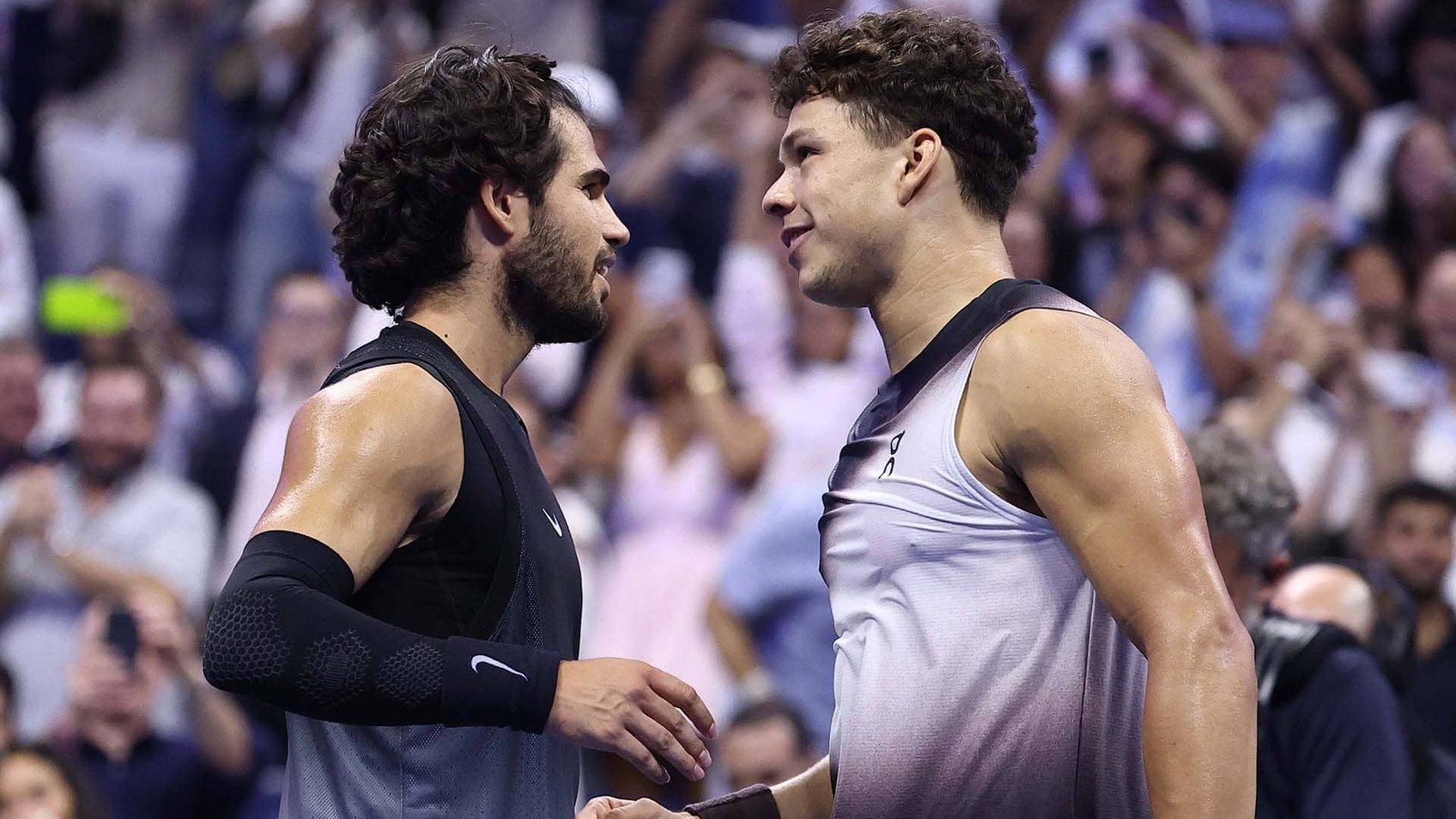
Ben Shelton beat defending champion Carlos Alcaraz at 3:33 a.m. on Wednesday, September 9, completing a five-set US Open quarterfinal that had lasted four hours and 28 minutes. No match in the tournament’s history had finished later.1
The victory put Shelton into a semifinal against Frances Tiafoe, guaranteeing an American man a place in Sunday’s final. It was a result the tournament could build its closing weekend around, delivered at an hour that demanded considerable commitment from anyone watching in New York.1
The problem was not that Shelton and Alcaraz needed five sets to settle their quarterfinal. It was that they did not begin until 11:05 p.m. on Tuesday. Before debating whether spectators should have stayed until the finish, the tournament needs to explain why watching an entire match required them to stay that late.2
Four matches on one court
Tuesday’s Arthur Ashe Stadium programme left the last match dependent on how long the preceding matches lasted. Aryna Sabalenka needed a deciding-set tiebreak to beat Linda Noskova. Frances Tiafoe then recovered from two sets down against Alex Michelsen, with their match also reaching a deciding tiebreak.3
Jessica Pegula’s three-set victory over Emma Navarro opened the evening session. By the time Shelton and Alcaraz could begin, the court had already hosted 11 sets. Their five-set quarterfinal brought the day’s total to 16, with all four singles matches going the distance.31
That was an unusually demanding programme, but the possibility of long matches is something a Grand Slam schedule must accommodate. Explaining why the day ran late does not settle whether the arrangement was sound.
Chris Russo challenged the tournament’s priorities during the September 9 edition of Mad Dog Unleashed on SiriusXM.4
“Everybody knew that this could be the match of the tournament. Everybody in the world knew it. And so their idea to make sure that we can all watch it is to put the damn thing on at 11:05 at night. I give the audience credit, because a lot of the crowd stayed.”4
A match does not need to be declared the best of the tournament in advance to deserve a workable starting time. Nor should the spectators’ willingness to stay become the test of whether the schedule succeeded. The relevant question is whether the programme made reasonable provision for a long contest.
The decisions behind the delay
The schedule is assembled by identifiable officials making consequential choices. In September 3 reporting for Bounces, Ben Rothenberg described watching tournament director Eric Butorac work with referee Jake Garner, Grand Slam supervisor Wayne McKewen and other officials to construct an order of play using specialised software and a bank of monitors.5
That work must reconcile player requests with broadcasting preferences. It also has to account for recovery time and players entered in more than one event. Rothenberg’s account makes clear that a decision about one match can affect the placement of others.5
Butorac, a former Australian Open doubles finalist, discussed the broadcasting priorities with ESPN’s Simon Cambers in a September 4 article. “ESPN domestic obviously has a ton of weight,” he said. British broadcasters prefer earlier appearances for their players, while time differences create different preferences for Asian and Australian audiences.6
Butorac also explained that he tries to give players an honest account when another match receives the preferred court or time. His description is not of an operation indifferent to competitors. It is of an operation balancing demands that cannot all be satisfied.6
That distinction matters, but it does not remove responsibility. A difficult scheduling process can still produce a poor schedule. The tournament must judge the arrangement by what happens when matches run long, not only by how neatly the names fit into the available sessions.
An earlier start is only part of the answer
Starting the evening session earlier would create more room only if the court were available. A 6 p.m. start would accomplish little while the afternoon programme was still running. Changing the published time would therefore need to be accompanied by changes to what comes before it.
Butorac has identified the journey to Queens after work as a difficulty with earlier starts, and has defended an evening programme that includes both men’s and women’s tennis. Those considerations were part of his explanation to ESPN before the record finish.6
The commute deserves consideration alongside the difficulty of travelling home after a match that ends in the early morning. Neither group of spectators should disappear from the calculation because its inconvenience falls outside the advertised session time.
Russo also addressed the order of the evening matches.
“If they got into a backload, which they did, with the 2 matches in the afternoon going long, they obviously could have moved the Alcaraz match to 8:30, 9 o’clock. It wouldn’t have been that bad, you would have been fine.”4
Reversing the order would have given Shelton and Alcaraz an earlier start. It would also have left Pegula and Navarro waiting for a match that ultimately required more than four hours. The potential benefit for one audience has to be weighed against what that change would do to the other.
That is why the problem should not be reduced to a choice between showcasing the men and respecting the women. Putting either match second behind an unpredictable contest can create the same difficulty. A reform should reduce that exposure, rather than simply decide who must endure it.
Sharing the courts without moving the problem
Russo’s proposal for the women’s quarterfinals was specific. Speaking on September 9 about the following day’s semifinals, he said:
“The match is tomorrow, the semi-final. They should have put them both at the same time. So in a perfect world what the US Open organizers should have done is have Sabalenka play [Arthur Ashe] at 11:30 and have Pegula play Navarro at 12 o’clock, 5 feet away.”4
Scheduling those matches on separate courts at similar times would reduce the delay created by waiting for one to finish before starting another. It would not guarantee equal recovery time, because their durations could still differ. Viewers would also have to choose between simultaneous quarterfinals rather than watch both in full.
The ticket arrangements would need attention. An Arthur Ashe ticket provides a reserved seat in Ashe, but its access to general-admission seating in Louis Armstrong is first come, first served. Moving a match would not automatically give every Ashe ticket holder an equivalent seat elsewhere.7
That is an argument for designing a different programme before tickets are sold, not for treating a last-minute court switch as cost-free. Fans should know what their ticket buys and what happens when matches are reassigned.
A one-match quarterfinal evening session also deserves examination, provided the rest of the draw receives appropriate court access and television exposure. The question would then become how to distribute the remaining matches without routinely relegating the women to less desirable positions.
A curfew would impose a firmer limit. Wimbledon stops play under an 11 p.m. local curfew.8
A comparable cutoff in New York would prevent play from continuing indefinitely, but unfinished contests would have to resume on another day. Spectators could leave without seeing the conclusion, and a returning player might have less time before the next round. The surrounding schedule would need to account for those consequences.
None of these changes is without a cost. Keeping the existing structure makes a choice as well: when the programme runs long, the last players on court and the people trying to watch them absorb the delay.
The audience should not have to solve the schedule
This was not the tournament’s first difficult night. Venus Williams’ first-round match began at 12:13 a.m., while Shelton had already finished his second-round victory over Denis Shapovalov at 2:07 a.m., the Associated Press reported on September 9.9
There is a difference between a memorable night session and an arrangement that requires spectators to sacrifice the following day to see it through. The people who remain help create the atmosphere. Those who leave should not have to defend their commitment to the sport.
After the quarterfinal, the US Open posted a mock excuse letter for fans to present to their employers, acknowledging the clash between watching the match and showing up for work.9
The joke recognised the problem, but could not resolve it. For a spectator with an early shift, or a parent deciding when a child has to go to bed, the issue is not whether the tennis is worth watching. It is whether watching the whole match is feasible.
In a statement reported by Reuters on September 9, a US Open spokesperson said, “we acknowledge that we must evaluate all scheduling options in the future.” The spokesperson argued that attention should remain on the athletes’ performances rather than the finishing time.8
That is also the strongest argument for changing the arrangements. The schedule should help a major performance reach its audience, rather than become the subject that competes with it.
Russo made his objection explicit:
“And I understand they got a lot of mouths to feed, and money is important, I get that. But when you allow money and ticket holders and all that nonsense to get in the way of the quality of the product AND fandom, that’s when you cross the line. And they crossed the line.”4
The case for reform does not require assuming an undisclosed commercial motive. It requires judging whether the compromises being made serve the people expected to watch, and whether the consequences of a late finish are receiving enough weight.
Shelton earned his place in the semifinals by winning the deciding tiebreak 10-7, ending the match with a 146-mph serve. The achievement belonged to him, and the length of the contest reflected the resistance he had to overcome.1
The tournament cannot guarantee when a great match will end. It can take responsibility for how late it is allowed to begin. That is where the review should start, rather than with the spectators who could not stay until the last point.
Source notes
1. Jay Paris, USOpen.org / USTA, September 9, 2026. Shelton ends Alcaraz’s US Open title defense in late-night five-setter.
2. Shrivathsa Sridhar, Reuters, September 9, 2026. Shelton stuns Alcaraz in late, late show to reach US Open semis.
3. Arthur Kapetanakis, USOpen.org / USTA, September 8, 2026. Sabalenka, Tiafoe win US Open QF epics: Results and highlights.
4. Chris Russo, SiriusXM, September 9, 2026. Mad Dog Unleashed: US Open scheduling discussion. Supplied verbatim transcript, sections 1, 2, 5 and 6.
5. Ben Rothenberg, Bounces, September 3, 2026. Inside the U.S. Open’s Room Where It Happens.
6. Simon Cambers, ESPN, September 4, 2026. Inside the never-ending puzzle of US Open match scheduling.
7. USTA, USOpen.org / USTA, March 13, 2026. US Open ticket types explained.
8. Shrivathsa Sridhar, Reuters, September 9, 2026. Latest finish puts US Open scheduling under harsh spotlight again.
9. Associated Press, AP News, September 9, 2026. Late nights at the US Open add a new wild wrinkle with 3:33 a.m. finish to Shelton-Alcaraz thriller.