
 Business
Scores

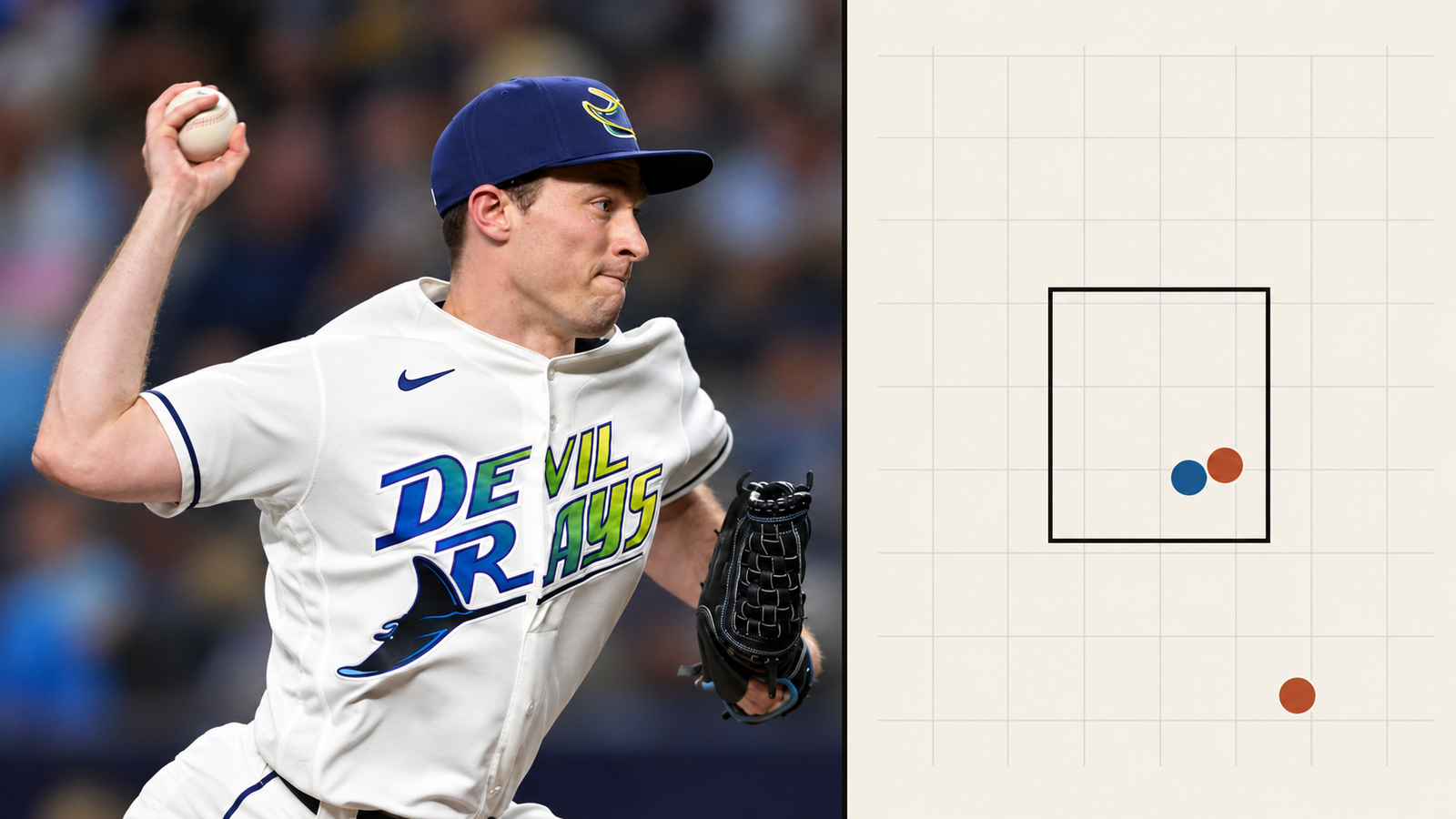
Kevin Kelly’s first changeup to Brayan Rocchio crossed at 86.6 mph for a called strike. Rocchio swung through the next at 85.9, then missed an 86.4-mph changeup below the recorded zone. Three pitches finished the plate appearance without putting a ball in play.
Kelly entered ALCS Game 6 with two outs, the bases loaded and Tampa Bay’s lead reduced to 5–3 in the eighth inning. Ian Seymour had walked Patrick Bailey and hit Angel Martínez to force in runs. Rocchio’s strikeout stranded the three runners Kelly inherited and preserved the two-run margin at Tropicana Field on October 19.
This was an effective sequence with an unusually concentrated selection: all three pitches were changeups. It was also Kelly’s entire outing. The useful explanation is how those three pitches acquired strikes in this situation, not a claim that one batter established a new repertoire or a repeatable strikeout rate.
The first take mattered as much as the final miss
The first two changeups finished at recorded plate heights of 1.94 and 1.90 feet. Both were inside the ball-center rectangle using Rocchio’s pitch-specific boundaries. The first became a taken strike; the second supplied a swing and miss. Kelly therefore reached 0–2 through two different hitter responses before throwing the final pitch.
The third finished 0.48 feet above the ground and 0.86 feet to the catcher-view right of plate center, below Rocchio’s recorded lower boundary of 1.55 feet. Its official result was a blocked swinging strike. The progression from two lower-zone pitches to one below the zone is directly observed; it does not establish what Rocchio expected or the location Kelly intended.
The regular-season comparison is 987 physical pitches in 71 Rays relief appearances, March 29 through September 25. Changeups accounted for 277, or 28.1%, behind a 57.5% sinker share. Showing Game 6 at 100% preserves what happened, but its denominator is only three. One different pitch would have changed that share by 33.3 percentage points.
His changeups averaged 86.3 mph here against 85.9 over the regular season. Two of two swings missed, while the remaining pitch was taken for a strike. Those counts are more informative than presenting a 100% whiff rate by itself. There was no contact sample from which to judge exit speed or expected batting outcomes.
Season repertoire and Game 6
Scale: 0–100%. Gray: regular season. Blue: Game 6.
Changeup
Change: +71.9 percentage points.
Sinker
Change: -57.5 percentage points.
Four-seam fastball
Change: -7.1 percentage points.
Sweeper
Change: -7.0 percentage points.
Cutter
Change: -0.3 percentage points.
| Type | Pitches | Share | Mean mph | Max mph | Speed n | Whiffs / swings | Called strikes | IVB in | Spin rpm |
|---|---|---|---|---|---|---|---|---|---|
| Changeup | 3 | 100.0% | 86.3 | 86.6 | 3 | 2/2 | 1 | -6.4 | 2100 |
IVB is induced vertical break relative to a gravity-only trajectory. It does not mean the ball rises. Rates and average measurements describe this appearance.
Brayan Rocchio: inning 8
A complete escape is still a very small sample
Rocchio hit left-handed, giving Kelly only one side of the plate and one set of count opportunities to work with. The selection cannot be generalized to right-handed hitters, longer appearances or situations in which the first pitch is called a ball. The season comparison supplies context, not evidence that Kelly abandoned his sinker.
He recorded one out, represented as 0.1 innings in baseball notation, and all three inherited runners remained on base. Those runners were created by the pitchers before him; Kelly’s individual line of no runs allowed does not itself describe how dangerous the entry situation was. The base-out context is essential to understanding the value of the strikeout.
Yandy Díaz’s two-run homer in the bottom of the inning later extended Tampa Bay’s lead, and the Rays won 7–3. Kelly’s contribution came before that additional cushion. His three changeups removed the immediate threat with a take followed by two misses. A future appearance with more hitters and different counts would be needed to test whether the same location pattern remains useful beyond this one confrontation.
Inning samples in context
| Inning | Pitches | Cumulative | Changeup mph | Measured n | Outs |
|---|---|---|---|---|---|
| 8* | 3 | 3 | 86.3 | 3 | 1 |
Every pitch: 3 of 3
Filter by pitcher, hitter, inning or pitch type. Pitch numbers belong to the named pitcher’s own outing. Select a number for the full measurement record. Pitch result and plate-appearance result or interruption are separate.
3 of 3 pitches
No pitches match these filters.
| Outing pitch | Pitcher | Inning | Hitter | Count before | Type | mph | Pitch result | PA result / interruption |
|---|---|---|---|---|---|---|---|---|
| Kevin Kelly | 8 | Brayan Rocchio | 0–0 | CH | 86.6 | Called Strike | Strikeout | |
| Kevin Kelly | 8 | Brayan Rocchio | 0–1 | CH | 85.9 | Swinging Strike | Strikeout | |
| Kevin Kelly | 8 | Brayan Rocchio | 0–2 | CH | 86.4 | Swinging Strike (Blocked) | Strikeout |
Sources, definitions and limitations
The official final MLB record supplies events, final calls, pitching lines and runner responsibility for Cleveland at Tampa Bay on October 19, 2026. Baseball Savant’s complete gamefeed supplies tracking measurements. Both were retrieved October 21, 2026, at approximately 17:35 UTC (11:35 a.m. MDT). The final score was Tampa Bay 7, Cleveland 3. Complete physical pitch identifiers, sequence, counts before each pitch, batters faced, strikeouts and integer outs were reconciled against the official record. Automatic count events, pickoffs and other nonpitch events are separate; none adds a physical pitch. Final calls after challenges are retained.
Kevin Kelly: 3 physical pitches, with speed, spin, extension, induced vertical break, horizontal movement, plate coordinates and recorded vertical boundaries available for every pitch. Measured exit speed is available for 0 of 0 balls in play. There is no batted-ball sample in this appearance. No missing measurement is replaced with zero.
The fixed primary baseline contains 987 physical pitches in 71 2026 regular-season relief appearances for Tampa Bay Rays, 2026-03-29 through 2026-09-25. Same club and role in the 2026 regular season. The frozen regular-season tracking export was reconciled against official appearance logs. All postseason games, including the target outing, are excluded.
Pitch share uses all physical pitches, retaining uncommon season classifications and types unused in this outing. A change in share is in percentage points. Conventional tracking whiffs include swinging strikes, blocked swinging strikes, caught foul tips and missed bunts. The swing denominator includes those events, fouls, bunt attempts and balls in play. A caught foul tip involves contact and is not a literal swing-and-miss. Called strikes and completed strikeout plate appearances are counted separately. The three outings here contain no caught foul tips or bunt attempts.
The descriptive zone uses the ball’s center within a 17-inch-wide rectangle and each pitch’s recorded vertical boundaries. Chase means a swing outside that rectangle, excluding missing coordinates. This does not recreate an umpire or ABS ruling: ball size, recorded boundaries and the source’s own zone classification can differ. The original Savant zone flag remains in each pitch’s detail. Locations are in feet from catcher view; speed is mph, spin rpm, extension feet and movement inches. Induced vertical break is relative to a gravity-only trajectory and does not mean a pitch physically rises.
Hard-hit contact is a measured exit speed of at least 95 mph. Savant expected contact values are model estimates, separate from actual hits and outs. Baseball innings use integer outs: 5.1 means 5⅓ innings, 0.1 one out and 1.0 three outs. Inherited-run responsibility follows the official scoring record, including force-out replacements. A single outing, especially three or nine pitches, does not establish intention, fatigue, injury or a lasting trend.