
 Business
Scores

The Minnesota Timberwolves have a top-five offense through three games. Their defense has been even farther ahead of the league, giving them room to win comfortably through different kinds of games.
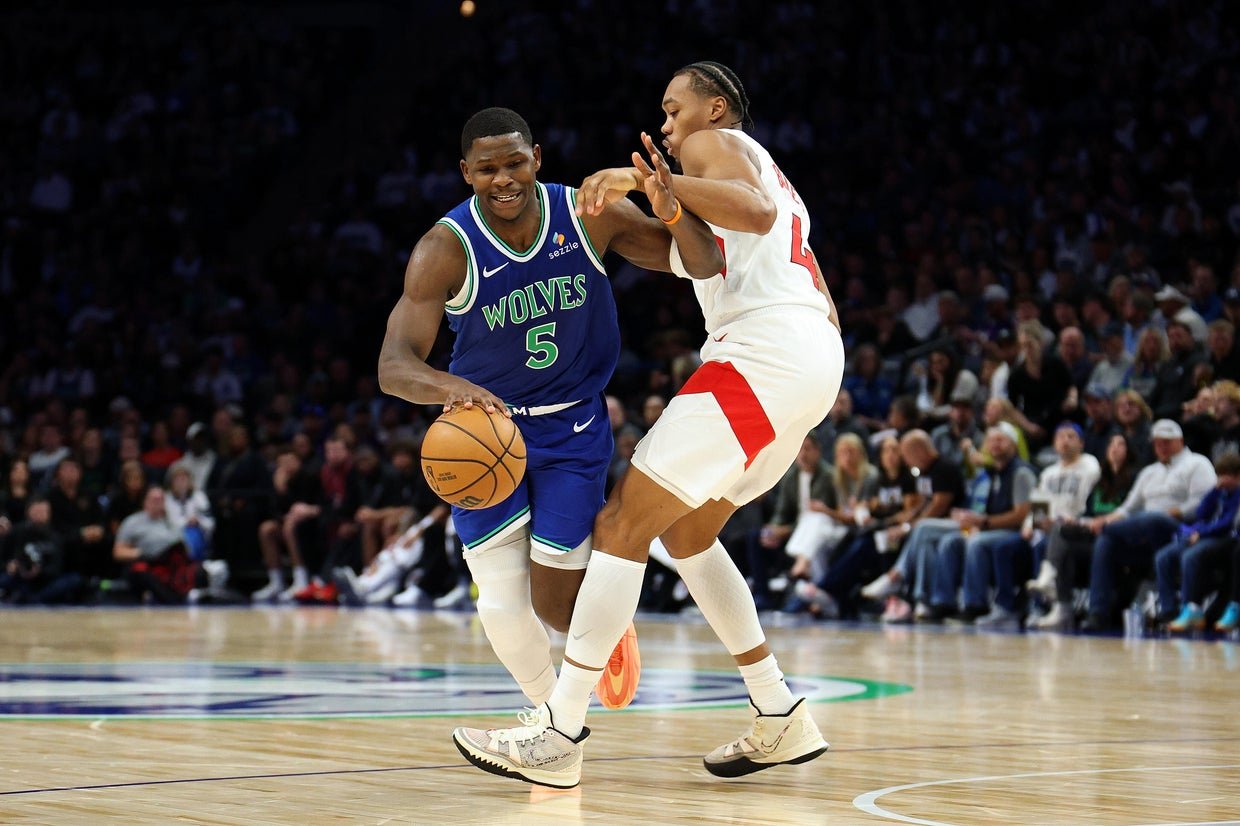
The question is how much of the 3–0 start comes from defensive work Minnesota can sustain, and how much depends on opponents missing shots. The opening week offers evidence of both: control of scoring opportunities in two road wins, then a home victory in which Toronto struggled to convert its chances.
The Wolves beat Miami 131–106, Orlando 115–93 and Toronto 117–94 between October 21 and 25. That is a combined 70-point margin, with 293 points allowed, or 97.7 per game. Those are descriptive totals from three games, with no adjustment for opponent strength.
Defense Provides the Bigger Advantage
A fairer comparison than points per game is scoring per 100 possessions, which accounts for differences in pace. In NBA.com’s opening-week figures, Minnesota scored 119.0 points and allowed 96.1 per 100 possessions. The league average was 111.5. The Wolves ranked fifth on offense and first on defense.
| Measure | Timberwolves | League Average | Minnesota’s Advantage |
|---|---|---|---|
| Points Scored per 100 Possessions | 119.0 | 111.5 | 7.5 more |
| Points Allowed per 100 Possessions | 96.1 | 111.5 | 15.4 fewer |
Using those displayed rates, the defensive gap is a little more than twice the offensive gap. Roughly two-thirds of Minnesota’s combined advantage over that benchmark sits on the defensive side. This calculation describes the size of the two gaps; it does not assign causal shares of the wins or predict a season-ending rating.
That distinction explains why the start deserves attention beyond Anthony Edwards’ scoring. An efficient offense helped Minnesota build leads. Allowing opponents so little per possession gave the team a larger cushion than an equally above-average offensive performance would have provided against the same league benchmark.
The Wins Have Come in Different Ways
NBA.com’s John Schuhmann reported shot-opportunity differentials of plus-18 in Miami and plus-19 in Orlando. Minnesota generated substantially more chances to score in those games. The Wolves also finished the week among the league’s top five in both offensive and defensive rebounding percentage, which measure the share of available rebounds secured at each end.
Defensive rebounding is the connection between a missed shot and a completed stop. Forcing a miss loses much of its value when the opponent retrieves it and tries again. Offensive rebounding works in the other direction: it gives Minnesota another chance without requiring another trip down the court. Success at both ends can protect a team on an ordinary shooting night.
Toronto presented a different test. Minnesota’s shot-opportunity differential was minus-12, but the Raptors made only 10 of 48 attempts from outside the paint, Schuhmann reported. That is 20.8%, covering both midrange shots and 3-pointers. It is not Toronto’s 3-point percentage.
The distinction matters to the interpretation. The same possession advantage that helped in Florida did not carry over, yet Minnesota still won by 23. Missed jump shots were a major part of that result. The available figures cannot separate the effects of defensive pressure, the shooters involved and ordinary shooting variation.
A simple sensitivity check shows the size of that uncertainty. Four more makes on those 48 attempts would add eight to 12 points, depending on whether they were twos or threes. That would materially reduce the final margin. It is not a reconstructed result: makes would also change rebounds, subsequent possessions and decisions.
LaMelo Ball’s Minutes Need Context
Minnesota allowed 81.2 points per 100 possessions with LaMelo Ball on the floor, according to Schuhmann’s report. That is a team figure during his minutes, not a measure of his individual defense. He averaged 22.8 minutes, and 68% of his playing time came alongside both Jaden McDaniels and Rudy Gobert.
The three therefore share much of the same evidence. Crediting Ball alone would also credit him for work by the defenders surrounding him. Opponent lineups and the timing of those minutes can affect the result, too. An on-court rating identifies a successful combination to examine; it does not isolate why that combination succeeded.
What the Opening Week Leaves Unsettled
Availability complicates the comparison. Toronto played without Kawhi Leonard, while Orlando’s game included the injury that led to Paolo Banchero’s subsequent absence. Minnesota’s early numbers describe those actual opponents, not every version of those teams.
The evidence supports a defense that has produced a large early advantage, with rebounding helping Minnesota complete possessions. The next useful test is whether those advantages persist when opponents convert more jumpers and Minnesota cannot rely on a large cushion of extra opportunities. Three decisive wins establish the starting point; they leave the durability of the defense open.