TSP Original Analysis
Philadelphia’s offensive line is not old across the board. But after three years as the NFL standard, the numbers show a real decline, particularly inside. Week 1 suggested those problems have not disappeared.
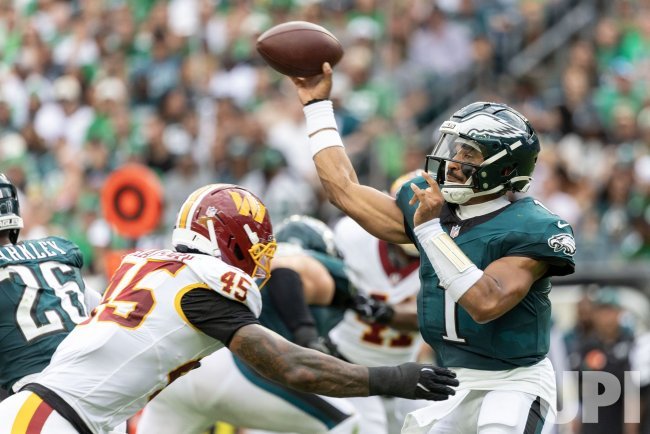
Jalen Hurts finished Sunday with the kind of box score that can conceal what happened around him. He completed 14 of 25 passes for 203 yards, threw three touchdowns without an interception and left Lincoln Financial Field with a 24-22 win over Washington.
The afternoon was far less comfortable than those numbers suggest.
Hurts was sacked three times. Philadelphia opened the second half with three consecutive three-and-outs. Cam Jurgens was called for two holding penalties. Landon Dickerson struggled repeatedly against Washington’s interior rush. Before the Eagles’ final kneel-downs, Hurts scrambled five times for 48 yards, including the 22-yard run on third-and-18 that rescued the drive that produced the winning touchdown.
There were no designed Hurts runs. His legs were largely being used to save pass plays.
“I thought Jalen did a great job of making plays, especially when something wasn’t going right.”
Cam Jurgens
Not every pressure belonged to the offensive line. Washington used blitzes, stunts and simulated pressures to create confusion. Saquon Barkley had trouble on at least one blitz pickup, and Hurts did not operate every pressured play perfectly himself.
But the larger impression was difficult to ignore because it looked familiar.
For years, Philadelphia’s offensive line created the margin for error for everyone else. Increasingly, Hurts and Barkley are being asked to create some of that margin for the offensive line.
Are the Eagles still the best offensive line in football?
Right now, the evidence says no.
That does not make them bad. It does not remove them from the NFL’s elite tier. It means the recent production has slipped, and a group that once deserved the title almost automatically now has to earn it again.
Sources: Pro Football Focus, PFF 2025 rankings, ESPN Analytics, Next Gen Stats reporting via the Philadelphia Inquirer, and Philadelphia Eagles team data.
The standard was almost impossible to maintain
Philadelphia created this problem by becoming so dominant.
Pro Football Focus ranked the Eagles’ offensive line No. 1 at the end of 2022, again in 2023 and once more in 2024.
The 2022 group was particularly extraordinary. Lane Johnson went 551 regular-season pass-blocking snaps without allowing a sack or quarterback hit and surrendered only nine hurries. By Super Bowl LVII, every starting Eagles lineman ranked inside the top 10 at his position by PFF grade.
The personnel changed and the standard survived.
Jason Kelce retired and Cam Jurgens eventually replaced him at center. Mekhi Becton reinvented himself at guard. Philadelphia still finished 2024 as PFF’s top offensive line and won a championship behind one of football’s most punishing rushing attacks.
Yet even that championship line was different from the 2022 version.
Philadelphia finished 2024 tied for only 24th in PFF pass-blocking efficiency after allowing 154 pressures, including 23 sacks, on 539 pass plays. Its greatness came increasingly from the running game and from how dominant the unit became once healthy late in the season.
Jordan Mailata finished as PFF’s highest-graded offensive lineman. Philadelphia rushed for 3,048 yards at 4.9 yards per carry and scored 29 rushing touchdowns.
The Eagles were still No. 1. The foundation of that ranking had already begun to change.
Then 2025 stopped looking like a blip
Philadelphia entered last season carrying the reputation of the league’s premier offensive line.
It finished seventh in PFF’s final rankings, with Denver taking over the top spot.
ESPN’s tracking-based metrics were harsher. The Eagles finished 17th in pass-block win rate at 64 percent and 16th in run-block win rate at 71 percent.
Those are almost perfectly average results from a unit still widely treated as elite.
The decline showed up most dramatically in the running game. Philadelphia fell from 3,048 rushing yards in 2024 to 1,988 last season. Its average dropped from 4.9 yards per carry to 4.2, while rushing touchdowns fell from 29 to 17.
Scheme and usage mattered. Hurts was used less as a designed runner, changing the numbers defenses had to account for, while Barkley was coming off a massive championship workload.
The best evidence that the blocking environment deteriorated comes from what happened before Barkley had a chance to create anything himself.
According to Next Gen Stats, as reported by the Philadelphia Inquirer, Barkley was hit behind the line of scrimmage on 37.7 percent of his carries during his 2,005-yard season. That rose to 47.1 percent in 2025.
His yards before contact per carry fell from 2.4 to 1.1.
When Barkley was not contacted before reaching the line, he still averaged 7.1 yards per carry and produced explosive runs at an 18.2 percent rate, both above league averages.
That does not mean Barkley was identical to his 2024 self. It does mean defenders were reaching him much earlier.
Sunday supplied another small sample of the same problem. Barkley finished with 83 yards on 15 carries, but 42 came on one run. His other 14 attempts produced 41 yards, an average of 2.9.
One game cannot establish a new trend. It can suggest that an old one has not disappeared.
The trouble is concentrated inside
This is where the aging argument needs to be corrected.
The Eagles’ starting five is not old.
Jordan Mailata is 29. Landon Dickerson and Cam Jurgens are 27. Tyler Steen is 26. Lane Johnson is 36. Their average age entering Week 1 was exactly 29.
Philadelphia’s concern is less about birthdays than accumulated physical mileage and a growing number of places where the line can be attacked.
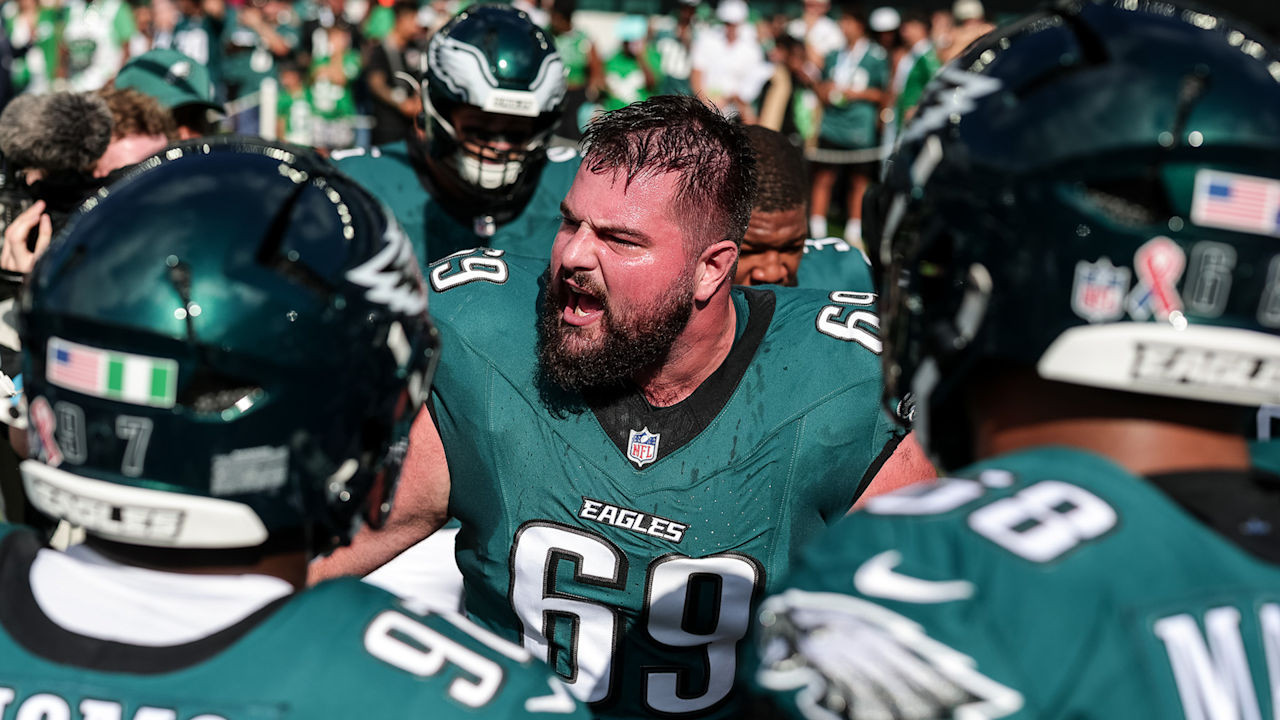
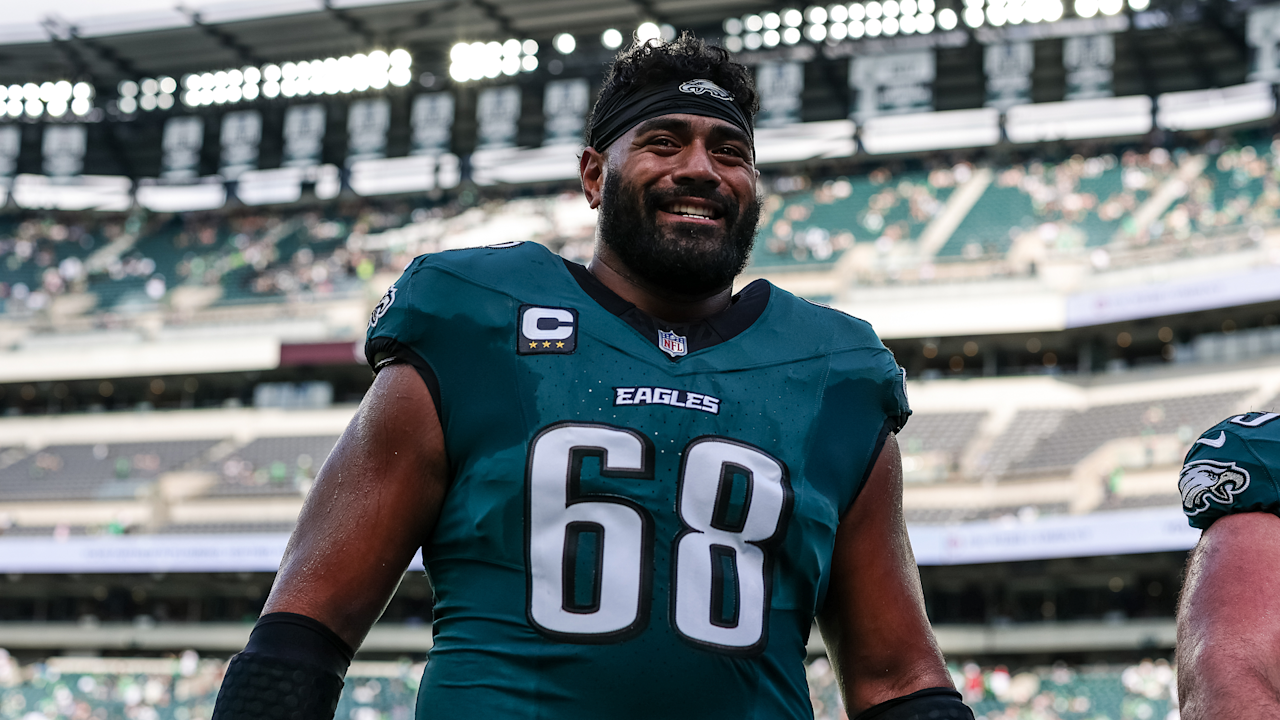
Dickerson is the clearest example of why “old” does not adequately describe what is happening.
He is young enough to be in his prime, but his body has endured an extensive injury history. During an injury-plagued 2025 season, he allowed 33 pressures on 506 pass-blocking snaps, including five sacks and seven quarterback hits.
Against Washington, he struggled again.
There is now important context for that performance.
Reuters reported that Philadelphia will place Dickerson on injured reserve because of the knee injury he was playing through. He will miss at least four games once the move is completed.
“I was a complete liability.”
Landon Dickerson
That admission changes how Sunday should be evaluated.
A terrible game from Dickerson is not clean evidence that a 27-year-old guard has simply declined. He was hurt.
The larger issue is that another important member of Philadelphia’s once-overwhelming line is dealing with another significant physical problem.
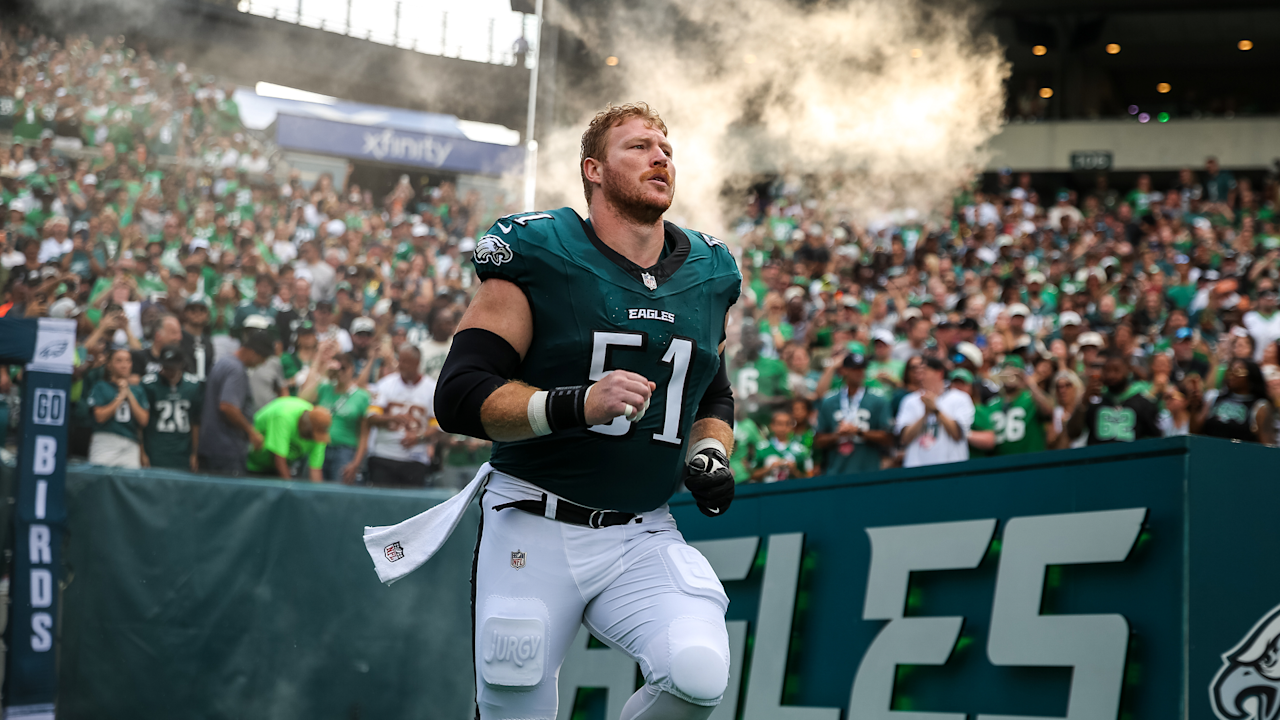
Jurgens presents a similar concern without the age.
He underwent back surgery following the Super Bowl run and spent much of the following offseason rehabilitating. Sports Info Solutions charted him with a 5.9 percent blown run-block rate in 2025, the highest among starting centers. He opened 2026 with two holding penalties and more trouble sorting through pressure inside.
Steen is the youngest starter and therefore the strongest argument against reducing this story to age.
Replacing Becton also changed the physical character of right guard. Steen allowed 37 pressures last season, tied for third-most among guards with at least 500 pass-blocking snaps.
At Philadelphia’s peak, opponents had trouble locating a weak point.
Today, Mailata and Johnson remain formidable tackles, but more of the uncertainty lives between them.
Lane Johnson is a different kind of warning
Johnson is the one starter whose age genuinely matters.
He is 36 and has said 2026 will “potentially, probably” be his final NFL season.
His 2025 season was interrupted by a Lisfranc injury. He missed the final seven regular-season games and was unable to return for Philadelphia’s playoff loss.
Remarkably, Johnson showed little evidence of becoming ordinary when he actually played.
PFF credited him with a 95.6 percent pass-block win rate in 2025, best among qualifying tackles. His island win rate, measuring pass-protection snaps without help, was 95.1 percent, also best among qualifiers. He allowed only seven pressures across 262 pass-blocking snaps.
Johnson is not a problem because he is 36 and suddenly cannot block.
Philadelphia’s vulnerability is that it remains heavily dependent on a 36-year-old tackle who is still exceptional and increasingly close to the day when he will no longer be there.
The Eagles are not watching one of the great right tackles decline in front of them.
They are approaching the end of the enormous advantage his presence has given them.
The Stoutland change complicates the diagnosis
For the first time since 2012, Philadelphia’s offensive linemen are being coached by someone other than Jeff Stoutland.
Stoutland spent 13 seasons building one of the franchise’s defining competitive advantages. Chris Kuper now has the job, while Sean Mannion’s offense has moved Philadelphia toward more wide and outside zone concepts and different blocking responsibilities.
That matters when assessing Washington’s success.
The Commanders did not simply line up four rushers and beat Philadelphia across five one-on-one matchups. Their blitzes, stunts and simulated pressures forced the Eagles to communicate and pass defenders from blocker to blocker. The group did not consistently handle those problems cleanly.
Those issues can improve with repetition.
That is the strongest counterargument to declaring that Philadelphia’s great line is simply fading.
There is reason to believe this group can improve as the new offense settles. One game in a new system is a poor sample from which to make sweeping conclusions.
But the coaching transition cannot explain everything.
The deterioration began in 2025.
No. 1 belongs to Denver now
PFF entered 2026 with Denver first and Philadelphia second.
That is the right order.
Denver finished No. 1 last season and allowed an NFL-low six sacks. The Broncos returned the same starting five. Philadelphia finished seventh, entered a different offensive system and began this season asking important players to prove they were physically closer to their old form.
Even Philadelphia’s No. 2 ranking needs context.
PFF says its 2026 offensive-line ratings use as many as three previous seasons of player performance, with extra weight placed on pass protection. During the first four weeks, the rankings are being changed only for lineup alterations because the current-season sample is too small.
Philadelphia is therefore being credited, appropriately, for what these players have already demonstrated.
That is different from demonstrating it now.
Mailata and Johnson can still give the Eagles an elite tackle combination. Jurgens has already shown himself capable of better football than he played last season. Dickerson has been a three-time Pro Bowler before his 28th birthday. There is enough talent for Philadelphia to finish the year as one of football’s best lines again.
But the Eagles should no longer receive the No. 1 designation simply because of what the group used to be.
Sunday was not a verdict.
It was another piece of evidence in a case that began forming last season.
The rushing lanes became less dependable. The interior became easier to challenge. Johnson moved another year closer to retirement. The coaching structure that helped produce more than a decade of elite offensive-line play changed.
Then Washington arrived in Week 1 and repeatedly forced Hurts to solve problems after the snap.
For years, Philadelphia’s offensive line made life easier for everyone around it. The Eagles could survive a difficult defensive look or an imperfect play call because the five men up front could erase the problem.
The line may still be very good. It may become elite again as the season develops.
Right now, though, Hurts and Barkley are doing more of the erasing.
That is why this offensive line does not feel like the one that ruled the NFL, even if several of the names remain the same.