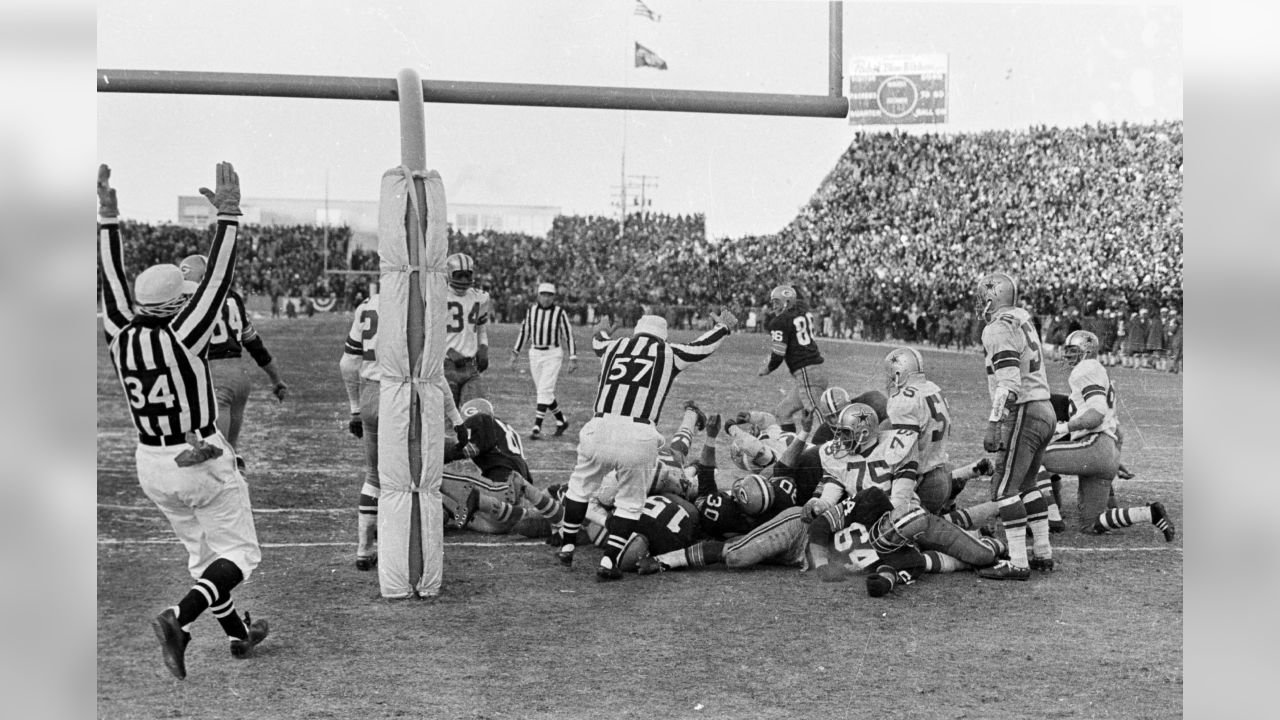
Bart Starr’s one-yard quarterback sneak with 13 seconds remaining won the Green Bay Packers the 1967 NFL Championship, 21-17 over the Dallas Cowboys. The touchdown finished a 68-yard drive at Lambeau Field on December 31, with the game played in a temperature of 13 degrees below zero.
The Ice Bowl is remembered through that final pile of bodies at the goal line. Reaching it required a series of completed passes, contributions from two running backs and a decision to try for the lead after Green Bay had used its last timeout. The winning play also belonged to an era in which the NFL Championship and the Super Bowl were separate games.
A championship before the Super Bowl
Green Bay and Dallas had met for the NFL title a year earlier, when the Packers won 34-27. The 1967 rematch determined which club would face the American Football League champion Oakland Raiders in the second Super Bowl. The two leagues had announced their merger, but their complete combination was still ahead in 1970.
That distinction matters to the championship language. Packers historian Cliff Christl’s research places the Ice Bowl within the NFL’s old title-game structure. Green Bay was seeking a third straight championship after its 1965 and 1966 titles. It subsequently beat Oakland in Super Bowl II, completing the run recognized in the league’s championship record.
The Packers had finished the regular season 9-4-1, then beat the Los Angeles Rams 28-7 to reach the title game. Starr had dealt with injuries during the season, and the team no longer had the backfield pairing of Paul Hornung and Jim Taylor. The record gives the aging champions a more specific setting than a general story about a team that always found a way to win.
Dallas took the lead before the final drive
Starr threw two touchdown passes to Boyd Dowler to put Green Bay ahead 14-0. Dallas recovered two Packers fumbles, turning one into George Andrie’s touchdown and the other into a Danny Villanueva field goal. The Cowboys trailed 14-10 at halftime.
Early in the fourth quarter, halfback Dan Reeves threw a 50-yard touchdown pass to Lance Rentzel. The option pass gave Dallas a 17-14 lead. Green Bay’s winning possession would have to cover the distance from its own 32-yard line to the Cowboys’ end zone.
The Associated Press report published immediately after the game credits Donny Anderson and Chuck Mercein with important catches and gains on that drive. Dowler also caught a 13-yard pass. Mercein’s 19-yard reception took the Packers to the Dallas 11, and his following run brought them close to the goal line.
Those contributions prevent the winning possession from being reduced to a single sneak. Starr was able to advance the ball through the air before the final short-yardage problem. The Cowboys’ pass rush had repeatedly stopped him earlier: the contemporary AP report records eight sacks for 76 yards in losses.
The decision at the one-yard line
Two Anderson runs failed to produce the touchdown. Starr called the Packers’ final timeout with 16 seconds left. A tying field goal remained an alternative, but another unsuccessful running play would leave Green Bay needing to stop the clock or get its kicking unit onto the field in the remaining seconds.
In the AP account, Vince Lombardi said he had the field-goal team warming up but did not know whether there would have been time to send it in after another play. Green Bay was accepting the clock consequences of another running play that failed to reach the end zone.
Starr kept the ball and followed the opening created against Dallas tackle Jethro Pugh. The Pro Football Hall of Fame’s account and scoring record identify the combined work of center Ken Bowman and right guard Jerry Kramer. The Packers’ documented account of Starr’s career also names both blockers. Crediting Kramer alone leaves out part of the recorded line play.
The touchdown came with 13 seconds remaining, and Don Chandler’s extra point made the score 21-17. The scoring record lists a one-yard quarterback sneak. The surviving accounts agree on that outcome while differing on some earlier clock and yardage details, which are not needed to establish the final decision.
Green Bay had won the NFL title, with the Super Bowl still to be played. The Packers’ subsequent victory over Oakland completed their season. The Ice Bowl’s defining sequence remains the same in that wider chronology: a 68-yard possession ended with Starr keeping the ball and Bowman and Kramer opening the way into the end zone.