The NHL doubled from six teams to twelve for the 1967-68 season. Its six newcomers played together in the West Division, while the established clubs formed the East. That arrangement guaranteed that one expansion team would reach the Stanley Cup Final.
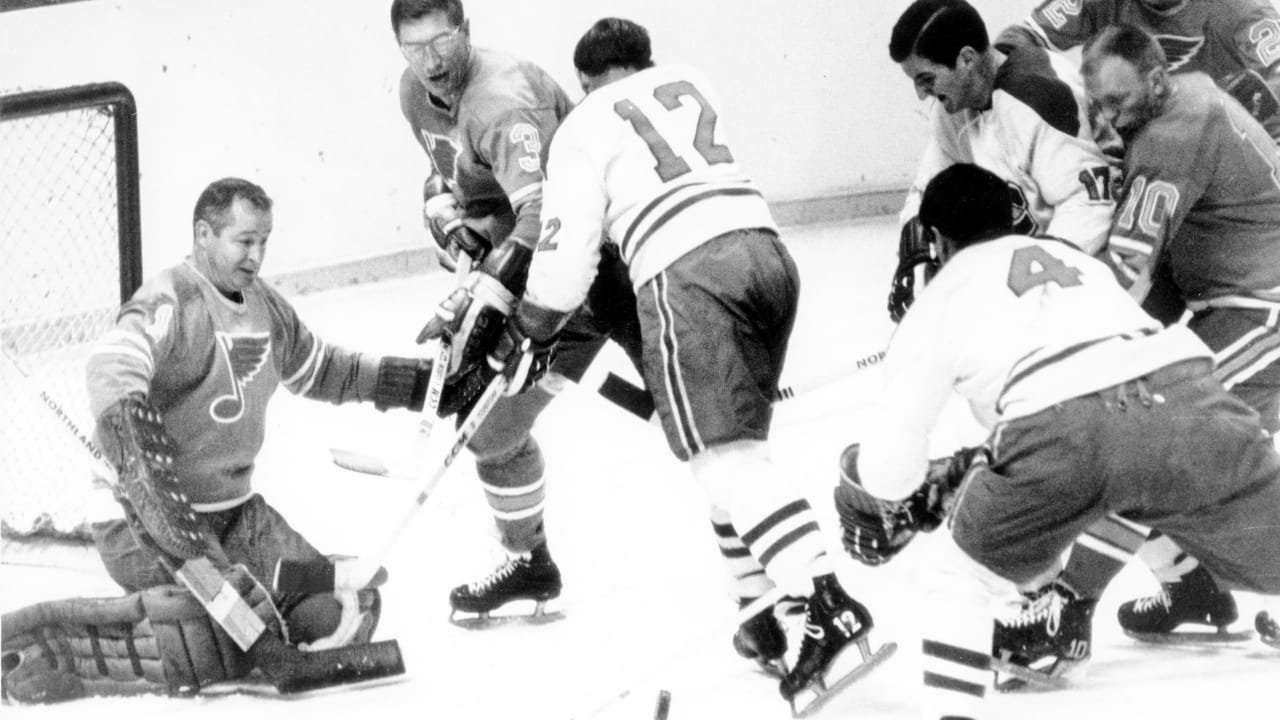
St. Louis became that finalist, winning two seven-game playoff series before losing four straight to Montreal. The Blues’ achievement is easier to understand when their path is placed inside the rules of the expansion season. They had beaten the other new clubs to reach the championship round; they had not eliminated an established NHL team along the way.
An award, full membership and a first season
The league’s expansion had several dates rather than one. On February 9, 1966, the Board of Governors awarded conditional franchises for Los Angeles, San Francisco, Minneapolis-St. Paul, Philadelphia and Pittsburgh. St. Louis received a conditional place dependent on a qualified ownership application.
Adam Kimelman’s NHL history based on the board meetings describes the financial and arena requirements behind those decisions. The proposed owners needed a $2 million franchise payment and an arena seating at least 12,500. The board considered television markets, financial backing and suitable buildings while choosing among competing groups.
The clubs became full members on June 5, 1967 after making their required payments. By their first season, their names were the California Seals, Los Angeles Kings, Minnesota North Stars, Philadelphia Flyers, Pittsburgh Penguins and St. Louis Blues. The Seals later used the Oakland name.
The distinction between a conditional award in 1966 and full membership in 1967 keeps the institutional chronology separate from the first games. It also explains why the new clubs could spend more than a year preparing before taking the ice.
The draft and a different schedule
The expansion draft followed on June 6, 1967. NHL.com’s account of the admission and draft process records the established clubs initially being allowed to protect 11 skaters and one goaltender. Each newcomer could select two goaltenders and 18 skaters.
Los Angeles used the first selection on Terry Sawchuk, who had recently helped Toronto win the Stanley Cup. St. Louis selected Glenn Hall from Chicago. Philadelphia selected Bernie Parent from Boston. The goalies’ different career stages mattered: Sawchuk and Hall were established veterans, while Parent was at an earlier stage of his NHL career.
The schedule grew from 70 games to 74. Each team played the other five clubs in its division ten times and the six clubs across the league four times. That gave the expansion teams more games against one another than against the established division.
The split also marked a large change in the league’s geography. Clubs in California brought NHL teams to the West Coast, while Minnesota, Pennsylvania and Missouri added other new markets. The six-club competition familiar from the long broadcasting history of CBC’s Hockey Night in Canada had become a league with a broader American footprint.
Why the Blues reached the Final
The top four teams in each division qualified for the playoffs and remained within their division for the first two rounds. The Western finalist therefore had to be an expansion club, whatever happened in the East.
Philadelphia finished first in the West with 73 points, followed by Los Angeles with 72, St. Louis with 70 and Minnesota with 69. Pittsburgh’s 67 and Oakland’s 47 left those two clubs outside the playoffs. The small gaps among the qualifiers show that the Blues did not begin their playoff run as the division’s runaway leader.
St. Louis beat Philadelphia in seven games, then needed seven more to eliminate Minnesota. The Blues faced Montreal in the Final and were swept. Hall nevertheless won the Conn Smythe Trophy as playoff most valuable player. Nicholas J. Cotsonika’s NHL account of the inaugural Blues connects the goaltending, the division format and Scotty Bowman’s coaching within that first-season result.
The Blues returned to the Final in each of their next two seasons under the same East-West structure, again losing without a win in the championship round. Philadelphia became the first of the six expansion clubs to win the Cup in 1974 and repeated in 1975.
The 1967 change therefore enlarged both the membership and the playoff opportunity. Six organizations gained places in the league, and their separate division supplied a route to the Final immediately. St. Louis had to win that route on the ice, even though the format ensured that one newcomer would take it.