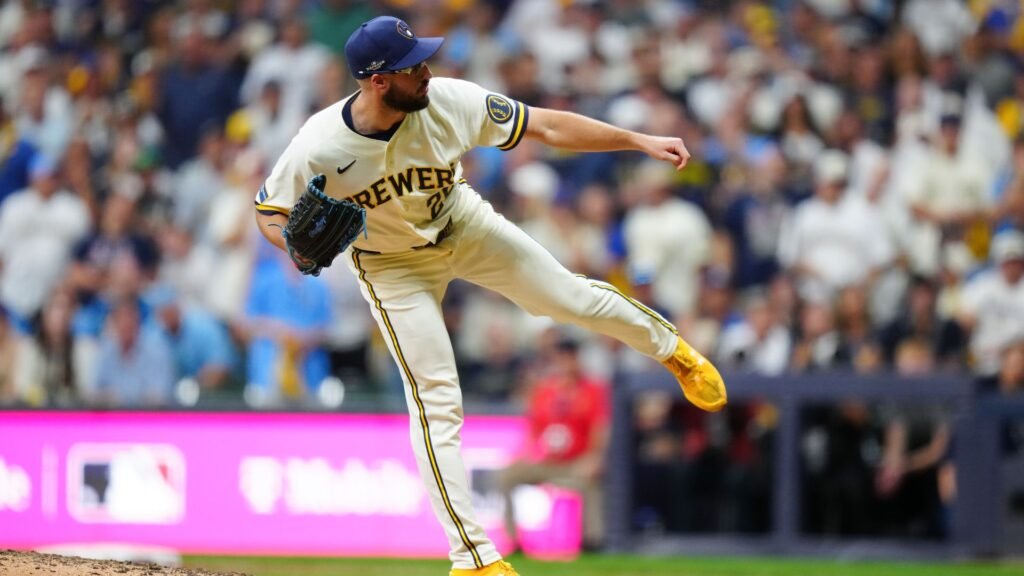
Will Smith took JoJo Romero’s 85.7-mph sweeper for strike three after fouling off a changeup with two strikes. Romero had already struck out Shohei Ohtani swinging, giving Milwaukee consecutive strikeouts to begin a sixth inning that required only 13 pitches.
Romero retired Max Muncy on a groundout to finish a scoreless inning with no hits or walks. The game was tied 4–4 during his work; William Contreras’ RBI single in the bottom half gave the Brewers a lead they retained in a 7–4 NLCS Game 2 win on October 12.
The two strikeouts came from different responses. Ohtani swung through a pitch, while Smith took the final sweeper. Treating both outs as evidence of the same swing-and-miss mechanism would miss an important part of Romero’s inning.
Season repertoire and Game 2
Scale: 0–100%. Gray: regular season. Blue: Game 2.
Sinker
Change: -3.6 percentage points.
Sweeper
Change: +8.8 percentage points.
Changeup
Change: -4.7 percentage points.
Four-seam fastball
Change: -0.5 percentage points.
Equal sinker and sweeper counts
Romero divided 12 pitches evenly between sinkers and sweepers, adding one changeup. His primary baseline is 201 pitches in 11 Brewers relief appearances, September 1 through September 26. Sinkers occupied 49.8% of that sample and sweepers 37.3%, compared with 46.2% each in Game 2.
The same-club comparison is short. His full regular season includes 922 pitches in 55 appearances for St. Louis and Milwaukee. The Brewers-only sample keeps the club and role aligned, while the full-season record establishes that the smaller comparison does not encompass all of his 2026 work. Neither sample supplies evidence of a specific coaching intervention.
His sinker averaged 95.2 mph, compared with 93.0 mph in that Brewers sample; the sweeper averaged 85.1 against 82.5. He generated three misses in eight swings, including two on sweepers and one on a sinker. The 37.5% outing whiff rate exceeds his Brewers baseline of 17.5%, but it rests on eight attempts.
Will Smith: inning 6
Recovered counts and one contact out
Smith’s sequence began with a low sinker for ball one. A second sinker drew a miss, a low sweeper brought the count to 2–1, and the changeup foul produced a second strike. The final sweeper finished inside the recorded zone rectangle. The at-bat shows recovery from two early balls rather than uninterrupted control of the count.
Romero’s only ball in play was Muncy’s 85.3-mph grounder. Five of nine pitches outside the geometric zone drew swings, but that denominator is also small. The data supports a varied set of finishes within one efficient inning, not a reliable estimate of how often future hitters will chase.
His previous postseason appearance, October 6, contained two misses in 16 swings across 30 pitches and five outs. Game 2 brought more swing-and-miss in less work, while preserving the distinction between Ohtani’s swinging strikeout and Smith’s called finish. Another appearance would test whether those harder pitches continue to produce useful takes and swings across a larger hitter sample.
Inning samples in context
| Inning | Pitches | Cumulative | Sinker mph | Measured n | Outs |
|---|---|---|---|---|---|
| 6 | 13 | 13 | 95.2 | 6 | 3 |
Every pitch: 13 of 13
Search a hitter, select an inning or pitch type, then inspect a pitch number. Pitch result and completed plate-appearance outcome are separate columns. The table scrolls within its border.
13 of 13 pitches
No pitches match these filters.
| Pitch | Inning | Hitter | Count before | Type | mph | Pitch result | Completed PA |
|---|---|---|---|---|---|---|---|
| 6 | Shohei Ohtani | 0–0 | SI | 93.6 | Ball | Strikeout | |
| 6 | Shohei Ohtani | 1–0 | SI | 94.1 | Foul | Strikeout | |
| 6 | Shohei Ohtani | 1–1 | ST | 84.1 | Swinging Strike | Strikeout | |
| 6 | Shohei Ohtani | 1–2 | SI | 95.0 | Foul | Strikeout | |
| 6 | Shohei Ohtani | 1–2 | ST | 84.2 | Foul | Strikeout | |
| 6 | Shohei Ohtani | 1–2 | ST | 84.8 | Swinging Strike | Strikeout | |
| 6 | Will Smith | 0–0 | SI | 95.5 | Ball | Strikeout | |
| 6 | Will Smith | 1–0 | SI | 96.2 | Swinging Strike | Strikeout | |
| 6 | Will Smith | 1–1 | ST | 85.8 | Ball | Strikeout | |
| 6 | Will Smith | 2–1 | CH | 89.5 | Foul | Strikeout | |
| 6 | Will Smith | 2–2 | ST | 85.7 | Called Strike | Strikeout | |
| 6 | Max Muncy | 0–0 | ST | 85.9 | Ball | Groundout | |
| 6 | Max Muncy | 1–0 | SI | 96.8 | In play, out(s) | Groundout |
Sources, definitions and limitations
The official final MLB record supplies events, final calls and the line. Baseball Savant’s complete Game 2 feed supplies all 13 physical pitches. Pitch ID, order, classification and pre-pitch count reconcile, including final ABS decisions. These records contain 3 batters, 3 integer outs and 2 strikeouts. In baseball notation, .1 means one out and .2 two outs. Source records current as of October 13, 2026.
The Statcast Search baseline is 201 physical pitches in 11 regular-season relief appearances for Milwaukee Brewers, 2026-09-01 through 2026-09-26. Each game total reconciles with the official appearance log. The target game and postseason work are excluded. Same club and role in the 2026 regular season.
Whiff rate means misses divided by physical swing attempts. Swinging strikes, blocked swinging strikes, caught foul tips and missed bunts count as conventional tracking whiffs. A caught foul tip involves bat contact; it is kept distinct from a literal swing that misses the ball. Fouls, bunt attempts and balls put into play enter the attempt denominator. Both outing and baseline use the same definitions. Called strikes and completed strikeout plate appearances are separate. Chase uses ball-center coordinates outside a 17-inch-wide rectangle and each pitch’s recorded vertical boundaries. Only complete coordinates enter the zone denominator. Savant’s separate zone flag remains in the CSV and detail rather than replacing that geometric definition.
Speed is mph, spin rpm, extension feet and movement inches. Induced vertical break describes movement relative to a gravity-only path. Location and zone boundaries are feet in catcher view. Numbered markers preserve exact coordinates and are not ball size. Release, location, spin, extension and movement measurements are complete for all outing pitches. Contact and expected-outcome measurements can be unavailable and remain missing in the detail and CSV. 1 of 1 balls put into play have measured exit speed. Hard-hit means at least 95 mph; the baseline has 38 measured contacts among 39. Expected outcomes are Savant model estimates, not actual results. The comparisons are descriptive and do not establish intention, fatigue, injury or a durable trend.