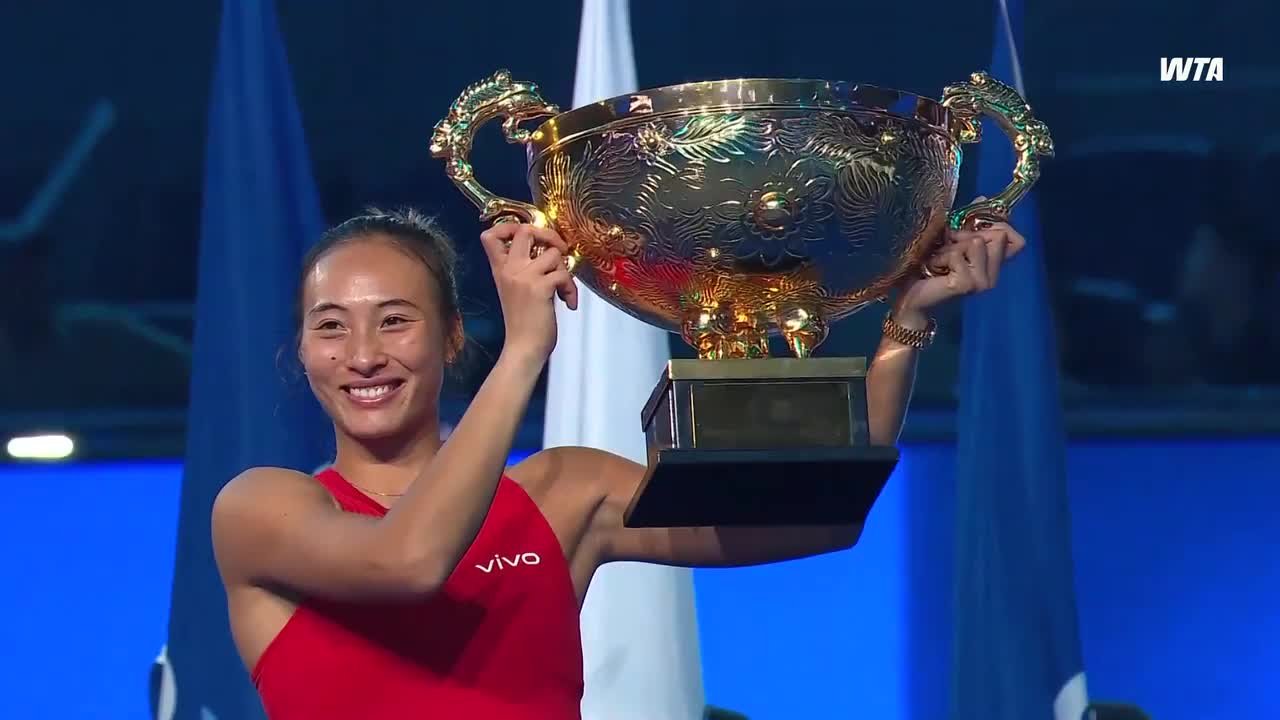
Zheng Qinwen’s first WTA 1000 title grew out of a season in which she had to recover her game while recovering her place in the tour’s hierarchy. The Olympic champion entered the China Open as a wildcard ranked No. 54. On October 11, she beat Mirra Andreeva 7–5, 6–4 to become the first Chinese woman to win the Beijing singles title. The route included four three-set matches before she won her final three rounds in straight sets.
The following day, Zheng withdrew from Wuhan, citing a right shoulder injury and fatigue. The withdrawal adds necessary context to the title run. Beijing demonstrated how far her tennis had progressed after an extended disruption. The withdrawal showed that winning a demanding tournament did not remove the physical limits on what she could do immediately afterward.
Her earlier achievements explain the expectations attached to that return. Zheng reached the Australian Open final in 2024, then won Olympic singles gold in Paris, beating Donna Vekic 6–2, 6–3 in the final. Her Olympic route had included consecutive matches lasting more than three hours against Emma Navarro and Angelique Kerber. Sustaining difficult matches was already part of her competitive record. The injury interrupted a player who had established that capacity at the sport’s highest levels, and her subsequent qualifying appearances made the contrast with her former position particularly visible.
A return that took longer than expected
The disruption began before the 2026 season. In July 2025, Zheng announced surgery for persistent pain in her right elbow. She subsequently missed the US Open. The WTA’s contemporary account records that she had tried treatments without fully resolving the discomfort. She was then world No. 6, so the interruption arrived when she already occupied an established position near the top of the game.
Her attempted return at the 2025 China Open ended in retirement during her second match. The problem then extended into the next season: she withdrew from the Australian Open before resuming competition in Doha in February. The missed tournaments changed the terms of her return. She needed to rebuild the physical capacity to compete while the ranking consequences of lost opportunities continued to accumulate.
Doha showed that the weapons in her game remained available. She hit 20 aces and 43 winners in a 4–6, 6–1, 6–2 win over Sofia Kenin. Asked about the serving performance in the WTA’s postmatch interview, Zheng warned against treating one round as a complete return: “it has to be consistent, it’s not only one round.”
She also said recovery had taken longer than she and her team expected. At the previous China Open, she recalled, the elbow had not regained full extension. Her account helps explain why the successful first match of 2026 could not settle the larger question. The serve could produce exceptional numbers on one day while the player still faced the work of sustaining competition over a season.
By September, Zheng had also revised her view of the earlier return. At her Beijing press conference, she said she had rushed because she wanted to play, and that her condition worsened after she competed. That was her retrospective assessment of the recovery decisions. It gives her later choice to prioritize a training block additional context, while leaving medical conclusions to the professionals responsible for her care.
The decision to leave the tournament circuit
Results during the first part of 2026 did not provide that consistency. By the time Zheng’s US Open revival began, the WTA recorded an 11–13 season in which she had not won more than two consecutive matches. A first-round Roland Garros defeat contributed to her fall outside the top 100. The ranking made her subsequent entry routes different from those of an established top seed.
After a 6–3, 6–4 loss in Toronto qualifying, Zheng and coach Pere Riba chose a training block instead of another immediate tournament. She skipped Cincinnati and went to IMG Academy in Bradenton, Florida. In her September account of that decision, she described the setting as “Just tennis, gym, and a resting place.”
That choice is a documented turning point in her season. It shifted time from competing for results to working on the game that would have to produce them. Zheng described needing to connect pieces she believed were already present. The later results support the value of the change, while they cannot isolate training from every other factor in her improvement. Her explanation remains the account of the player who made the decision.
Qualifying in New York then forced Zheng to earn her place through three additional matches. The setting carried a particular difficulty for an Olympic champion accustomed to the largest courts. It placed her recent ranking against the status she had established before the injury. She continued through qualifying and into the main draw, where the strength of the opposition soon provided a more demanding measure of her progress.
New York gave the recovery competitive substance
Zheng came back from 5–0 down in the deciding set against Madison Keys, saving a match point on the way to victory. Against Iga Swiatek in the next round, she recovered from the same deficit in the first set and won 7–5, 6–3. The WTA’s account of the Swiatek match documents seven consecutive games to take the opener, including three successive breaks of serve.
Those were substantial results against major champions, rather than evidence drawn solely from practice or a favorable early opponent. They also showed repeated recovery after a match had moved badly against her. Reaching the quarterfinals from qualifying meant Zheng could again sustain a run through a major event. Her eventual loss to Elena Rybakina set the limit of that run without erasing how she had reached it.
The performances changed the context for her return to China. At her September 29 Beijing press conference, Zheng described improved baseline consistency and clearer choices on court. She still wanted a higher first-serve percentage. Her assessment was specific: the serve’s power was useful, but getting it into play more consistently remained part of the work.
She also acknowledged the demands of playing at home. Fan support came with an expectation that she perform well, alongside the need to balance training with sponsor events. Zheng described the pressure and support as parts of the same experience. Her public comments establish those competing demands without requiring an invented account of what she privately felt during any particular point.
Zheng’s complete China Open Champions Reel
Credit: WTA · Event: 2026-10-11
Beijing required repeated repairs before the finish
Zheng’s first four matches in Beijing all went to three sets. Against Alina Charaeva in the fourth round, she won the first set 6–1, lost the second 2–6 and took the third 6–4. The official match report notes that the pattern of winning the opener, losing the second and recovering in the third had occurred in three of those four victories.
The Charaeva finish also resisted a simple story of control. Zheng led the deciding set 5–2, but the margin narrowed to 5–4 with the match back on serve. She needed another break to finish it. The sequence showed how much of the tournament depended on responding to reversals, including reversals that arrived after she had built a significant advantage.
Her last three rounds were more efficient. Zheng beat Elina Svitolina in the quarterfinals, then defeated Elise Mertens 7–5, 6–2 in the semifinals. Against Mertens, she won eight of the final 10 games and finished with 32 winners to 16 unforced errors, according to the WTA’s semifinal report. The numbers give substance to the improvement in the later rounds.
Andreeva presented another test in the final. Zheng saved three set points while serving at 4–5 in the opener, then won 11 consecutive points to take the set. That passage connected successful resistance with immediate pressure on the opponent. A set that could have been lost instead became a lead, and Zheng completed the second set 6–4 to secure the championship.
Zheng vs. Andreeva: the final and trophy
Credit: WTA · Event: 2026-10-11
The title was the sixth of her career and her first since Tokyo in 2024. It was also her first at WTA 1000 level. The WTA’s final report records the significance of a Chinese woman winning the Beijing event. Zheng’s result joined a personal return to title-winning form with an achievement that had not previously been reached at her home tournament.
The ranking change captures the scale of the season’s reversal. The WTA recorded a low of No. 160 in June and projected Zheng at No. 23 after Beijing. Those dated positions reflect the competitive consequences of her results; they do not measure her physical condition.
The recovery continues beyond the trophy
Zheng’s Wuhan withdrawal announcement cited a right shoulder injury and fatigue. It described a demanding stretch involving the US Open, Billie Jean King Cup and Beijing. That stated shoulder problem is distinct from the earlier elbow surgery. The title provides no basis for treating the two as the same injury or declaring her recovery medically complete.
Her season’s change is clearest in the decisions and results. She returned from a longer recovery than expected, stepped away from tournaments to rebuild her game, earned a major quarterfinal through qualifying and then won seven matches in Beijing. The final three victories required fewer sets, but the next withdrawal preserved the physical uncertainty. Zheng finished the China Open with a first WTA 1000 trophy and evidence of restored competitive strength, while still needing to manage the demands that followed it.