
MLB · Pitching Data
Whiff Rate vs. Strikeout Rate: How to Read a World Series Pitching Line
The formulas use different opportunities. Rasmussen’s actual 95-pitch ALCS start shows why a whiff percentage cannot be read as a strikeout percentage.
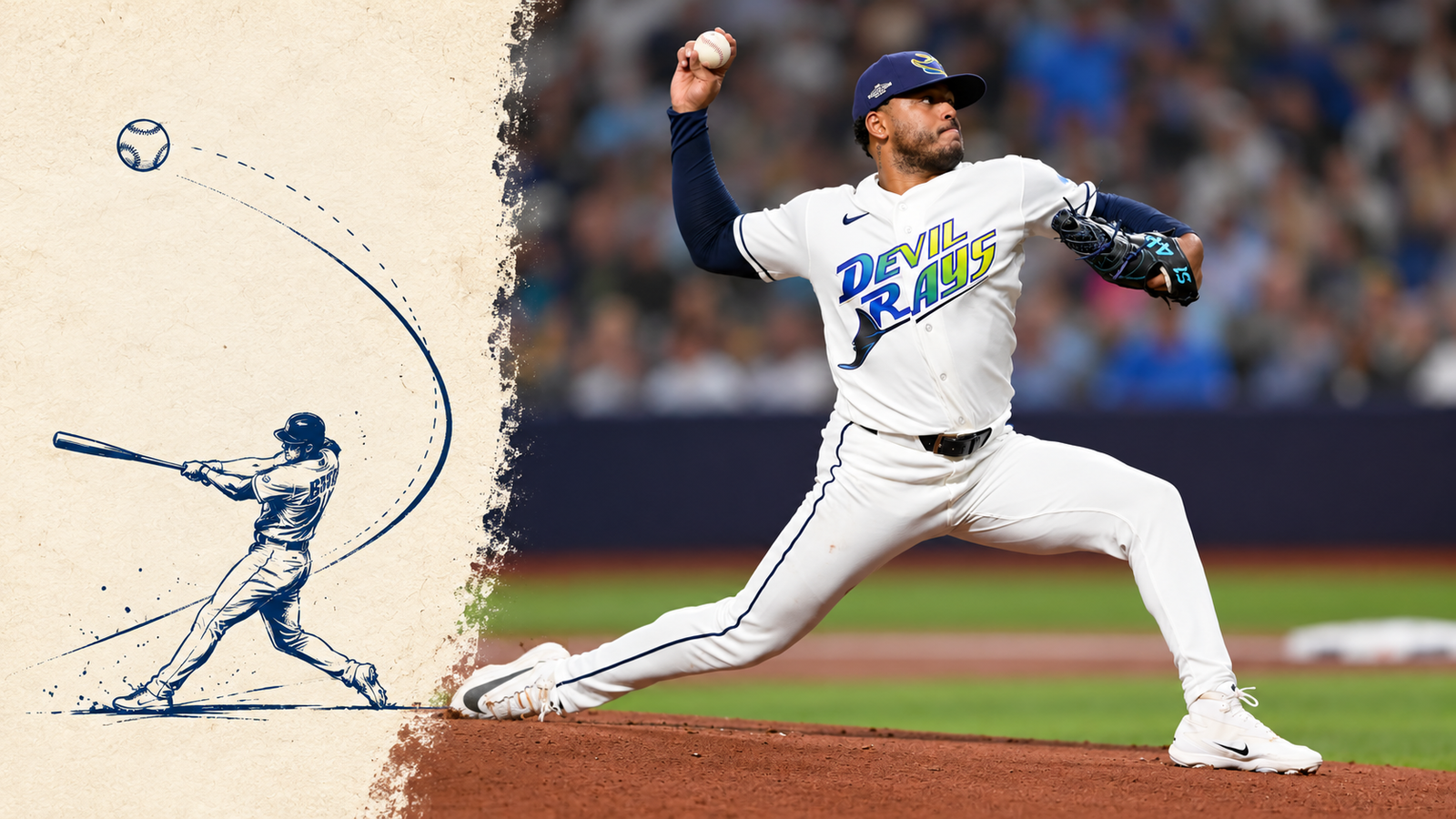
Whiff rate asks how often hitters’ swings against a pitcher produce misses. Strikeout rate asks how often the batters he faces finish with a strikeout. The denominators are different, so the percentages answer different questions even when they describe the same game.
Whiff Rate vs. Strikeout Rate
| Metric | Calculation | Question Answered |
|---|---|---|
| Whiff rate | Whiffs ÷ swings × 100 | How often did swings produce a recorded whiff? |
| Strikeout rate (K%) | Strikeouts ÷ batters faced × 100 | How often did a batter strike out? |
| Swinging-strike rate (SwStr%) | Swinging strikes ÷ total pitches × 100 | How often did a pitch produce a swinging strike? |
The FanGraphs plate-discipline reference distinguishes misses per swing from misses per pitch. A taken ball belongs in the total-pitch denominator but supplies no swing to the whiff-rate denominator. A foul or ball in play contributes a swing without usually supplying a miss. The outcome definitions used by the data provider still matter, particularly for foul tips.
A Real Example: Rasmussen’s ALCS Game 5
Drew Rasmussen threw 95 physical pitches against Cleveland on October 18, 2026. The Statcast gamefeed records 59 swings and 15 whiffs under its classification, while the official MLB record confirms six strikeouts against 25 batters. Those are three counts from one outing, with different opportunities beneath them.
| Calculation | Numerator | Denominator | Result |
|---|---|---|---|
| Whiff rate | 15 Statcast whiffs, including 2 foul tips | 59 swings | 25.4% |
| Strikeout rate | 6 strikeouts | 25 batters faced | 24.0% |
| Same Statcast whiff count per all pitches | 15 whiffs | 95 physical pitches | 15.8% |
The third row holds the whiff count fixed to isolate what changing the denominator does. It is not presented as another provider’s published SwStr%: two of Statcast’s 15 whiffs were foul tips. A calculation that handles those differently would change the numerator as well. For this game, the remaining swing sample consists of 26 fouls and 18 balls in play, totaling 59 with the 15 whiffs.
The two foul-tip pitches also show why a whiff is not automatically a strikeout. Jo Adell’s first-pitch sinker was recorded as a foul tip; his plate appearance continued. Nathaniel Lowe’s fourth-inning foul tip came with two strikes and ended his plate appearance. The count gives those similar pitch outcomes different consequences.
Why the Rates Can Move Apart
A pitcher can collect several misses against one hitter and receive credit for only one strikeout in that plate appearance. He can also finish a hitter with a called third strike, adding a strikeout without a swing on the final pitch. Whiff rate describes what happened to swings; it does not record every way a pitcher acquired or completed two-strike counts.
For an outing, read the underlying counts alongside the percentages. 15 misses in 59 swings tells you the size of the swing sample; six strikeouts in 25 batters tells you the size of the completed-hitter sample. To study a repertoire, separate pitch types before comparing them, and keep the same event definitions across the game and season.
TSP’s complete Rasmussen Game 5 analysis provides the 95-pitch record behind this example.