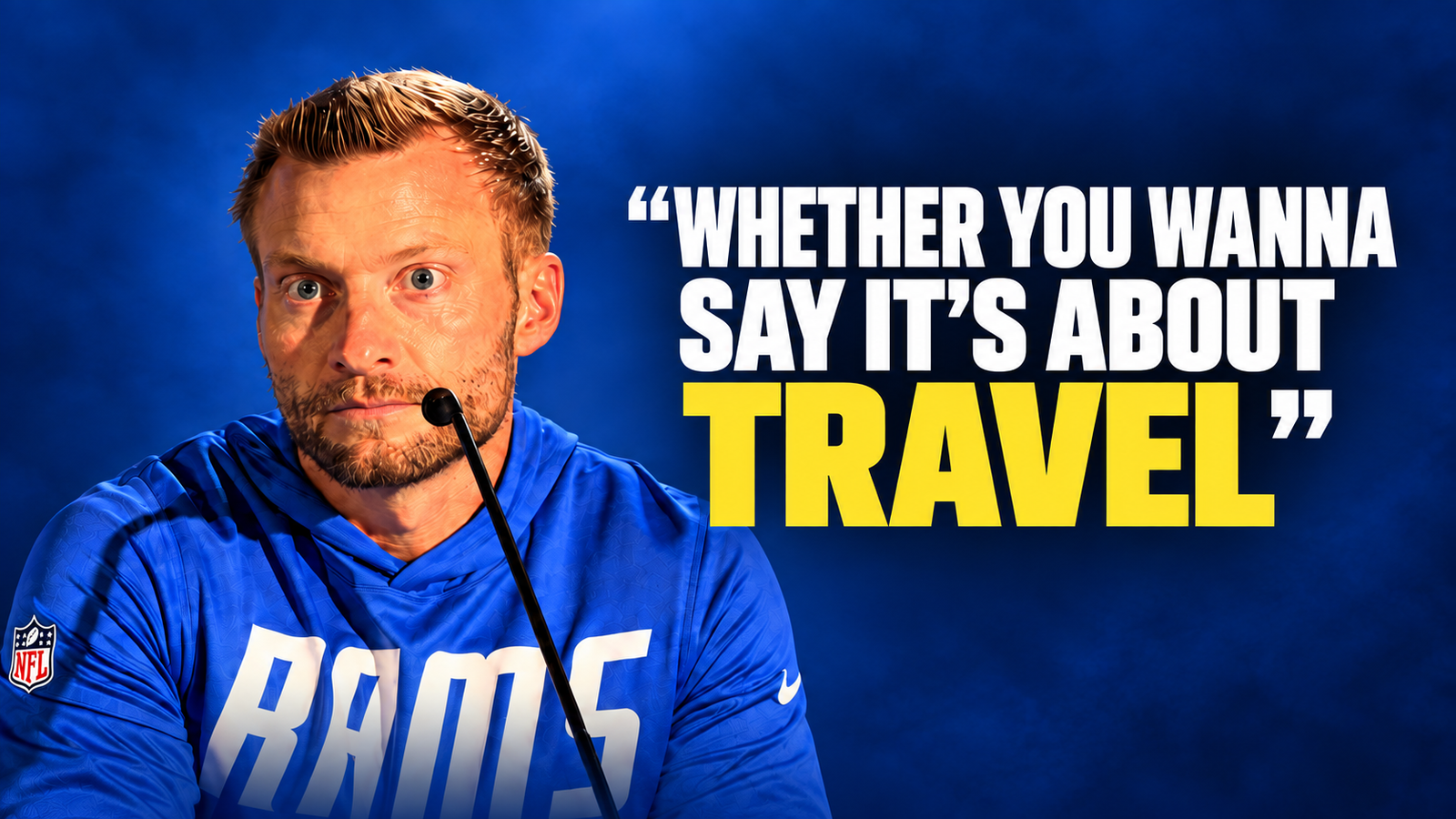
Sean McVay did not wait for a question about travel.
He brought it up himself, in his opening statement after the Los Angeles Rams’ 27–7 loss to the San Francisco 49ers in Melbourne. He called the day humbling, accepted responsibility for the preparation and said his coaching had fallen short. Then he offered an explanation nobody in that press conference had asked him to offer.
“Whether you wanna say it’s about travel, whatever, we just weren’t good enough in that window. I didn’t coach good enough, and we’ll look at it and we’ll move forward.”[1]
The slickness is in the construction. McVay takes responsibility for his coaching while inviting someone else to make the travel argument. He supplies the excuse without having to declare it his own. The admission of failure and the qualification arrive together.
McVay also explicitly denied that travel caused the loss. ABC reported him saying, “I don’t believe that’s why we didn’t play well enough. I really don’t.” The denial sits alongside the excuse he volunteered. Travel is available to the audience as an explanation even as the coach distances himself from it.[2]
Seattle got a qualification, too
The Rams’ previous season ended with a 31–27 loss to Seattle in the NFC Championship Game on January 25, 2026. McVay described the decisive fourth-down coverage as a “fortuitous bust by them” and said Seattle had “kind of lucked into” two defenders following Kyren Williams. He also praised the Seahawks.[3]
There was a real execution issue: Mike Macdonald acknowledged it. But DeMarcus Lawrence’s account described a deliberate adjustment. Seeing Williams release from the backfield, Lawrence judged that helping cover him offered more value than continuing his rush.[4]
Devon Witherspoon completed the stop by breaking up the fourth-down throw in the end zone, after breaking up the preceding third-down pass.[5]
The praise and the qualification coexist. McVay can acknowledge the winner while giving the defeat an asterisk. In Seattle, he invoked fortune. In Melbourne, he raised travel. That is the pattern worth examining in his explanations of these two losses.
Garrett’s debut: zero tackles, zero sacks
The football evidence in Melbourne makes the qualification harder to sell. Myles Garrett, the reigning Defensive Player of the Year, finished his first game for the Rams without a tackle.[6]
Los Angeles acquired Garrett from Cleveland on June 1 for Jared Verse, a 2027 first-round pick, a 2028 second-round pick and a 2029 third-round pick. He was coming off an NFL-record 23 sacks. The investment was in a player who could decide games.[7]
Knee soreness had kept Garrett out of most preseason practices, but McVay endorsed his readiness: “He’s going to be ready to go.” Garrett expressed confidence, too, and identified a Super Bowl and a third Defensive Player of the Year award as goals. Aaron Donald would not travel or play, delaying their anticipated partnership.[8]
Garrett received no tackle, sack or quarterback-hit credit in the official gamebook.[9]
His own explanation put responsibility on execution. Garrett said the 49ers “mixed it up well, but they weren’t doing anything specifically different.” He singled himself out among the players who needed to improve.[10]
An opponent planning for Garrett is an expected part of the assignment. Producing against that attention is part of what the Rams acquired him to do. His recorded totals demand scrutiny without needing a speculative explanation for why they happened.
The official replay of Demarcus Robinson’s 39-yard touchdown shows Garrett aligned on left tackle Trent Williams’ side. It supplies one specific matchup to examine on a scoring play.[11]
Donald’s eventual return will add to the interior. The Rams’ unofficial depth chart lists him alongside Braden Fiske at defensive end, with Garrett separately at outside linebacker. It does not establish how the coaches will divide their snaps.[12]
Fiske started in Melbourne and recorded 2 tackles, 1 solo and 1 assisted, with no sack, tackle for loss or quarterback hit.[13]
Donald’s absence was planned. Before departure, McVay expressed confidence in Fiske, Kobie Turner, Poona Ford, Tyler Davis and Ty Hamilton while explaining the decision to give Donald more time after two seasons away.[14]
The 49ers kept finding answers
McVay identified poor communication on both sides of the ball and inefficiency in the kicking game. He said San Francisco outplayed Los Angeles in every phase. The game supplies concrete reasons for that assessment.[15]
The Rams trailed only 10–7 at halftime. San Francisco opened the second half with a long Deebo Samuel kickoff return, productive Christian McCaffrey runs and a Mike Evans touchdown catch. Los Angeles was down 17–7 before its offense took the field.[16]
Evans had already converted three third downs on the opening possession and another third-and-eight before Robinson’s touchdown. All seven San Francisco third-down conversions came through Evans receptions or Brock Purdy runs.[17]
Defensive coordinator Chris Shula had anticipated the challenge of San Francisco’s receiving personnel: “we’ll wait and see how they deploy them, and we’ll adjust accordingly.” Recognizing and answering the 49ers’ approach was part of the job he had described.[18]
The Rams later reached the San Francisco 1-yard line with a chance to cut the deficit to three points after a touchdown and successful extra point. Matthew Stafford’s fourth-down sneak was stopped.[19]
San Francisco answered with 99 yards in 11 plays without facing a third down. Purdy found Luke Farrell for 14 yards to escape his own goal line, later scrambled for 18 and 8, and finished with a touchdown pass to Samuel.[20]
Fred Warner then forced Tyler Higbee’s fumble, Keion White recovered and Eddy Piñeiro added the field goal that made it 27–7.[21]
San Francisco finished with 174 rushing yards and 33:50 of possession. Stafford completed 15 of 25 passes for 155 yards, no touchdowns and an interception. The Rams scored no second-half points.[22]
Neither team recorded a sack, but the quarterback-hit totals differed sharply: San Francisco had 8 to the Rams’ 2, with Osa Odighizuwa credited with 4. The sack column alone would conceal that difference.[23]
The preparation plan was a choice
At his September 4 press conference, McVay was asked about the coming verdict: win, and the Rams’ itinerary would look smart; lose, and the 49ers’ earlier arrival would look correct. He argued that a sound process should be assessed separately from its result. Preserving familiar routines had driven the decision.[24]
Los Angeles planned three practice days at home before leaving Tuesday night. Sunday functioned as the usual Wednesday of game week.[25]
The Rams arrived Thursday morning for Friday’s game in Melbourne.[26]
Gary Klein reported that feedback from players’ earlier Australia trips informed the Rams’ travel plan.[27]
The Rams had beaten Jacksonville 35–7 in London the previous season after arriving the day before the game.[28]
That precedent helps explain confidence in a late arrival. It cannot settle whether the Australia plan worked. A win in London and a loss in Melbourne cannot, by themselves, isolate the effect of either itinerary.
San Francisco made different choices. Its earlier departure complicated roster and injury decisions, practice-squad assembly and travel paperwork. The 49ers accepted that work to establish their game-week routine in Australia.[29]
They held practices in Melbourne on Monday, Tuesday and Wednesday. By Monday, Kyle Shanahan was expressing satisfaction with how the team felt.[30]
Later in the week, McVay said of travel, “we’re not going to let it bother us anymore.” That was the posture before kickoff. After the loss, the subject reappeared in his opening statement, on his own initiative.[31]
The itinerary’s effect remains a question for the Rams to investigate. McVay’s choice of words is already on the record. He introduced the possibility that travel belonged in the explanation, surrounded it with admissions of responsibility and left the audience to do the excusing.
He told people to give the 49ers credit because they deserved it. That credit would sound less conditional without the excuse he had already volunteered.[32]
Sources and notes
[19] Los Angeles Rams, “Game Recap: Rams Fall to 49ers 27–7.”
[22] Los Angeles Rams, “49ers at Rams 2026 Box Score,” September 10, 2026; accessed September 10, 2026.
[25] Los Angeles Rams, Week 1 press-conference report, September 6–8, 2026.
[26] Doyle, De Silva, and Smale, “NFL Melbourne Live,” September 11, 2026, 1:47 p.m. entry.
[31] Los Angeles Rams, Week 1 press-conference report, September 6–8, 2026.
[32] The Sporting Tribune, McVay postgame opening statement, 0:59–1:07.
Reporting draws on the NFL gamebook and official team box score; Rams, 49ers and Seahawks reporting and press conferences; contemporary AP, ABC, BBC and Los Angeles Times coverage; and the editor-supplied McVay opening-statement transcript and screenshots. The opening-statement sequence was verified by the editor and corroborated by the source video’s captions: the travel passage precedes the invitation for questions. The official touchdown replay supports one observed alignment, not a full-game blocking assignment. Lead-frame source: The Sporting Tribune / YouTube, as identified by the editor.