
MLB · Pitching Data
Two double plays helped Messick before Tampa Bay’s three-run fourth
Parker Messick allowed three unearned runs in five innings, generating six whiffs in 34 swings. Explore his pitch mix and all 82 pitches in ALCS Game 2.
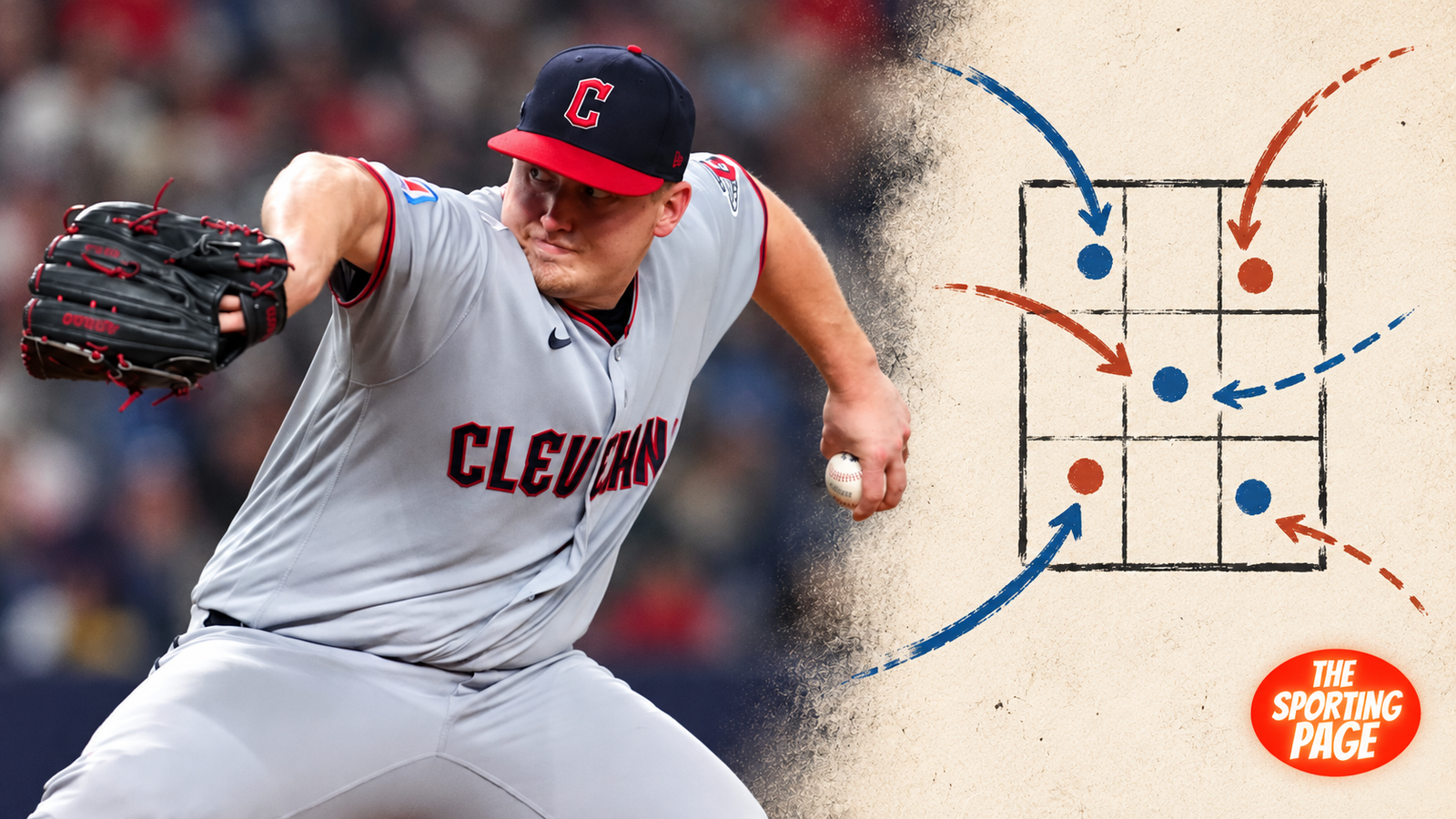
Ben Williamson put Parker Messick’s 85.9-mph changeup on the ground with a 2–1 count and two outs in the fourth inning. The ball left the bat at 84.9 mph toward José Ramírez, whose fielding error allowed Victor Mesa Jr. to score and left Chandler Simpson and Williamson in scoring position.
Liam Hicks drove the next pitch, an 88.9-mph slider, into center field at 96.9 mph. Simpson and Williamson scored for a 3–0 Tampa Bay lead. All three runs were unearned, although the final two crossed on a hard-hit single against Messick.
The Cleveland left-hander finished five innings with six hits, three runs, no earned runs, two walks and three strikeouts on 82 pitches. Tampa Bay won ALCS Game 2, 3–1, at Tropicana Field on October 13. His pitch record shows an outing built largely on contact: 10 of 16 balls in play were grounders, with two double plays helping keep the first three innings scoreless.
Parker Messick strikes out Victor Mesa Jr.
The sinker supplied grounders; the changeup supplied misses
Messick threw 39 four-seamers, 21 sinkers and 16 changeups. He also used three sliders, two curveballs and one cutter. The fastball classifications accounted for 60 of his 82 pitches, but they contributed in different ways.
The primary comparison contains 2,948 physical pitches from Messick’s 32 Cleveland regular-season starts, March 30 through September 27. His sinker share rose from 15.0% in that sample to 25.6% in Game 2, an increase of 10.6 percentage points. Four-seamers occupied 47.6% of this start against 41.8% during the season, while changeups fell from 23.6% to 19.5%.
His four-seamer averaged 95.5 mph, compared with 94.4 in the regular season. The sinker averaged 94.0 against 92.8. Those higher averages coexisted with fewer whiffs. A whiff normally means a swing that misses; the conventional tracking count also includes caught foul tips. The outing’s six whiffs in 34 swings were 17.6%, compared with 365 in 1,433, or 25.5%, during the season.
All 11 swings at sinkers made contact. Six became balls in play, including the double plays by Simpson in the second inning and Yandy Díaz in the third. Three other sinkers became called strikes. That is evidence of a pitch contributing through takes and grounders, even without a swing-and-miss result.
The changeup supplied three of Messick’s six recorded whiffs, including the strikeout pitches to Mesa in the first inning and Jonny DeLuca in the fourth. One four-seam whiff to Díaz was a caught foul tip, so five swings missed the ball outright. Messick also obtained 13 called strikes across the start, eight with four-seamers.
The matchup distribution explains part of the selection difference. Left-handed hitters received 33 of the 82 pitches, or 40.2%, compared with 26.5% in the regular-season sample. Seventeen of those 33 pitches were sinkers, a 51.5% share against left-handers, compared with 29.3% during the season. Against right-handers, Messick used only four sinkers in 49 pitches and delivered 15 of his 16 changeups.
Both the larger left-handed opportunity and the increased sinker share within those matchups matter. The complete mix changed descriptively, but the record does not establish Messick’s intended plan or what Tampa Bay’s hitters expected. The sinker-heavy left-handed sample is 33 pitches, not evidence that every future lineup will receive the same distribution.
Season repertoire and Game 2
Scale: 0–100%. Gray: regular season. Blue: Game 2.
Four-seam fastball
Change: +5.8 percentage points.
Sinker
Change: +10.6 percentage points.
Changeup
Change: -4.1 percentage points.
Slider
Change: -2.9 percentage points.
Curveball
Change: -5.9 percentage points.
Cutter
Change: -3.5 percentage points.
| Type | Pitches | Share | Mean mph | Max mph | Speed n | Whiffs / swings | Called strikes | IVB in | Spin rpm |
|---|---|---|---|---|---|---|---|---|---|
| Four-seam fastball | 39 | 47.6% | 95.5 | 97.4 | 39 | 3/11 | 8 | 17.5 | 2253 |
| Sinker | 21 | 25.6% | 94.0 | 95.8 | 21 | 0/11 | 3 | 9.2 | 2178 |
| Changeup | 16 | 19.5% | 86.0 | 87.8 | 16 | 3/9 | 1 | -0.6 | 1880 |
| Slider | 3 | 3.7% | 88.3 | 89.6 | 3 | 0/1 | 1 | 5.2 | 2425 |
| Curveball | 2 | 2.4% | 81.8 | 82.0 | 2 | 0/1 | 0 | -5.5 | 2386 |
| Cutter | 1 | 1.2% | 89.3 | 89.3 | 1 | 0/1 | 0 | 6.2 | 2495 |
IVB is induced vertical break relative to a gravity-only trajectory. It does not mean the ball rises. Rates and average measurements describe this appearance.
Ben Williamson: inning 4
Ground-ball outs did not mean uniformly soft contact
DeLuca’s leadoff single in the second inning and Simpson’s ensuing double-play grounder both reached 100 mph off the bat. The double play removed DeLuca before Ben Williamson walked. Messick then picked Williamson off first during Hicks’ interrupted plate appearance. The two pitches already thrown to Hicks remain part of the 82-pitch workload, although the pickoff ended the inning before Hicks completed the plate appearance.
Hicks and Taylor Walls began the third with consecutive singles. Díaz’s double play moved Hicks to third, and Jonathan Aranda grounded out on a sinker to end the inning. Messick reached the fourth at 45 pitches with no runs allowed, despite four hits and a walk. The two double plays and pickoff were material parts of that outcome.
The fourth began with a walk to Junior Caminero. Mesa’s grounder became a forceout after replay left Caminero out at second and overturned the out call at first. DeLuca then struck out on four pitches: a curveball foul, a low changeup taken for a ball, a missed four-seamer and a missed changeup. Simpson’s infield single kept the inning going before the error and Hicks’ scoring hit.
Ten of the 16 measured balls in play reached 95 mph, the Statcast threshold for hard contact, compared with 34.4% of 500 measured regular-season contacts. Their average exit velocity was 93.9 mph, against 86.6 in the season sample. Those measurements prevent the zero in the earned-runs column from becoming an explanation of the whole start. Some hard grounders became useful outs, while the softer grounder that Ramírez misplayed preceded a hard-hit scoring single.
Messick ended the fourth with a three-pitch strikeout of Walls, finishing him with a 95.6-mph four-seamer. He used 26 pitches in that inning and another 11 in a scoreless fifth, departing at 82 with no runners left for Cleveland’s bullpen. He hit Aranda with a sinker in the fifth, then retired Caminero on a flyout and Mesa on a popup. His four-seam velocity averaged 96.0 mph in the first inning and 93.6 across five four-seamers in the fifth. That observed decline does not establish fatigue or injury.
Grounders supplied valuable outs in this start, but their outcomes also depended on fielding and runner situations. The error accounts for the three unearned runs, while the hard-hit single after it remains part of Messick’s pitching record. A larger sample would test whether the sinker continues to generate useful grounders and whether he obtains more misses alongside them.
Inning samples in context
| Inning | Pitches | Cumulative | Four-seam fastball mph | Measured n | Outs |
|---|---|---|---|---|---|
| 1 | 18 | 18 | 96.0 | 9 | 3 |
| 2 | 14 | 32 | 95.6 | 9 | 3 |
| 3 | 13 | 45 | 95.7 | 5 | 3 |
| 4 | 26 | 71 | 95.6 | 11 | 3 |
| 5 | 11 | 82 | 93.6 | 5 | 3 |
Every pitch: 82 of 82
Filter by pitcher, hitter, inning or pitch type. Pitch numbers belong to the named pitcher’s own outing. Select a number for the full measurement record. Pitch result and plate-appearance result or interruption are separate.
82 of 82 pitches
No pitches match these filters.
| Outing pitch | Pitcher | Inning | Hitter | Count before | Type | mph | Pitch result | PA result / interruption |
|---|---|---|---|---|---|---|---|---|
| Parker Messick | 1 | Yandy Díaz | 0–0 | SI | 94.0 | Called Strike | Groundout | |
| Parker Messick | 1 | Yandy Díaz | 0–1 | FF | 96.3 | Ball | Groundout | |
| Parker Messick | 1 | Yandy Díaz | 1–1 | FF | 95.1 | Foul Tip | Groundout | |
| Parker Messick | 1 | Yandy Díaz | 1–2 | CH | 87.0 | In play, out(s) | Groundout | |
| Parker Messick | 1 | Jonathan Aranda | 0–0 | FF | 96.2 | Foul | Groundout | |
| Parker Messick | 1 | Jonathan Aranda | 0–1 | SI | 93.9 | Ball | Groundout | |
| Parker Messick | 1 | Jonathan Aranda | 1–1 | SI | 94.9 | Ball | Groundout | |
| Parker Messick | 1 | Jonathan Aranda | 2–1 | FF | 96.1 | In play, out(s) | Groundout | |
| Parker Messick | 1 | Junior Caminero | 0–0 | FF | 96.9 | Called Strike | Double | |
| Parker Messick | 1 | Junior Caminero | 0–1 | CH | 87.8 | Ball | Double | |
| Parker Messick | 1 | Junior Caminero | 1–1 | CH | 87.7 | In play, no out | Double | |
| Parker Messick | 1 | Victor Mesa Jr. | 0–0 | FF | 95.4 | Ball | Strikeout | |
| Parker Messick | 1 | Victor Mesa Jr. | 1–0 | FF | 95.4 | Foul | Strikeout | |
| Parker Messick | 1 | Victor Mesa Jr. | 1–1 | SI | 95.8 | Ball | Strikeout | |
| Parker Messick | 1 | Victor Mesa Jr. | 2–1 | FF | 96.2 | Called Strike | Strikeout | |
| Parker Messick | 1 | Victor Mesa Jr. | 2–2 | SI | 95.6 | Foul | Strikeout | |
| Parker Messick | 1 | Victor Mesa Jr. | 2–2 | FF | 96.7 | Foul | Strikeout | |
| Parker Messick | 1 | Victor Mesa Jr. | 2–2 | CH | 87.3 | Swinging Strike (Blocked) | Strikeout | |
| Parker Messick | 2 | Jonny DeLuca | 0–0 | CH | 85.3 | Called Strike | Single | |
| Parker Messick | 2 | Jonny DeLuca | 0–1 | FF | 95.2 | Ball | Single | |
| Parker Messick | 2 | Jonny DeLuca | 1–1 | FF | 95.2 | Ball | Single | |
| Parker Messick | 2 | Jonny DeLuca | 2–1 | CH | 86.1 | In play, no out | Single | |
| Parker Messick | 2 | Chandler Simpson | 0–0 | FF | 94.3 | Ball | GIDP | |
| Parker Messick | 2 | Chandler Simpson | 1–0 | SI | 93.0 | In play, out(s) | GIDP | |
| Parker Messick | 2 | Ben Williamson | 0–0 | FF | 95.6 | Ball | Walk | |
| Parker Messick | 2 | Ben Williamson | 1–0 | FF | 95.7 | Ball | Walk | |
| Parker Messick | 2 | Ben Williamson | 2–0 | FF | 96.3 | Foul | Walk | |
| Parker Messick | 2 | Ben Williamson | 2–1 | FF | 95.4 | Ball | Walk | |
| Parker Messick | 2 | Ben Williamson | 3–1 | FF | 95.7 | Called Strike | Walk | |
| Parker Messick | 2 | Ben Williamson | 3–2 | FF | 97.4 | Ball | Walk | |
| Parker Messick | 2 | Liam Hicks | 0–0 | SI | 94.0 | Foul | Pickoff 1B | |
| Parker Messick | 2 | Liam Hicks | 0–1 | SI | 95.0 | Ball | Pickoff 1B | |
| Parker Messick | 3 | Liam Hicks | 0–0 | FF | 95.7 | Ball | Single | |
| Parker Messick | 3 | Liam Hicks | 1–0 | SI | 94.9 | Foul | Single | |
| Parker Messick | 3 | Liam Hicks | 1–1 | FF | 96.4 | In play, no out | Single | |
| Parker Messick | 3 | Taylor Walls | 0–0 | CH | 85.0 | Ball | Single | |
| Parker Messick | 3 | Taylor Walls | 1–0 | CH | 85.0 | Swinging Strike | Single | |
| Parker Messick | 3 | Taylor Walls | 1–1 | CH | 84.3 | In play, no out | Single | |
| Parker Messick | 3 | Yandy Díaz | 0–0 | FF | 95.5 | Ball | GIDP | |
| Parker Messick | 3 | Yandy Díaz | 1–0 | SI | 93.1 | Foul | GIDP | |
| Parker Messick | 3 | Yandy Díaz | 1–1 | FF | 95.1 | Ball | GIDP | |
| Parker Messick | 3 | Yandy Díaz | 2–1 | FF | 95.7 | Ball | GIDP | |
| Parker Messick | 3 | Yandy Díaz | 3–1 | SI | 94.8 | In play, out(s) | GIDP | |
| Parker Messick | 3 | Jonathan Aranda | 0–0 | CU | 81.5 | Ball | Groundout | |
| Parker Messick | 3 | Jonathan Aranda | 1–0 | SI | 94.9 | In play, out(s) | Groundout | |
| Parker Messick | 4 | Junior Caminero | 0–0 | CH | 86.9 | Ball | Walk | |
| Parker Messick | 4 | Junior Caminero | 1–0 | FF | 95.4 | Called Strike | Walk | |
| Parker Messick | 4 | Junior Caminero | 1–1 | FF | 97.0 | Ball | Walk | |
| Parker Messick | 4 | Junior Caminero | 2–1 | FF | 96.4 | Called Strike | Walk | |
| Parker Messick | 4 | Junior Caminero | 2–2 | SL | 89.6 | Ball | Walk | |
| Parker Messick | 4 | Junior Caminero | 3–2 | FF | 96.7 | Ball | Walk | |
| Parker Messick | 4 | Victor Mesa Jr. | 0–0 | SI | 93.9 | Called Strike | Forceout | |
| Parker Messick | 4 | Victor Mesa Jr. | 0–1 | FC | 89.3 | Foul | Forceout | |
| Parker Messick | 4 | Victor Mesa Jr. | 0–2 | FF | 95.7 | Ball | Forceout | |
| Parker Messick | 4 | Victor Mesa Jr. | 1–2 | SI | 95.0 | Ball | Forceout | |
| Parker Messick | 4 | Victor Mesa Jr. | 2–2 | SI | 94.1 | In play, out(s) | Forceout | |
| Parker Messick | 4 | Jonny DeLuca | 0–0 | CU | 82.0 | Foul | Strikeout | |
| Parker Messick | 4 | Jonny DeLuca | 0–1 | CH | 85.3 | Ball In Dirt | Strikeout | |
| Parker Messick | 4 | Jonny DeLuca | 1–1 | FF | 95.0 | Swinging Strike | Strikeout | |
| Parker Messick | 4 | Jonny DeLuca | 1–2 | CH | 85.7 | Swinging Strike | Strikeout | |
| Parker Messick | 4 | Chandler Simpson | 0–0 | SI | 93.0 | Called Strike | Single | |
| Parker Messick | 4 | Chandler Simpson | 0–1 | SI | 93.1 | Foul | Single | |
| Parker Messick | 4 | Chandler Simpson | 0–2 | FF | 95.9 | In play, no out | Single | |
| Parker Messick | 4 | Ben Williamson | 0–0 | FF | 94.9 | Called Strike | Field Error | |
| Parker Messick | 4 | Ben Williamson | 0–1 | FF | 94.9 | Ball | Field Error | |
| Parker Messick | 4 | Ben Williamson | 1–1 | CH | 85.9 | Ball In Dirt | Field Error | |
| Parker Messick | 4 | Ben Williamson | 2–1 | CH | 85.9 | In play, run(s) | Field Error | |
| Parker Messick | 4 | Liam Hicks | 0–0 | SL | 88.9 | In play, run(s) | Single | |
| Parker Messick | 4 | Taylor Walls | 0–0 | FF | 93.8 | Called Strike | Strikeout | |
| Parker Messick | 4 | Taylor Walls | 0–1 | CH | 84.9 | Foul | Strikeout | |
| Parker Messick | 4 | Taylor Walls | 0–2 | FF | 95.6 | Swinging Strike | Strikeout | |
| Parker Messick | 5 | Yandy Díaz | 0–0 | FF | 92.6 | Ball | Flyout | |
| Parker Messick | 5 | Yandy Díaz | 1–0 | FF | 91.5 | Ball | Flyout | |
| Parker Messick | 5 | Yandy Díaz | 2–0 | SI | 91.8 | In play, out(s) | Flyout | |
| Parker Messick | 5 | Jonathan Aranda | 0–0 | SI | 93.1 | Hit By Pitch | Hit By Pitch | |
| Parker Messick | 5 | Junior Caminero | 0–0 | FF | 94.2 | Called Strike | Flyout | |
| Parker Messick | 5 | Junior Caminero | 0–1 | SL | 86.3 | Called Strike | Flyout | |
| Parker Messick | 5 | Junior Caminero | 0–2 | CH | 85.2 | Ball In Dirt | Flyout | |
| Parker Messick | 5 | Junior Caminero | 1–2 | FF | 94.8 | In play, out(s) | Flyout | |
| Parker Messick | 5 | Victor Mesa Jr. | 0–0 | FF | 94.8 | Ball | Pop Out | |
| Parker Messick | 5 | Victor Mesa Jr. | 1–0 | SI | 93.1 | Ball | Pop Out | |
| Parker Messick | 5 | Victor Mesa Jr. | 2–0 | SI | 93.1 | In play, out(s) | Pop Out |
Sources, definitions and limitations
The official final MLB record supplies the pitching lines, events and final calls for Cleveland at Tampa Bay on October 13, 2026. Baseball Savant’s gamefeed supplies the tracking measurements. Physical pitch identifiers, pitch counts, batters and integer outs were reconciled. Automatic balls and strikes, pickoffs and other nonpitch events stay outside the physical pitch ledger. ABS challenges use the final official call.
Parker Messick: 82 outing pitches. Regular-season comparison: 2,948 physical pitches in 32 starter appearances for Cleveland Guardians, 2026-03-30 through 2026-09-27. Same club and role in the 2026 regular season. The target outing and postseason work are excluded. Tracking coverage: release, movement and plate-location fields are complete. Measured exit speed is available for 16 of 16 balls in play.
Messick threw two pitches to Liam Hicks in the second inning before a pickoff of Ben Williamson ended the inning. Those physical pitches remain in the 82-pitch ledger. That interrupted plate appearance does not add a completed batter to his official 22 batters faced.
Whiff rate is conventional tracking whiffs divided by swing attempts. Swinging strikes, blocked swinging strikes, caught foul tips and missed bunts count as whiffs. A caught foul tip involves contact and is distinct from a literal swing-and-miss. Fouls, bunt attempts and balls in play enter the swing denominator. Called strikes and completed strikeout plate appearances are separate. Chase uses ball-center locations outside a 17-inch-wide rectangle and each pitch’s recorded vertical boundaries, excluding missing locations. Savant’s own zone flag remains separately available.
Pitch share uses all physical pitches in the identified sample. Speed is mph, spin rpm, extension feet and movement inches. Plate location and recorded strike-zone boundaries are feet in catcher view. Hard-hit contact means an exit speed of at least 95 mph. Missing measurements remain missing rather than zero. Expected contact outcomes are Savant model estimates, distinct from actual results. Each reliever retains a separate repertoire and baseline. Small appearances do not establish a lasting change, intention, fatigue or injury.
Sources and notes
- Official MLB final game 849813: https://statsapi.mlb.com/api/v1.1/game/849813/feed/live
- Baseball Savant complete tracking: https://baseballsavant.mlb.com/gf?game_pk=849813
- Pregame regular-season and prior-postseason samples, denominators and limitations are declared in the article methods.
- Statcast field definitions: https://baseballsavant.mlb.com/csv-docs