

One Night at the Garden
On January 1, 1965, Lew Alcindor played the preliminary, Wilt Chamberlain drew the crowd, and rookie Willis Reed supplied the ending.
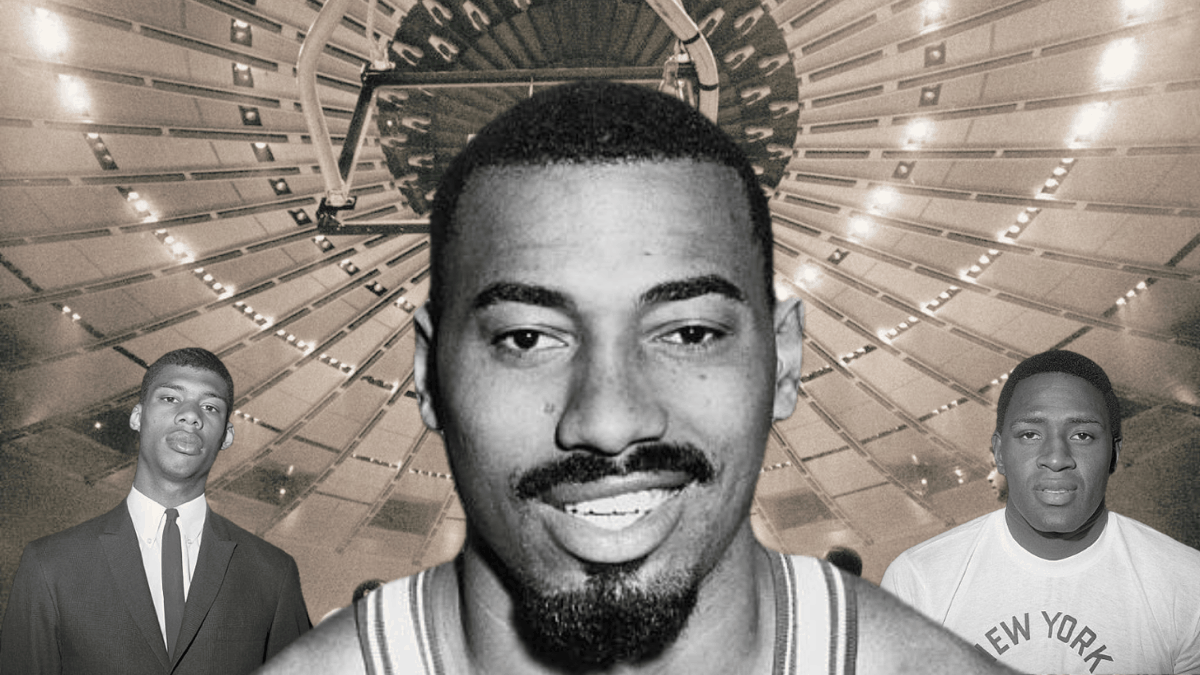
THREE BASKETBALL LIVES.TSP archive montage; not a photograph of the 1965 double bill.
Wilt Chamberlain was the attraction. Lew Alcindor was the attraction to come. Willis Reed was the rookie who won the game.
For one New Year’s evening in 1965, Madison Square Garden put all three on the same bill: Power Memorial Academy against Archbishop Stepinac, followed by the New York Knicks against the San Francisco Warriors. Alcindor and Chamberlain did not face each other. The schoolboy played first; the professional watched him, then went to work against Reed.1
Seen backward, the evening looks almost too neatly arranged. Three future Hall of Famers, three stages of a basketball life, one floor. But the newspaper clippings tell a better story than a ceremonial passing of the torch. They show an audience looking toward one young man’s future while another was already doing something worth remembering.
The preliminary
The advance notice scheduled the schoolboys for 6:45. It introduced Chamberlain as basketball’s established drawing card and Alcindor as the high-school star who might eventually replace him in that role. The comparison was the sales pitch.1
Stepinac coach Nat Volpe had a more immediate concern. When Power Memorial arrived, his players were warming up. He sent them back to the dressing room. As he explained in Time: “I didn’t want them to see him before they had to.” Alcindor was seventeen; the magazine listed him at 7-foot-1 and 235 pounds.2
Volpe could postpone the encounter. He could not change it.
Alcindor scored 37 points in Power Memorial’s 69–44 victory. It was the school’s 64th consecutive win. About 7,000 spectators watched, according to the contemporary New York Times account in TSP’s archive. The professional game helped explain the audience, as did the coaches and scouts in town for the holiday college tournament.3
The report was interested in more than height. It noted Alcindor’s shooting touch, movement and footwork, while acknowledging the problem with judging a seven-footer against much smaller schoolboys. Watching him dominate could establish that he was exceptional. It could not establish his limit.
Nor could it settle the question surrounding him: which college would get him? Power coach Jack Donohue kept reporters at a distance. In the account’s telling, the destination remained a mystery even as the talent became an increasingly public fact.3
Alcindor had finished the job assigned to him that evening. The adults could continue arguing about the next one.
The man in the seats
Chamberlain watched the preliminary. That detail, recorded in the Times clipping, is what turns an unusual double bill into something more intimate. The man used to explain Alcindor’s possibilities was there to see them for himself.3
He knew the part. Before Kansas, before the Globetrotters, before the NBA, Chamberlain had been the extraordinary schoolboy at Philadelphia’s Overbrook High. By 1965, he had put a 100-point game into the professional record book. It was possible to describe a prospect as the next Chamberlain because the original had already stretched the language of basketball achievement.4
The comparison could also obscure what was in front of the audience. Alcindor was not an unfinished copy of Wilt. His career would have its own shape. The appeal of seeing them in the same building was that the question remained open: what could this teenager become once the opponents grew up around him?
For the second game, speculation had to give way to a score.
The rookie’s game
Chamberlain finished with 29 points. He also missed seven of eight free throws. Reed collected 18 rebounds to Chamberlain’s 17. Those were the particulars preserved in the contemporary game clipping—not an account of Wilt being overwhelmed, but of a close game in which the margins mattered.5
The box score adds useful perspective. Reed scored 12 points. Jim Barnes had 21 for New York and Bob Boozer had 20. Reed did not carry every Knicks possession, and his eventual stature should not write his teammates out of the evening.6
What belonged to him was the decisive basket.
With 1:13 remaining, Chamberlain and Nate Thurmond were stationed on either side of the basket. The surviving report describes Reed slipping between them. His field goal gave the Knicks the points they needed for a 101–100 victory.5
It is a small piece of action to set beside Alcindor’s 37 points or Chamberlain’s reputation. It is also the difference between winning and losing. The advance publicity had organized the evening around the two famous giants. The rookie found the opening that settled it.
Reed’s later career makes it tempting to call the play a preview of everything New York would come to love about him. There is some justice in that reading: he would become the leader of the Knicks’ 1970 and 1973 championship teams, a left-handed big man whose shooting and physical resolve helped him contend with larger opponents.7
Still, the basket deserves to survive without borrowing significance from his famous injured entrance in the 1970 Finals. Five years before that scene, Reed had already helped win an ordinary January game. The future captain did not need to know the future to make the right play.
Three careers, still unfolding
Alcindor would go to UCLA and lead the Bruins to three consecutive NCAA championships, from 1967 through 1969. His professional career would be played mostly under the name Kareem Abdul-Jabbar, which he publicly adopted in 1971.8
Chamberlain still had both of his NBA championships ahead of him. Reed still had his finest New York seasons ahead of him. Nobody had surrendered a place that night, and nobody had been formally anointed to inherit one.47
That is what makes the bill worth recovering. It catches the players before their careers could be compressed into familiar images: Kareem and the skyhook, Wilt and the impossible number, Willis emerging from the tunnel. On January 1, they were a teenager finishing a high-school assignment, a star watching before his own game, and a rookie trying to win it.
The preliminary showed what everyone wanted to see. The main event left room for someone else to decide what they would remember.
Notes & sources
“Knicks, Warriors at Garden Tonight.” Partial contemporary advance clipping supplied by the publisher, reviewed for this edition. It identifies both games and the 6:45 preliminary. The crop does not establish the publication, author or complete issue date.
↩1 ↩2Time, “High School Basketball: The Courtship of Lew Alcindor”, January 22, 1965. Source for Volpe’s quotation and Alcindor’s age and listed dimensions.
↩“Alcindor, 7-Foot Schoolboy, Thrills 7,000 at Garden.” Contemporary New York Times clipping supplied by the publisher, reviewed for this edition. Source for the preliminary’s result, Alcindor’s 37 points, the 64-game streak, estimated crowd, scouting observations and Chamberlain’s attendance. The supplied crop does not display the issue date or a byline.
↩1 ↩2 ↩3Naismith Memorial Basketball Hall of Fame, Wilt Chamberlain. Career background and championship record; the contemporary Times clipping also recounts his route through Overbrook, Kansas and the Globetrotters.
↩1 ↩2“Knicks Top Warriors, 101-100, On Goal by Reed With 1:13 Left.” Partial contemporary game clipping supplied by the publisher, reviewed for this edition. Source for the closing play, Chamberlain’s points and free throws, and the Reed–Chamberlain rebounding comparison. The publication and full issue date are not visible in the crop.
↩1 ↩2Basketball-Reference, San Francisco Warriors at New York Knicks, January 1, 1965. Box-score figures cross-checked against the indexed record. No modern play-by-play has been substituted for the contemporary account.
↩Naismith Memorial Basketball Hall of Fame, Willis Reed. Career context, playing style and the 1970 and 1973 championships.
↩1 ↩2UCLA Athletics, Lew (Kareem Abdul-Jabbar) Alcindor; NBA.com, Kareem Abdul-Jabbar’s career profile. UCLA championship years and the 1971 name-change chronology.
↩
About the reporting
This feature combines contemporary newspaper excerpts from the publisher’s archive with Time’s January 1965 reporting, the historical box score, and institutional player histories. The excerpts were reread for this edition; incomplete publication details remain identified as incomplete. Quotations are attributed to their original reporting, not to new TSP interviews. The narrative does not invent a meeting or conversation among the three players.
Updated September 2, 2026. This edition corrects the timing of Abdul-Jabbar’s public name change and adds the Knicks’ supporting scorers. The original article URL and publication date are preserved.