
NFL
Marvin Harrison Jr. to the Texans: What Houston Is Getting After the Cardinals Trade
Harrison offers C.J. Stroud another large target alongside Nico Collins. His receiving record shows what Houston must restore to justify the second-round price.
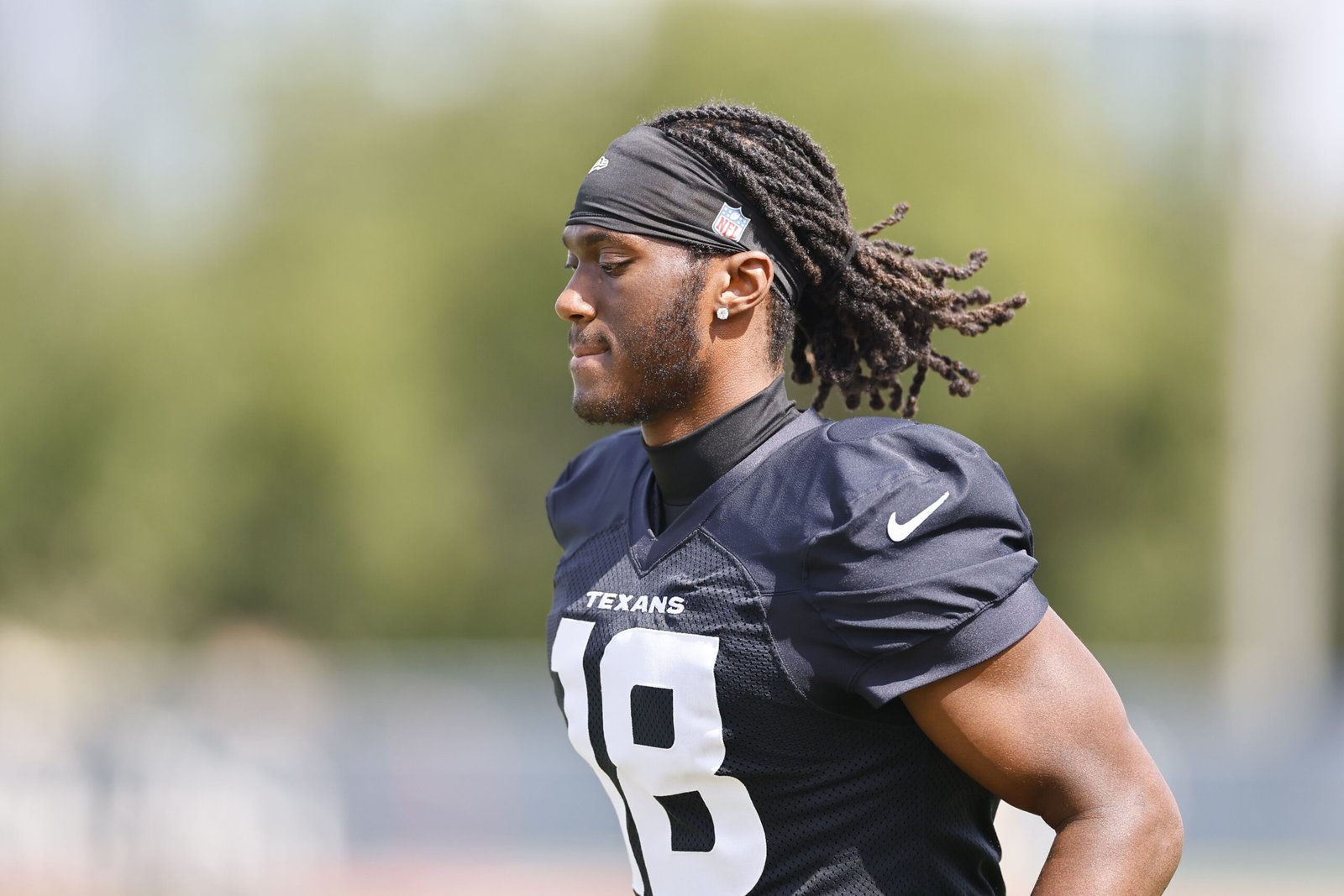
The Texans are getting a second large receiving target for C.J. Stroud, a player whose college production gives them a reason to attempt a revival and whose recent NFL output explains why that revival is necessary. Marvin Harrison Jr. can make Houston less dependent on Nico Collins. His Arizona record does not establish that he can immediately match Collins.
That distinction matters when judging the Harrison trade. Houston paid 2027 second-round and seventh-round picks for Harrison and a 2027 sixth-rounder. Those are the Cardinals’ announced final terms, which differ from early reports. The second-round selection is the substantial cost; moving up a round late in the draft is a smaller part of the return.
The receiving decline comes from fewer catches
Harrison’s official NFL receiving record shows a sharp decline in catches per appearance this season. He caught five passes for 85 yards and one touchdown across four Arizona appearances. He had no catches against Seattle, three against San Francisco and one each against the Chargers and Giants.
| Season | Games | Catches | Yards | Catches/game | Yards/game |
|---|---|---|---|---|---|
| 2024 | 17 | 62 | 885 | 3.65 | 52.1 |
| 2025 | 12 | 41 | 608 | 3.42 | 50.7 |
| 2026, Arizona | 4 | 5 | 85 | 1.25 | 21.3 |
Source: Houston Texans official player statistics, checked October 17, 2026. Per-game figures divide receiving totals by games played, rounded half up to two decimal places for catches and one for yards. The partial 2026 season is not a full-season comparison.
His yardage per catch has held up: 14.3 as a rookie, 14.8 in 2025 and 17.0 this year. That last figure comes from only five receptions. A respectable average on the catches he makes cannot compensate for stretches in which he contributes almost none. Houston needs more dependable involvement before it can treat him as a substantial second option.
The earlier seasons offer a more useful baseline than the draft position alone. Harrison produced more than 50 receiving yards per appearance in both 2024 and 2025. Getting him back near that level would add something meaningful alongside Collins. Expecting an immediate top receiver’s workload would require a larger improvement than simply reversing the four-game slump.
Those rates also put the lower 2025 season total in context. Harrison played 12 games that year after appearing in all 17 as a rookie. Comparing 608 yards with 885 without accounting for those five fewer appearances exaggerates the fall in production when he actually played. Per-game yardage fell about 2.7%, compared with a 31.3% drop in the season total.
This season is a different-sized sample again. Four appearances cannot establish that a 24-year-old receiver has permanently lost his ability. They do establish how little receiving production Houston is acquiring from the immediate run-up to the trade. The Texans are paying for an improvement from that starting point, rather than purchasing a player already sustaining his best form.
Collins gives the new role a clear reference point
Collins has 19 receptions for 249 yards and three touchdowns in three appearances this season. Houston’s game log shows he did not play in Weeks 2 and 3. Those missed games should not be recorded as zero-catch performances when comparing him with Harrison.
Collins also supplies a stronger established NFL standard: 1,297 receiving yards in 2023, 1,006 in 2024 and 1,117 in 2025. Houston can ask Harrison to complement that production rather than immediately build the passing game around him. The question is whether the offense gains another receiver Stroud can use regularly when Collins is covered or unavailable.
There is physical overlap. The Texans list Collins at 6-foot-4 and 222 pounds, Harrison at 6-foot-3 and 220. Adding another large receiver can give Stroud options on opposite sides of a formation, but size alone does not establish a different skill set. Whether Harrison creates separation, wins contested throws or draws extra defensive attention must be judged from his Houston work.
The Ohio State connection helps explain the bet
Harrison and Stroud have already operated a productive passing partnership. In 2022, Harrison caught 77 passes for 1,263 yards and 14 touchdowns at Ohio State, according to his official college biography. That season provides concrete evidence behind the reunion’s appeal, rather than familiarity based only on sharing a roster.
That college season was four years ago. Houston’s terminology, teammates and NFL opponents make this a new assignment. Familiarity can help the pair communicate about a route or a preferred throw, but it does not give Harrison a command of every responsibility in Nick Caley’s offense on arrival.
His role also has to fit receivers who have recently contributed. After the Dallas game, DeMeco Ryans highlighted Jaylin Noel’s explosive plays, Kayshon Boutte’s contested catches and Xavier Hutchinson’s third-down work. Harrison’s arrival creates choices about personnel and opportunities; it does not make those contributions disappear.
What would make the acquisition work?
The immediate need is particularly visible with Tank Dell ruled out against Jacksonville because of his knee. Harrison adds another available receiving option for the London game. That is useful roster depth even before deciding how much of the passing attack he can handle.
For the price to look worthwhile, however, Houston needs more than another available receiver or one memorable catch. Consistent participation, repeated opportunities and production that survives beyond a favorable matchup would provide stronger evidence. An occasional touchdown cannot answer a workload question by itself, and one difficult debut would be too little evidence to settle the trade.
The cost should be judged against the job Houston actually gets filled. If Harrison becomes a dependable complementary receiver, the deal can help without him overtaking Collins. If his receiving production remains close to the Arizona opening month, a second-round pick is a substantial commitment for that return. His original fourth-overall draft slot cannot decide either outcome.
The statistical test should also distinguish opportunity from results. More catches could reflect more routes and targets, improved execution or both. The season totals used here do not isolate those causes. A fair evaluation of the next stretch needs the actual role and opponent context beside the receiving line, rather than assigning every change to the quarterback reunion.
Houston’s next game is against Jacksonville at Wembley Stadium on October 18. The team says DeMeco Ryans has confirmed Harrison will make his Houston debut. The useful comparison will be Harrison’s participation and opportunities alongside the existing receivers, with the passing results judged against the responsibilities he actually receives.