
Tennis
Ben Shelton Beats Alcaraz to Set Up an All-American US Open Semifinal
Shelton’s composure against the defending champion impressed Chris Russo. Against Frances Tiafoe, he now has a chance to turn that performance into a first major final.
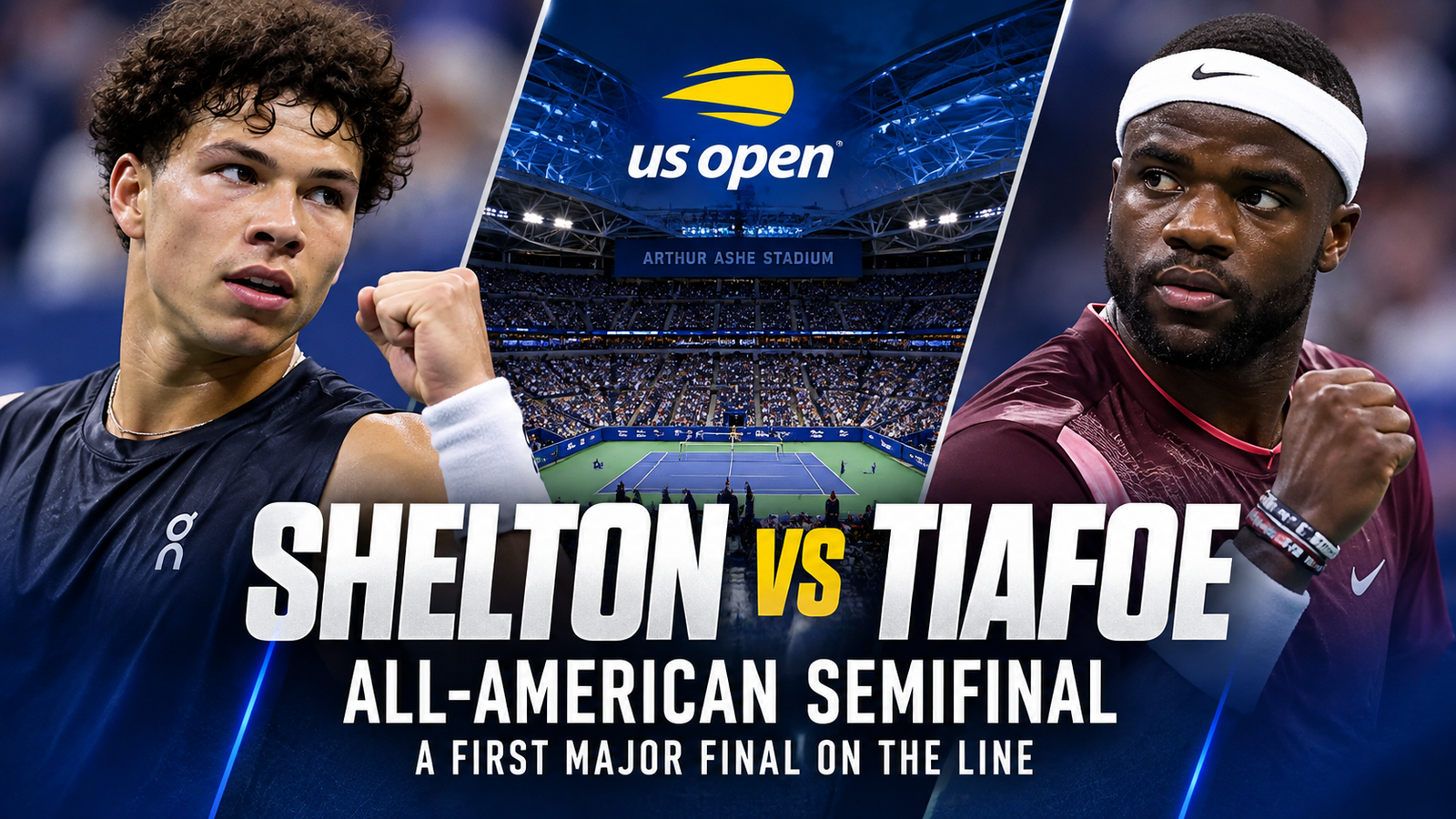
Ben Shelton set up a 2026 US Open semifinal against Frances Tiafoe by ending Carlos Alcaraz’s title defence with a 146-mph ace. The more revealing part of his quarterfinal victory was how he kept the match within reach when the defending champion recovered and threatened to take it away. 1
Shelton’s 6-7(5), 6-1, 6-3, 1-6, 7-6(10-7) win, completed on September 9, sends him into an all-American semifinal against Frances Tiafoe on Friday, September 11. One of them will reach a first Grand Slam final. Both arrive after five-set quarterfinals that required them to recover from positions in which defeat looked increasingly likely. 1,2
September 11 update: The Shelton–Tiafoe semifinal is on Arthur Ashe Stadium’s Friday night programme, with a scheduled 7 p.m. ET start. This article analyses the matchup ahead of their first major final opportunity. 14
Related: Our report on the 3:33 a.m. Shelton–Alcaraz finish examines the US Open’s scheduling problem. Find more coverage in The Sporting Page’s Other sports section.
Chris Russo’s assessment on the September 9 edition of Mad Dog Unleashed on SiriusXM concentrated on Shelton’s handling of those changes.
“He was sturdy as a rock. He didn't have to dip in the valley, as sometimes he can. He kept his course. He had his gameplan. He didn't waste energy going crazy. He handled himself superbly. Absolutely superbly. And he deserved to win.” 3
The distinction matters. Shelton did not need to maintain the same level throughout every set to win. He needed to prevent a bad passage from determining what happened next.
More than a powerful serve
Shelton entered the quarterfinal with an 0-17 record against players ranked in the world’s top three. He had also lost his three previous meetings with Alcaraz. This was a different level of opponent from those he had already beaten in New York. 4,5
There had nevertheless been evidence of control before the quarterfinal. Against Stefanos Tsitsipas in the fourth round, Shelton won 6-2, 6-3, 6-4 without facing a break point. He served 11 aces and won 83 per cent of his first-serve points. The tournament’s report described him using his left-handed forehand to press Tsitsipas’s backhand before attacking the space on the opposite side. 5
Against Alcaraz, the return mattered as well. Shelton converted five of 16 break-point opportunities, while Alcaraz converted three of 11. Those figures complicate any account that reduces the result to one enormous delivery at match point: Shelton repeatedly created chances in his opponent’s service games. 6
After losing the opening tiebreak, Shelton won nine consecutive games across the second and third sets. Alcaraz’s mistakes contributed, but Shelton still had to take advantage without giving back the openings he received. 1
“I knew that my serve was only going to get better,” Shelton said afterwards, according to AFP’s match report. He explained that breaking Alcaraz during the first set had given him confidence in his return, despite losing the set. 7
That is a useful distinction between the score and the information a player takes from it. Shelton had lost the set, but he had also established that Alcaraz’s serve could be challenged. The setback did not require him to abandon what was working.
Alcaraz’s comeback required another response
Alcaraz was playing his first tournament after four-and-a-half months away with a right wrist injury. He later acknowledged physical fatigue, but the fourth set demonstrated why his difficulties could not be treated as the end of the contest. He won it 6-1 and forced Shelton to begin again in a deciding set. 8,9
Across the match, Shelton committed 35 unforced errors to Alcaraz’s 53, according to EFE’s report. That difference supports Russo’s assessment of a comparatively controlled performance, although it should not be mistaken for a claim that Shelton was passive. His return opportunities show how often he put the champion under pressure. 9,6
The deciding tiebreak presented another reversal. Shelton led 3-1, fell behind 5-3, then recovered to win it 10-7. His earlier lead had disappeared, but the match remained available to him. 1
Russo returned to that response in his match assessment:
“And then he was down in the tiebreaker for a while, but figured out a way to win that 10 points to 7.” 3
Alcaraz’s own evaluation was similarly direct. “He just managed to play really, really well in every situation, so credit to him,” he said after the match. The Spaniard singled out Shelton’s serve as particularly valuable in a deciding tiebreak, when an unreturned delivery can remove the uncertainty of a rally. 8
For Friday, the relevant lesson is not that Shelton can reproduce the quarterfinal exactly. It is that a setback within the match need not change his approach to the next opportunity.
Tiafoe has already survived his own reversals
Tiafoe’s route to the semifinal provides a warning against assuming Shelton’s quarterfinal will be the harder assignment. Alex Michelsen served for their match at 5-4 in the third set on September 8. Tiafoe broke him and eventually won 5-7, 3-6, 7-5, 6-3, 7-6(10-6), despite also trailing 3-0 in the fifth. 2
Michelsen had broken Tiafoe six times in his first 12 service games. Tiafoe’s recovery therefore required more than waiting for a single mistake. From the moment Michelsen served for the match, Tiafoe won 17 of the final 22 points of the third set. 2
“You see a little opening window, you see turning points,” Tiafoe said afterwards. 2
Nor had his tournament consisted entirely of escaping trouble. In the previous round, he defeated Daniil Medvedev 7-6(1), 6-4, 7-6(6). Medvedev had won six of their seven earlier meetings. Tiafoe had already beaten an opponent who usually troubled him before the Michelsen comeback became the defining image of his week. 10
That combination makes Tiafoe a substantial opponent rather than simply the beneficiary of Alcaraz’s departure. He has demonstrated that he can play well enough to win in straight sets and recover when his level is far less convincing.
Shelton vs. Tiafoe head-to-head
Shelton leads their head-to-head 3-1, according to the US Open’s quarterfinal report. Their two meetings at this tournament are split: Shelton won the 2023 quarterfinal in four sets, and Tiafoe won their 2024 third-round match in five. 1,11
The latter provides a useful reference for Friday. Tiafoe recovered from two sets to one down to win 4-6, 7-5, 6-7(5), 6-4, 6-3. He won 35 points at the net and converted a crucial break on set point in the fourth before breaking again for a 3-1 lead in the fifth. 11
For Tiafoe, that suggests a route beyond trying to match Shelton’s serve: make enough returns to establish rallies, then look for opportunities to move forward rather than leave every exchange to be decided from the baseline. The 2024 match shows that he has already made that combination work against this opponent. 11
For Shelton, the return pressure he generated against Alcaraz is particularly relevant. Extending Tiafoe’s service games would give him opportunities beyond tiebreaks. Equally, he cannot assume that winning a set or gaining a break will make Tiafoe less dangerous. Their previous US Open meeting offers a direct counterexample. 6,11
A US Open final berth with wider significance
Friday will be the first Grand Slam semifinal between Black American men in the Open Era. In reporting published September 10, Reuters described Coco Gauff celebrating the achievement and crediting Tiafoe’s comeback as inspiration during her own quarterfinal. The significance extends beyond a guarantee that the home country will have a finalist. 12
No American man has won a Grand Slam singles title since Andy Roddick at the 2003 US Open. 13
Shelton has earned the opportunity by beating the defending champion rather than waiting for someone else to remove him. Tiafoe has earned his by refusing to accept a quarterfinal that appeared lost. Their semifinal now asks a different question: which player can turn those recoveries into the first major final of his career?
Source notes
1. Jay Paris. Shelton ends Alcaraz’s US Open title defense in late-night five-setter. USOpen.org / USTA, September 9, 2026.
2. Adesina O. Koiki. Frances Tiafoe makes epic comeback to defeat Alex Michelsen at the 2026 US Open QFs. USOpen.org / USTA, September 8, 2026.
3. Chris Russo. Mad Dog Unleashed, match assessment. SiriusXM, September 9, 2026.
4. Sky Sports. US Open: Ben Shelton beats Carlos Alcaraz in five-set thriller. Sky Sports, September 9, 2026.
5. Arthur Kapetanakis. Shelton dominates Tsitsipas, sets Alcaraz clash in 2026 US Open quarterfinals. USOpen.org / USTA, September 6, 2026.
6. Tennis.com. Ben Shelton vs. Carlos Alcaraz, 2026 US Open quarterfinal: match statistics. Tennis.com, September 9, 2026.
7. AFP. Alcaraz falls to Shelton in epic latest-ever US Open finish. SuperSport, September 9, 2026.
8. Arthur Kapetanakis. Carlos Alcaraz on 2026 US Open defeat to Ben Shelton: ‘He is a beast’. USOpen.org / USTA, September 9, 2026.
9. EFE. Shelton beats Alcaraz in five-set US Open thriller. EFE, September 9, 2026.
10. Adesina O. Koiki. Frances Tiafoe dazzles, downs Daniil Medvedev for 2026 US Open QF spot. USOpen.org / USTA, September 6, 2026.
11. Adesina O. Koiki. Frances Tiafoe takes five-set rematch vs. Ben Shelton at 2024 US Open. USOpen.org / USTA, August 30, 2024.
12. Reuters. Gauff celebrates breakthrough success of Black Americans at US Open. Reuters, September 10, 2026.
13. Brian Mahoney / Associated Press. American Ben Shelton ends Carlos Alcaraz’s title reign in U.S. Open. Associated Press via Yahoo Sports, September 9, 2026.
14. Haley Fuller. Ben Shelton vs. Frances Tiafoe: 2026 US Open men’s semifinal preview. USOpen.org / USTA, September 10, 2026. Match date, scheduled start time and venue checked September 11.