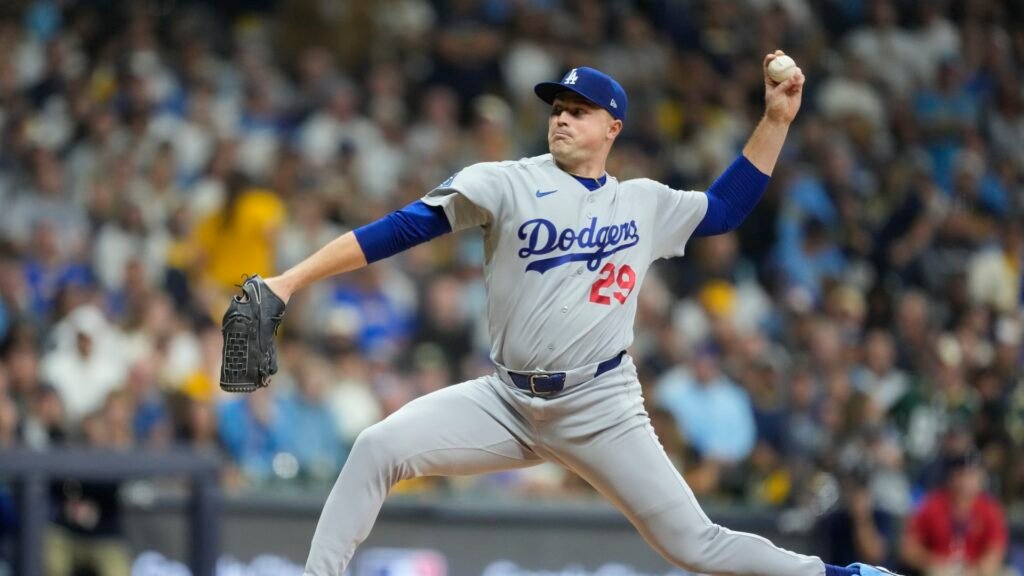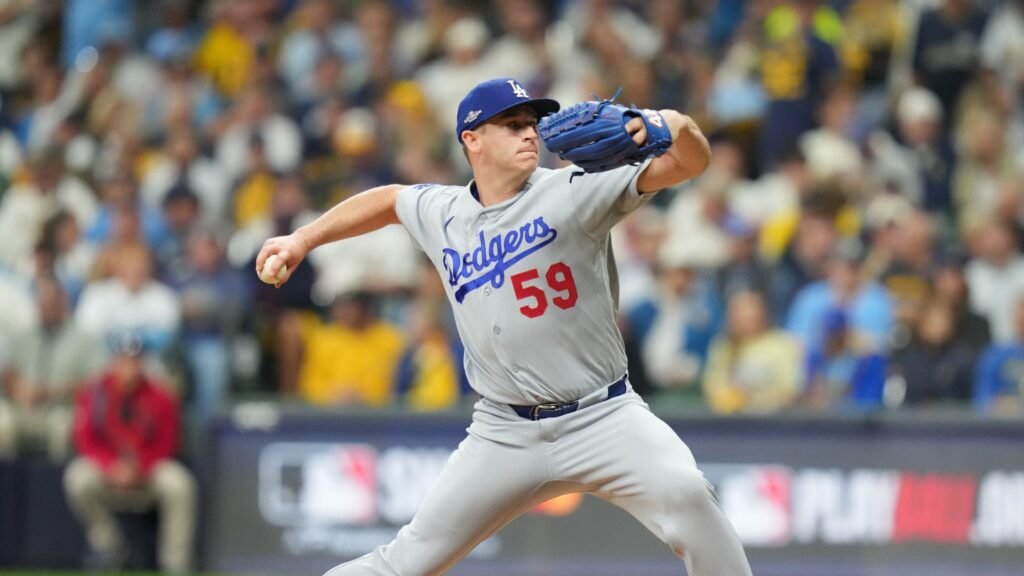
Andrew Vaughn took two Alex Vesia sliders for strikes around a high fastball, reaching a 2–2 count in the sixth. Vesia finished with another four-seamer at 92.2 mph above Vaughn’s recorded upper boundary. Vaughn missed, and Vesia’s second batter was retired after Jake Bauers’ leadoff walk.
Vesia recorded a scoreless inning on 16 pitches in the Dodgers’ 2–1 NLCS Game 1 loss to Milwaukee at American Family Field on October 11. He struck out Vaughn and Garrett Mitchell, allowed no hits and walked Bauers. The remaining out came from the pickoff play that removed Bauers, not another completed strikeout.
No hitter put a ball into play against him. His established fastball-slider pairing produced taken strikes and misses, while the baserunning out resolved the walk. A complete pitching account has to include that non-pitch event without adding it to the 16 physical pitches.
Season repertoire and Game 1
Scale: 0–100%. Gray: regular season. Blue: Game 1.
Four-seam fastball
Change: +0.5 percentage points.
Slider
Change: +13.6 percentage points.
Changeup
Change: -14.0 percentage points.
Slider use rose while the fastball share held
The comparison is 1,011 physical pitches in 72 regular-season Dodgers relief appearances from March 27 through September 27. Vesia threw nine four-seamers and seven sliders in Game 1. His 56.3% fastball share was close to the baseline’s 55.8%, while slider share rose from 30.2% to 43.8%.
Changeups accounted for 14.0% of the season record but none of this short outing. Their absence does not establish that Vesia abandoned the pitch. He faced only Bauers, Vaughn and Mitchell, so selection was constrained by three specific confrontations rather than a full lineup.
Four-seamers averaged 92.4 mph against 92.1 in the baseline; sliders averaged 84.7 against 84.4. The more consequential responses were three misses on five swing attempts and four called strikes. Three of those taken strikes came from sliders, including the two that helped set up Vaughn’s finish.
Andrew Vaughn: inning 6
The walk required a separate route to an out
Bauers worked a seven-pitch walk to open the sixth. The official game sequence records his removal on a pickoff-caught-stealing play. That baserunning event matters to the inning, while its throw is not a Statcast physical pitch in the article’s ledger.
Vaughn’s missed fastball crossed at about 4.15 feet, above his recorded 3.13-foot upper boundary. The event documents a swing at that location, not Vesia’s intended target or a general claim about how Vaughn recognizes pitches. Mitchell’s strikeout then ended on a slider.
With no balls put into play, there is no game exit-speed average or hard-hit rate to report. Missing opportunity is not a zero exit velocity. The method notes keep that distinction explicit alongside the season’s 131 measured contacts.
Vesia’s inning combined a familiar speed pairing, useful slider takes and a baserunning out that removed the only runner. His 60.0% whiff rate comes from five attempts and is descriptive. The result demonstrates the completed escape, while a broader future sample would be required to establish a changed swing response.
Inning samples in context
| Inning | Pitches | Cumulative | Four-seam fastball mph | Measured n | Outs |
|---|---|---|---|---|---|
| 6 | 16 | 16 | 92.4 | 9 | 3 |
Every pitch: 16 of 16
Search a hitter, select an inning or pitch type, then inspect a pitch number. Pitch result and completed plate-appearance outcome are separate columns. The table scrolls within its border.
16 of 16 pitches
No pitches match these filters.
| Pitch | Inning | Hitter | Count before | Type | mph | Pitch result | Completed PA |
|---|---|---|---|---|---|---|---|
| 6 | Jake Bauers | 0–0 | SL | 84.3 | Called Strike | Walk | |
| 6 | Jake Bauers | 0–1 | FF | 91.5 | Ball | Walk | |
| 6 | Jake Bauers | 1–1 | SL | 85.1 | Foul | Walk | |
| 6 | Jake Bauers | 1–2 | FF | 92.8 | Ball | Walk | |
| 6 | Jake Bauers | 2–2 | FF | 92.8 | Foul | Walk | |
| 6 | Jake Bauers | 2–2 | FF | 92.1 | Ball | Walk | |
| 6 | Jake Bauers | 3–2 | FF | 92.9 | Ball | Walk | |
| 6 | Andrew Vaughn | 0–0 | SL | 84.6 | Ball | Strikeout | |
| 6 | Andrew Vaughn | 1–0 | SL | 84.6 | Called Strike | Strikeout | |
| 6 | Andrew Vaughn | 1–1 | FF | 92.5 | Ball | Strikeout | |
| 6 | Andrew Vaughn | 2–1 | SL | 84.0 | Called Strike | Strikeout | |
| 6 | Andrew Vaughn | 2–2 | FF | 92.2 | Swinging Strike | Strikeout | |
| 6 | Garrett Mitchell | 0–0 | SL | 85.1 | Ball | Strikeout | |
| 6 | Garrett Mitchell | 1–0 | FF | 92.2 | Called Strike | Strikeout | |
| 6 | Garrett Mitchell | 1–1 | FF | 92.4 | Swinging Strike | Strikeout | |
| 6 | Garrett Mitchell | 1–2 | SL | 85.4 | Swinging Strike | Strikeout |
Sources, definitions and limitations
The official final MLB record supplies events, final calls and the line. Baseball Savant’s complete Game 1 feed supplies all 16 physical pitches. Pitch ID, order, classification and pre-pitch count reconcile, including final ABS decisions. These records contain 3 batters, 3 integer outs and 2 strikeouts. In baseball notation, .1 means one out and .2 two outs. Source records current as of October 12, 2026. Bauers’ pickoff-caught-stealing out remains a game event outside the physical pitch ledger. No ball was put into play against Vesia, so game contact averages are unavailable rather than zero.
The Statcast Search baseline is 1,011 physical pitches in 72 regular-season relief appearances for Los Angeles Dodgers, 2026-03-27 through 2026-09-27. Each game total reconciles with the official appearance log. Target game, postseason work, other clubs and other roles are excluded.
Whiff rate means misses divided by physical swing attempts. Swinging strikes, blocked swinging strikes, caught foul tips and missed bunts count as misses. Fouls, bunt attempts and balls put into play enter the attempt denominator. Both outing and baseline use the same definitions. Called strikes and completed strikeout plate appearances are separate. Chase uses ball-center coordinates outside a 17-inch-wide rectangle and each pitch’s recorded vertical boundaries. Only complete coordinates enter the zone denominator. Savant’s separate zone flag remains in the CSV and detail rather than replacing that geometric definition.
Speed is mph, spin rpm, extension feet and movement inches. Induced vertical break describes movement relative to a gravity-only path. Location and zone boundaries are feet in catcher view. Numbered markers preserve exact coordinates and are not ball size. Release, location, spin, extension and movement measurements are complete for all outing pitches. Contact and expected-outcome measurements can be unavailable and remain missing in the detail and CSV. 0 of 0 balls put into play have measured exit speed. Hard-hit means at least 95 mph; the baseline has 131 measured contacts among 131. Expected outcomes are Savant model estimates, not actual results. The comparisons are descriptive and do not establish intention, fatigue, injury or a durable trend.