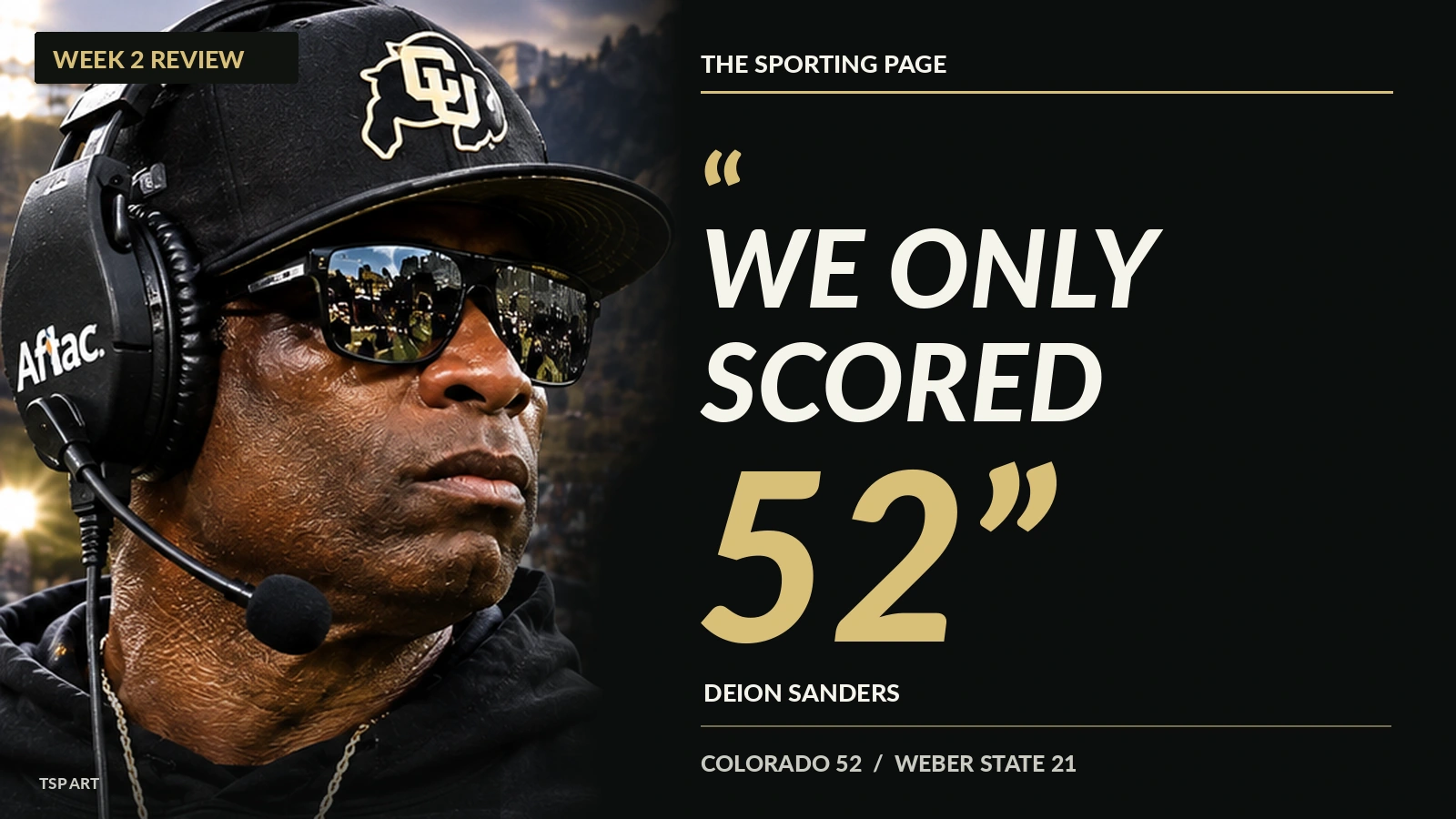
Colorado scored six touchdowns before halftime against Weber State, then spent much of the second half giving Deion Sanders reasons to demand more. The Buffaloes won 52–21 at Folsom Field on September 12, but their coach’s assessment extended well beyond the scoreboard.
“We didn’t capitalize on offense,” Sanders said afterward. “We only scored 52 points.”
The win moved Colorado to 2–0 with 578 yards of offense. It also left the Buffaloes with 13 penalties for 107 yards and two lost fumbles. One holding call pushed a scoring opportunity backward; another erased a touchdown. Those mistakes gave substance to Sanders’ dissatisfaction in a game Colorado led 42–14 at halftime.
The opponent was part of that standard. Weber State had allowed 47 points and 514 yards to Southern Utah the previous week, including 368 rushing yards. Colorado was facing an FCS defense that had already conceded substantial production. Its own scoring opportunities still required the execution Sanders said was missing.
How the passing game opened the afternoon
Lewis completed 17 of 23 passes for 366 yards, with four passing touchdowns and a rushing score. He was 15-of-18 for 331 yards before halftime. Colorado scored touchdowns on six of its eight first-half possessions, including second-quarter drives of 90 and 55 yards, so the production was not confined to the opening burst.
DeAndre Moore Jr. scored from 66 yards on Colorado’s first offensive snap. Two plays later, Joseph Williams turned a short completion into a 63-yard touchdown. Those first two catches gained 129 yards, already more than Colorado’s 124 passing yards in the Week 1 win at Georgia Tech.
The official play record distinguishes the two scores. Moore’s catch came downfield; Williams caught his pass seven yards beyond the line of scrimmage before covering the remaining 56 yards. Both created immediate points, but the routes to those points were different.
Ernest Campbell added a 48-yard touchdown reception, and Williams scored again from 32 yards. Williams finished with four catches for 123 yards, while Moore caught four for 107. The gamebook credits Williams with 71 yards after the catch and Moore with 63.
Micah Welch supplied the longest rushing play, a 55-yard touchdown on third-and-seven to begin the second quarter. He finished with 106 yards on 11 carries. His other 10 attempts gained 51 yards, giving Colorado useful rushing production beyond the touchdown itself.
Weber State coach Eric Kjar credited the protection around Lewis and the receivers’ work downfield. In his postgame assessment, he described a more aggressive passing approach than the one he had seen against Georgia Tech. Sanders also praised Lewis’ statistical performance, even while rejecting the team’s overall execution as sufficient.
Kaneal Sweetwyne led Colorado’s only second-half touchdown drive, finishing it with a nine-yard run on fourth-and-one. Lewis had played the opening possession after halftime, and Isaac Wilson handled the final two. The 10-point second half covered the work of each quarterback, not just the starter.
Where the opportunities went wrong
Colorado’s third possession ended with Teni Worthen stripping Lewis on a sack. Zion Finau recovered at the Colorado 28, and Weber State converted that short field into its first touchdown. Nate Dahle’s 16-yard scramble on third-and-11 kept the possession alive before his 13-yard scoring pass to Robert Young.
The opening drive after halftime offered a different example. Colorado reached third-and-five at the Weber State 14. Lewis completed a pass to JaQuail Smith that appeared to reach the 5, but holding on Chauncey Gooden nullified the gain. A 10-yard sack followed. Instead of continuing near the goal line, Colorado needed Elliott Arnold to make a 52-yard field goal.
Colorado scored on all three official red-zone visits, with two touchdowns and that field goal. The issue on the third-quarter drive was not an empty possession; it was the penalty and sack that turned a promising situation into a long kick.
The Buffaloes later failed to score after a takeaway. Carson Crawford’s fourth-quarter fumble recovery and return gave the offense possession at the Weber State 28. With Isaac Wilson at quarterback, the next three plays produced a one-yard loss, a three-yard run and a two-yard loss. Colorado gained nothing, called timeout and missed a 47-yard field goal.
Sanders also criticized a player who was not ready to join the field-goal unit. His description of someone failing to get onto the field pointed to a readiness problem before the kick, separate from the miss itself.
The closing possession put the discipline problem into its clearest form. Titus Bautista gained seven yards on his first carry, then broke an apparent 73-yard touchdown run. Holding on tight end Zayne DeSouza erased the score.
“It’s hard to even look the kid in the eye,” Sanders said of the runner whose opportunity had been taken away.
Sanders praised Bautista for executing when his opportunity arrived and attributed the hold to the blocker’s failure to get his feet into position. Bautista’s official line remained one carry for seven yards. The mistake belonged in the evaluation even though Colorado no longer needed the points to win.
The defense adjusted, but third-and-long remained a problem
Weber State’s production was not all accumulated late. The Wildcats had 233 yards and 14 points before halftime, including Noah Kjar’s 70-yard reception on third-and-10 to set up their second touchdown.
The play-by-play shows five Weber State conversions requiring at least eight yards. Four came before halftime; the fifth was Young’s 15-yard catch on third-and-13 in the third quarter. Colorado had put Weber State into difficult situations without consistently completing the stop.
Dahle finished 20-of-48 for 244 yards, with three touchdowns and an interception. Noah Kjar caught seven passes for 121 yards and two scores. Colorado forced plenty of incompletions, but did not consistently finish possessions after creating favorable down-and-distance situations.
There were adjustments and successful responses. In his postgame comments, Sanders credited Boo Carter’s move into the slot and praised Jason Stokes Jr. for being ready to take the opportunity outside. Stokes broke up three passes, including the fourth-down attempt that ended a third-quarter possession. Kjar also described Colorado increasing its pressure and making Weber State’s protection work harder.
Lamont Lester Jr. recorded a seven-yard sack on third-and-10 with 33 seconds left before halftime. After Carter muffed the ensuing punt, Toby Anene sacked Dahle and forced a fumble on Weber State’s next snap. The Wildcats recovered their own fumble, but the half ended without another score.
Tyler Martinez’s assessment supplied another corrective. The linebacker acknowledged two or three missed tackles of his own and identified technique as something the defense needed to address. Randon Fontenette, who intercepted Dahle, emphasized leverage and trust between defenders rather than blaming the scheme.
Weber State finished with 127 rushing yards, 74 of them after Colorado had moved ahead 52–14. The long third-down conversions were an earlier problem: four had already occurred before halftime, when the Wildcats scored twice.
Special teams needed cleaner operation
Carter’s muff gave Weber State possession at Colorado’s 20 with 13 seconds left before halftime. Anene’s sack and forced fumble were the last play of the half, leaving the Wildcats without points from the turnover.
Colorado also took two delays before punts and two accepted penalties after kickoff returns. Together, those special-teams fouls accounted for 27 of the team’s 107 penalty yards. Sanders’ complaint about the operation of the units was therefore separate from whether a particular kick was successful.
Arnold made all seven extra points and the 52-yard field goal before missing from 47. Damon Greaves averaged 51 yards on three punts, with two inside the 20. The kickers produced useful field position and points while the units around them still struggled with their operation.
Week 2 snapshot
| Measure | Colorado | Weber State |
|---|---|---|
| Points | 52 | 21 |
| Total yards | 578 | 372 |
| Passing yards | 398 | 245 |
| Rushing yards | 180 | 127 |
| Third downs | 6 of 13 | 8 of 17 |
| Penalties | 13 for 107 yards | 6 for 55 yards |
| Turnovers lost | 2 | 2 |
Five performances under review
TSP grades weigh production against the opponent and the job required, informed by coaching assessments. Week 1 letters are shown as originally published; the stricter standard applies to this week. Limited-sample and component grades are identified rather than presented as full-game assessments.
NO. 10 · QUARTERBACK
Julian Lewis
Game contribution
17 of 23 · 366 passing yards · 4 passing TD · 1 rushing TD · 1 lost fumble
Week 1: C+
A substantial passing improvement, with the lost fumble preventing a clean afternoon.
Read the assessment
Lewis converted Colorado’s early advantages into touchdowns and was far more productive than in Atlanta. His completion rate rose from 51.9% to 73.9%, and his passing average climbed from 4.6 to 15.9 yards per attempt. That is a clear improvement from our original Week 1 C+.
The lost fumble keeps this below the top tier. It handed Weber State the short field for its first touchdown, while Lewis’ last possession was less efficient: 2-of-5 for 35 yards before Colorado settled for the field goal. Sanders praised his numbers but wanted cleaner offensive execution. The B rewards the improvement while accounting for the ball-security failure.
From Atlanta to the home opener
| Measure | Week 1 | Week 2 |
|---|---|---|
| TSP grade | C+ | B |
| Passing | 14 of 27 | 17 of 23 |
| Completion rate | 51.9% | 73.9% |
| Passing yards | 124 | 366 |
| Yards per attempt | 4.6 | 15.9 |
| Passing touchdowns | 1 | 4 |
| Interceptions | 0 | 0 |
| Lost fumbles | 0 | 1 |
“Two and zero is not the end goal.”
Julian Lewis, postgame · CU Athletics transcript
NO. 56 · DEFENSIVE LINE
Lamont Lester Jr.
Game contribution
2 tackles · 1 sack · 1.5 tackles for loss
Week 1: A+ (original)
Another third-down sack, following the three-sack opener that earned last week’s A+.
Read the assessment
Lester’s sack with 33 seconds left in the first half forced Weber State to punt. He also shared a stop for a loss near Colorado’s goal line. The sack brought his total to four through two games, following his three against Georgia Tech.
The B recognizes that third-down impact and his contribution near the goal line. His documented influence was more limited than in the three-sack opener, but he again produced a play that ended a Weber State possession. Last week’s original A+ remains the comparison point, not an automatic expectation of three sacks every game.
NO. 8 · WIDE RECEIVER
Joseph Williams
Game contribution
4 targets · 4 catches · 123 yards · 2 TD · 71 yards after catch
First featured grade this season
Colorado’s most productive receiver also contributed beyond his two scoring catches.
Read the assessment
Williams caught all four of his targets. His 10- and 18-yard receptions helped the final touchdown drive before halftime, while his work after the catch was central to the first of his two scores.
The B+ reflects a strong receiving performance against this opponent, with the work after the catch carrying considerable value. Williams’ own assessment was less satisfied than his perfect catch rate might suggest; he said there was still more to get from his game and the offense.
“But I still felt like I didn’t play my best.”
Joseph Williams, postgame · CU Athletics transcript
NO. 34 · RUNNING BACK
Titus Bautista
Limited sample: rushing
Officially: 1 carry · 7 yards · 0 TD
Limited-sample assessment
The runner Sanders praised is assessed separately from the penalty that erased his apparent touchdown.
Read the assessment
Bautista gained seven yards on his first carry and then reached the end zone on a run that was nullified by DeSouza’s hold. Sanders specifically praised the way he took his opportunity. That coaching assessment supports a positive mark for the brief rushing appearance.
The limited-sample B credits his response when called upon. His official production remains seven rushing yards; the canceled touchdown is not added back.
NO. 83 · TIGHT END
Zayne DeSouza
Component: blocking / discipline
1 holding penalty · 10 enforced yards · apparent TD erased
Component assessment
The documented blocking mistake took away Bautista’s scoring opportunity.
Read the assessment
DeSouza was the player named on the holding penalty that nullified the final apparent touchdown. Sanders explained the failure in terms of the blocker’s feet not getting into position to do the job. The result was a lost scoring play for a teammate who had just received his opportunity.
The component D reflects a consequential failure in that blocking assignment. The game being decided did not make discipline optional or reduce the value of Bautista’s opportunity.
Statistics: official gamebook. Grades: The Sporting Page. Complete individual snap counts were not available for this edition.
What carries into Northwestern
Colorado’s next game is at Northwestern on September 19. The passing improvement gives the Buffaloes something tangible to carry into that trip. The opponent’s first-half scoring drives and Colorado’s own penalties provide equally specific work for the next practice week.
Colorado established a passing threat that was missing for most of the opener. Carrying it into the next game means keeping the successful execution without repeating the penalties that made other possessions harder than they needed to be.