
MLB · Pitching Data
Armstrong’s Nine Pitches: Three Soft Outs and a Run Charged After His Exit
His seven-pitch first inning and one-run final line describe different parts of a nine-pitch opener assignment.
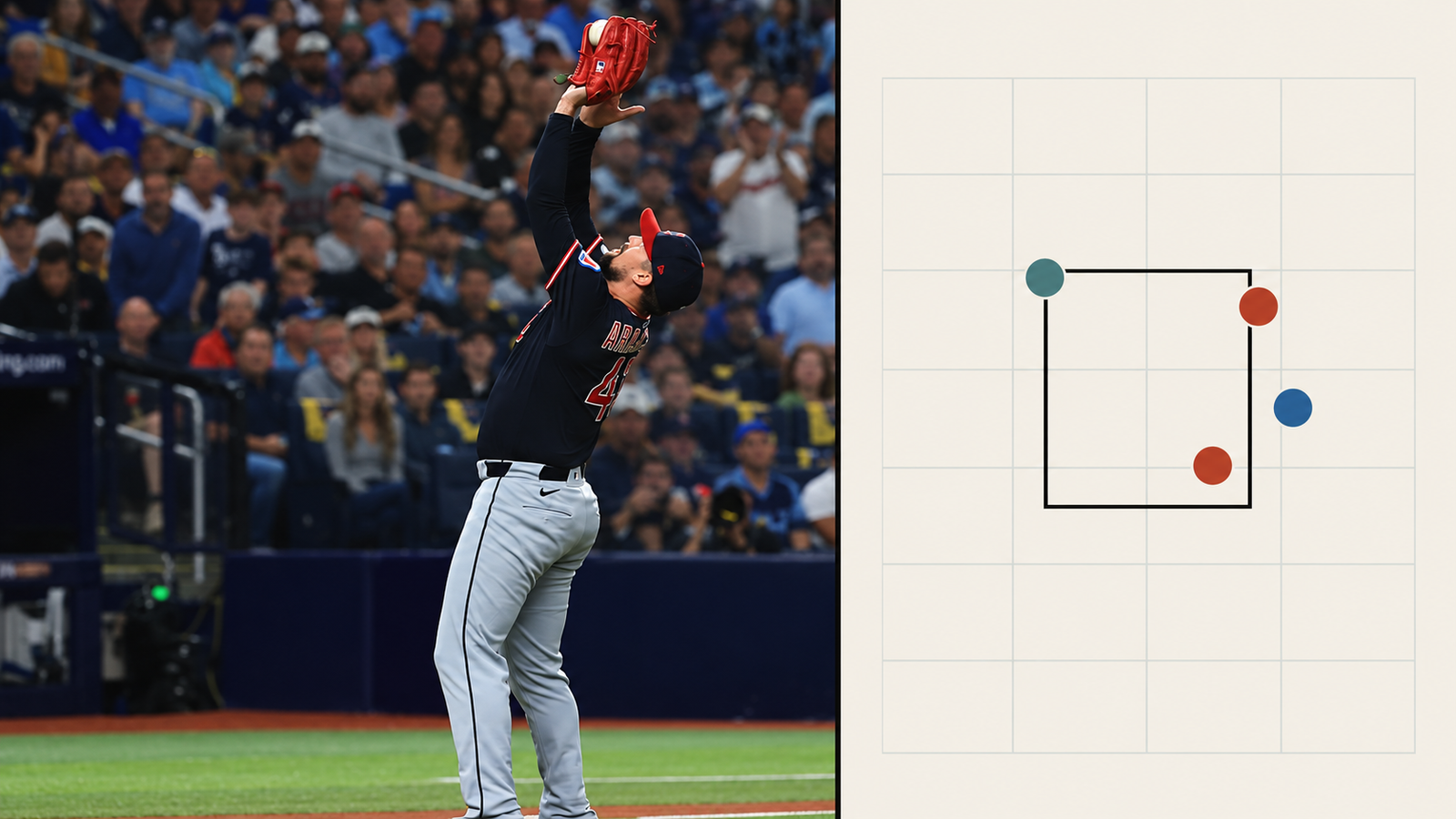
Liam Hicks lifted Shawn Armstrong’s 92.2-mph four-seamer almost straight up in the first inning. The ball left the bat at 54.6 mph with a 77-degree launch angle, and Armstrong caught it himself. Cleveland’s opener had three outs after seven pitches, without a strikeout or a ball struck at 95 mph.
The final line was less tidy: one inning, one hit and one earned run in Tampa Bay’s 7–3 ALCS Game 6 victory at Tropicana Field on October 19. Armstrong returned for the second inning, allowed Junior Caminero’s single and departed without recording another out. The run charged to him scored later, after a force play had replaced the runner he originally allowed.
The complete nine-pitch record therefore separates two things. Armstrong obtained weak contact during the first turn through three hitters. He also left a baserunner who carried an earned-run responsibility into Cleveland’s relief sequence. Neither the early efficiency nor the eventual run alone explains the whole appearance.
Four classifications, five swings and no misses
Armstrong began Yandy Díaz with an 84.6-mph sweeper for a called strike. A sinker was taken for a ball, a cutter produced a foul, and a 91.5-mph sinker became a 70.5-mph groundout. Four different results brought him from 0–0 to the first out; the final pitch did not do that work alone.
Jonathan Aranda then popped up an 84.6-mph sweeper at 64.2 mph. Hicks took a sweeper for a ball before the four-seamer produced the second popup. Those three balls in play were all below the 95-mph hard-hit threshold. They explain the quick first inning more directly than a missing-bat argument: Armstrong had zero recorded whiffs in five total swings during the outing.
He threw four sweepers, two cutters, two sinkers and one four-seamer. Sweepers accounted for 44.4%, compared with 28.0% in the frozen regular-season sample. That comparison contains 628 physical pitches in 41 Cleveland relief appearances from March 26 through September 26. Game 6 was a starting opener assignment, so role and nine-pitch opportunity both limit any claim of changed strategy.
The sweepers averaged 84.9 mph across four pitches, close to their 84.5-mph regular-season average. The single four-seamer was 92.2 mph, below a 93.5-mph season average but far too little evidence for a velocity trend. All four season classifications appeared in this outing; their shares describe which pitches happened to be used against these four hitters.
Season repertoire and Game 6
Scale: 0–100%. Gray: regular season. Blue: Game 6.
Sweeper
Change: +16.4 percentage points.
Cutter
Change: -1.8 percentage points.
Sinker
Change: +5.2 percentage points.
Four-seam fastball
Change: -19.8 percentage points.
| Type | Pitches | Share | Mean mph | Max mph | Speed n | Whiffs / swings | Called strikes | IVB in | Spin rpm |
|---|---|---|---|---|---|---|---|---|---|
| Sweeper | 4 | 44.4% | 84.8 | 85.2 | 4 | 0/2 | 1 | 11.9 | 2571 |
| Cutter | 2 | 22.2% | 89.2 | 89.3 | 2 | 0/1 | 0 | 8.3 | 2450 |
| Sinker | 2 | 22.2% | 92.0 | 92.4 | 2 | 0/1 | 0 | 12.9 | 2133 |
| Four-seam fastball | 1 | 11.1% | 92.2 | 92.2 | 1 | 0/1 | 0 | 17.9 | 2341 |
IVB is induced vertical break relative to a gravity-only trajectory. It does not mean the ball rises. Rates and average measurements describe this appearance.
Yandy Díaz: inning 1
The charged run followed a force-out replacement
Caminero opened the second by taking an 89.3-mph cutter for a ball, then lining an 85.2-mph sweeper into center for a single. Its measured exit speed was 78.9 mph. It was the hardest of the four balls put in play against Armstrong, but still below the hard-hit threshold. The soft contact yielded a hit rather than another out.
Tim Herrin replaced Armstrong with Caminero at first and none out. Chandler Simpson then grounded into a force play that retired Caminero at second. Simpson reached first and later scored on Richie Palacios’s double. The official runner record explicitly assigns Simpson’s run to Armstrong, preserving the original pitcher’s responsibility through the force-out replacement.
That sequence matters because simply saying Armstrong’s runner later scored would obscure what happened. Caminero did not cross the plate. Simpson did, and the official scoring still charged Armstrong with an earned run. Victor Mesa Jr. also scored on the double, but that runner belonged to Herrin. The two pitchers’ lines must remain separate.
Armstrong’s recorded innings remain 1.0 because he collected three outs in the first and none in the second. His early contact outcomes support a descriptive finding: three softly hit outs allowed a seven-pitch first inning. The next two pitches produced a softly hit single and the end of his appearance. Nine pitches cannot establish a durable contact-suppression skill or a changed repertoire; they can show exactly how an efficient opening became a one-run line after departure.
Inning samples in context
| Inning | Pitches | Cumulative | Sweeper mph | Measured n | Outs |
|---|---|---|---|---|---|
| 1 | 7 | 7 | 84.7 | 3 | 3 |
| 2* | 2 | 9 | 85.2 | 1 | 0 |
Every pitch: 9 of 9
Filter by pitcher, hitter, inning or pitch type. Pitch numbers belong to the named pitcher’s own outing. Select a number for the full measurement record. Pitch result and plate-appearance result or interruption are separate.
9 of 9 pitches
No pitches match these filters.
| Outing pitch | Pitcher | Inning | Hitter | Count before | Type | mph | Pitch result | PA result / interruption |
|---|---|---|---|---|---|---|---|---|
| Shawn Armstrong | 1 | Yandy Díaz | 0–0 | ST | 84.6 | Called Strike | Groundout | |
| Shawn Armstrong | 1 | Yandy Díaz | 0–1 | SI | 92.4 | Ball | Groundout | |
| Shawn Armstrong | 1 | Yandy Díaz | 1–1 | FC | 89.1 | Foul | Groundout | |
| Shawn Armstrong | 1 | Yandy Díaz | 1–2 | SI | 91.5 | In play, out(s) | Groundout | |
| Shawn Armstrong | 1 | Jonathan Aranda | 0–0 | ST | 84.6 | In play, out(s) | Pop Out | |
| Shawn Armstrong | 1 | Liam Hicks | 0–0 | ST | 85.0 | Ball | Pop Out | |
| Shawn Armstrong | 1 | Liam Hicks | 1–0 | FF | 92.2 | In play, out(s) | Pop Out | |
| Shawn Armstrong | 2 | Junior Caminero | 0–0 | FC | 89.3 | Ball | Single | |
| Shawn Armstrong | 2 | Junior Caminero | 1–0 | ST | 85.2 | In play, no out | Single |
Sources, definitions and limitations
The official final MLB record supplies events, final calls, pitching lines and runner responsibility for Cleveland at Tampa Bay on October 19, 2026. Baseball Savant’s complete gamefeed supplies tracking measurements. Both were retrieved October 21, 2026, at approximately 17:35 UTC (11:35 a.m. MDT). The final score was Tampa Bay 7, Cleveland 3. Complete physical pitch identifiers, sequence, counts before each pitch, batters faced, strikeouts and integer outs were reconciled against the official record. Automatic count events, pickoffs and other nonpitch events are separate; none adds a physical pitch. Final calls after challenges are retained.
Shawn Armstrong: 9 physical pitches, with speed, spin, extension, induced vertical break, horizontal movement, plate coordinates and recorded vertical boundaries available for every pitch. Measured exit speed is available for 4 of 4 balls in play. No missing measurement is replaced with zero.
The fixed primary baseline contains 628 physical pitches in 41 2026 regular-season relief appearances for Cleveland Guardians, 2026-03-26 through 2026-09-26. 2026 Cleveland regular-season relief appearances. Game6 was an opener assignment; this role difference and nine pitches limit the comparison. The frozen regular-season tracking export was reconciled against official appearance logs. All postseason games, including the target outing, are excluded. Game6 was an opener start, while the regular-season comparison contains relief appearances.
Pitch share uses all physical pitches, retaining uncommon season classifications and types unused in this outing. A change in share is in percentage points. Conventional tracking whiffs include swinging strikes, blocked swinging strikes, caught foul tips and missed bunts. The swing denominator includes those events, fouls, bunt attempts and balls in play. A caught foul tip involves contact and is not a literal swing-and-miss. Called strikes and completed strikeout plate appearances are counted separately. The three outings here contain no caught foul tips or bunt attempts.
The descriptive zone uses the ball’s center within a 17-inch-wide rectangle and each pitch’s recorded vertical boundaries. Chase means a swing outside that rectangle, excluding missing coordinates. This does not recreate an umpire or ABS ruling: ball size, recorded boundaries and the source’s own zone classification can differ. The original Savant zone flag remains in each pitch’s detail. Locations are in feet from catcher view; speed is mph, spin rpm, extension feet and movement inches. Induced vertical break is relative to a gravity-only trajectory and does not mean a pitch physically rises.
Hard-hit contact is a measured exit speed of at least 95 mph. Savant expected contact values are model estimates, separate from actual hits and outs. Baseball innings use integer outs: 5.1 means 5⅓ innings, 0.1 one out and 1.0 three outs. Inherited-run responsibility follows the official scoring record, including force-out replacements. A single outing, especially three or nine pitches, does not establish intention, fatigue, injury or a lasting trend.