

MLB
José Ramírez Is Finding His Power Again, and Cleveland Is Following
After a hand injury diminished his power, José Ramírez is driving Cleveland’s postseason run. The contact data and Game 5 video show what has improved, and what remains uncertain.
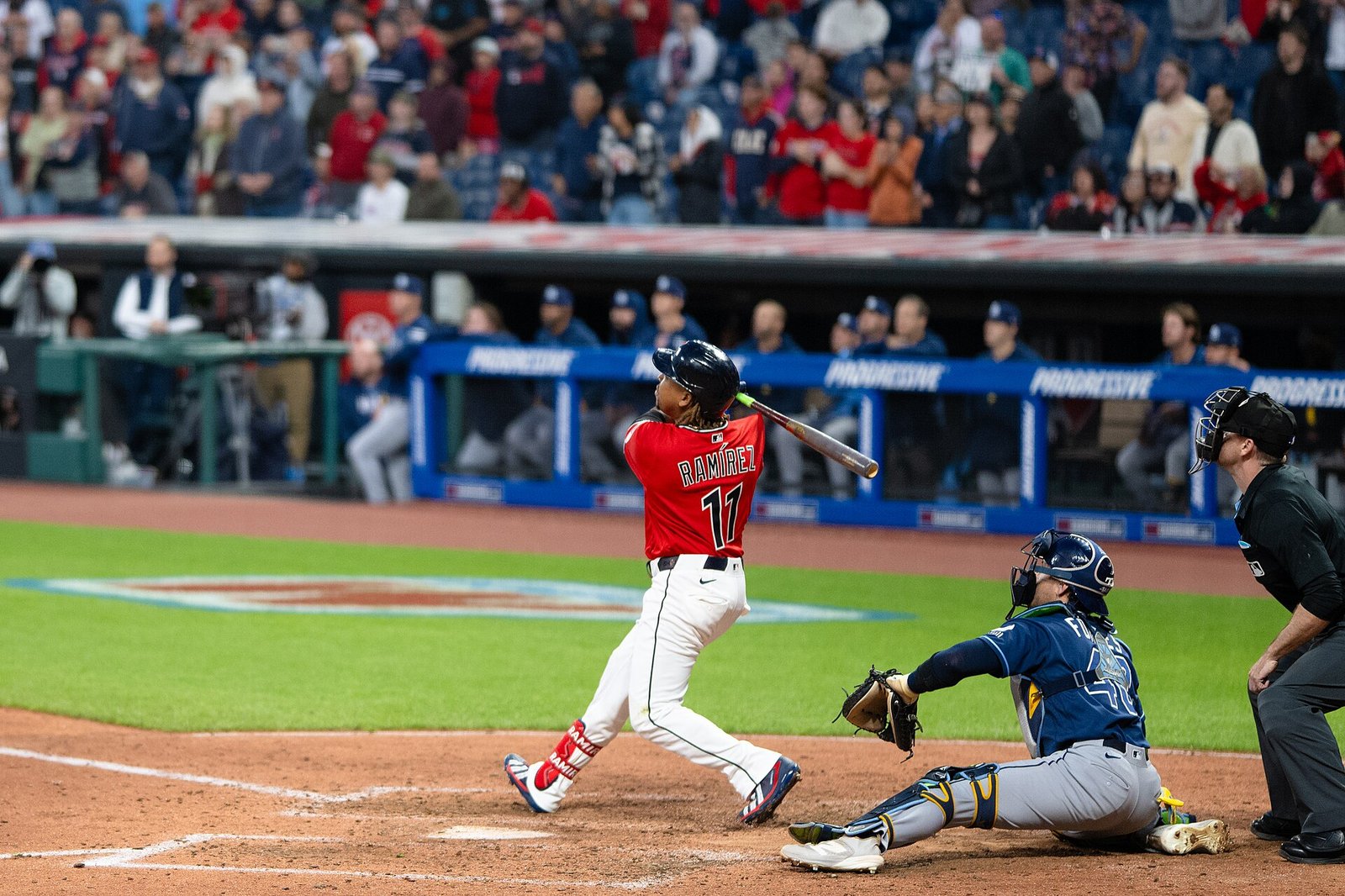
José Ramírez needed eight pitches to get through his first plate appearance in the American League Championship Series. The result was a single, a modest opening to a night in which he would collect three hits, make a leaping catch and help Cleveland win again. Two nights after hitting the home run that decided the division series, he was contributing in smaller increments.
That range matters in assessing his October. The Guardians’ third baseman has spent much of the season trying to produce with a hand that has not felt right since June. His recent power is an encouraging change. His willingness to work through an at-bat, get aboard and make the next play is a more familiar part of his game.
Across Cleveland’s four consecutive wins from October 7 through October 12, Ramírez went 8-for-17 with two home runs, a double and a triple. He drove in eight runs and scored seven. The Guardians recovered from an 0-2 deficit against the White Sox and then won ALCS Game 1 against Tampa Bay, 7-3. The improvement at the plate, however, had begun before those elimination games.
The injury behind the missing power
Ramírez fractured his left hamate on June 13 and underwent surgery to remove the fractured hook of the bone on June 16. He returned July 22. Returning to the lineup and returning to his usual offensive production proved to be different stages of the season.
In his first 44 games back, through September 15, he hit one home run in 188 plate appearances. His .263 slugging percentage reflected how rarely he was getting extra bases. Statcast recorded no barrels in that stretch, and just 41 of his 148 tracked batted balls reached 95 mph, the threshold for a hard-hit ball.
The injury was still relevant in October. In MLB.com’s October 6 reporting, Ramírez acknowledged that his wrist felt better on some days than others. Stephen Vogt said he had not been fully healthy since June. TSP’s earlier Pedro Martínez, Jimmy Rollins and Curtis Granderson discussion addressed the context behind his struggles.
It would go too far to assign every disappointing result to the fracture. Through June 13, Ramírez was already hitting .239 with a .418 slugging percentage and 10 home runs in 72 games. The post-surgery falloff was substantial, but his season had not been a straight line from dominant production to injury. Nor do a few successful October swings establish that his hand has fully recovered.
The recovery began before the headline swings
The most useful dividing point is September 16. From that date through the end of the ALDS, Ramírez hit .304 and slugged .571 in 64 plate appearances. His hard-hit rate rose to 52 percent, nearly twice the rate from the first stretch after his return. These are small samples, particularly the later one, but the combination of better results and stronger contact is more persuasive than batting average alone.
| Period | PA | HR | AVG / SLG | Hard-hit balls |
|---|---|---|---|---|
| Through June 13 | 314 | 10 | .239 / .418 | 100/227 (44.1%) |
| July 22–September 15 | 188 | 1 | .210 / .263 | 41/148 (27.7%) |
| September 16–October 10 | 64 | 3 | .304 / .571 | 26/50 (52.0%) |
There is an important switch-hitting detail inside that comparison. His later sample contained a larger share of right-handed swings, so combining both sides can exaggerate how much changed within either one. Even after separating them, the direction is the same: his hard-hit rate rose from 24.8 to 42.3 percent batting left-handed and from 35.9 to 62.5 percent batting right-handed. The later groups contain only 26 and 24 tracked balls, respectively.
That is evidence of a broader improvement in contact, rather than a surge confined to one side. It does not identify the cause. Health, timing, the pitches he received and ordinary variation can all influence such short stretches. His hitless first two ALDS games also show why declaring a recovery from any single night would have been premature.
A small move on a very low pitch
The most consequential swing came in the fourth inning of Game 5. Sean Burke threw a knuckle-curve that crossed the plate just 0.74 feet above the ground. Ramírez reached it and sent it out for the two runs in Cleveland’s 2-0 victory. The pitch was difficult enough to make the swing look improvised, but his postgame explanation described preparation.
In his clubhouse interview, speaking through an interpreter, Ramírez said he knew Burke’s repertoire and had been looking for the slower pitch. That account adds a strategic element to the highlight: he was prepared to attack a pitch the pitcher could reasonably expect to be difficult to drive.
Mark DeRosa drew attention to the front foot in MLB Network’s analysis, identifying a toe tap on the homer. The replay shows a compact move into the swing. It offers a specific mechanical detail to examine, but a two-strike swing against one breaking ball cannot establish a permanent replacement for Ramírez’s leg kick. A hitter can vary his move with the count and the pitch he anticipates.
The distinction is useful. The video shows how he succeeded on that pitch; the longer run of batted-ball data shows that his contact had improved. Neither proves that the toe tap restored his power. Ramírez’s own explanation emphasized recognizing what Burke might throw and executing against it. TSP’s Game 5 pitching study places that mistake within Burke’s outing.
The example Cleveland follows
Game 1 of the ALCS expanded the picture. Ramírez’s first-inning single came after a prolonged at-bat. In the sixth, with Cleveland trailing, he jumped to take a line drive away from Jonny DeLuca. His eighth-inning infield single helped begin the go-ahead sequence, and his ninth-inning RBI single added another run after Cleveland successfully challenged the initial out call at first base.
There were limits, too. Tampa Bay caught him stealing in the first inning. His aggression does not make every decision successful, and the Guardians’ win depended on contributions around him. Chase DeLauter had three hits, including a homer and double; Patrick Bailey homered; Nathaniel Lowe and Jo Adell each drove in two runs. Ramírez’s value was in helping those opportunities develop.
Craig Albernaz, who worked on Cleveland’s staff before becoming Baltimore’s manager, described the daily work behind that influence in Jake Rill’s MLB.com report: “He works every single day like his job is going to be taken.” It is a more specific explanation of leadership than the familiar description of a star carrying a club.
After Game 5, Ramírez’s interpreter conveyed the satisfaction of reaching this point: “It hasn’t been an easy year, but here we are celebrating.” By the end of the ALCS opener, his postseason line stood at 8-for-23 with two homers and eight RBIs. Cleveland was getting the big swings again, along with the at-bats and defensive plays that kept him involved when the power was harder to find.
Sources, video and data methods
Statistics cover games through October 12, 2026. TSP calculated the displayed splits from MLB official game logs and Baseball Savant pitch records. The September 16–October 10 period combines the regular season and ALDS and contains 14 games. Hard-hit means at least 95 mph off the bat, among balls with recorded exit velocity; it is not a measure of medical recovery. Statcast player data; surgery reporting; complete Game 5 clubhouse interview. The injury and preparation accounts are attributed reporting, not interviews conducted by TSP.
Cover photograph: José Ramírez in Cleveland on April 28, 2026, by Erik Drost, via Wikimedia Commons, CC BY 4.0. Resized; no added text. This is an archival regular-season photograph.
.jpg)