Carlos Alcaraz’s Shanghai defeat showed how vulnerable a successful comeback can remain in a close match. Six days after defending his Tokyo title, he lost 7–5, 7–6(4) to Zizou Bergs in the Shanghai Masters third round on October 12. He had chances to extend the contest, but the decisive points belonged to his opponent. That is a competitive setback within a return that has already produced substantial results.
The distinction matters because Alcaraz’s season was interrupted for more than four months by a right wrist injury. His first tournament back ended in a US Open quarterfinal, and his next ATP tournament ended with a trophy. Those outcomes establish that he can compete through a major draw and win a title again. Shanghai supplies a different test: whether he can reproduce his best decisions and execution when another player is serving well and refusing to retreat.
The interruption behind the results
Alcaraz’s absence began in Barcelona in April. After beating Otto Virtanen on April 14, he withdrew from the tournament because of wrist trouble. In the ATP’s account of his withdrawal, he described discomfort during the match and tests that indicated a more serious problem than he had initially expected. The season’s interruption therefore began with a completed match, followed by a decision that he could not continue the event.
The following withdrawals progressively removed whole sections of the calendar. He missed Rome and Roland Garros, then announced he would also miss Queen’s Club and Wimbledon. The May announcement described improvement that was still insufficient for a return to competition. A player can be progressing in recovery while remaining unable to meet the demands of tournament tennis.
By the time New York approached, Alcaraz had also missed the summer events in Canada and Cincinnati. The ATP’s August return account described a gradual increase in training in Murcia. That chronology is essential to interpreting his autumn. His recent results come after a long break from competition that removed the usual sequence of clay, grass and summer hard-court matches.
The public accounts establish the timing and the reason for the absence. They do not supply a clinical assessment of the wrist after Shanghai or a measurement of how completely his former match rhythm has returned. Those questions cannot be settled by the score of one defeat. Alcaraz’s own descriptions of his condition and the performances he has completed provide narrower, useful evidence.
The standard is also unusually high because Alcaraz had already won the Australian Open before the injury. He returned as a major champion whose season had stopped, rather than a player discovering the level for the first time. Reaching another quarterfinal therefore needs two contexts: it was progress after a long absence, and it still fell short of the titles he had won before that absence. Both descriptions can be accurate without turning every defeat into a failed recovery.
New York tested endurance and competitive range
At the US Open, Alcaraz reached the last eight before Ben Shelton beat him in five sets. The September 9 match report records a contest lasting four hours and 28 minutes, decided by a first-to-10 tiebreak in the fifth set. Alcaraz won the opener, lost the next two sets, then won the fourth 6–1. His return was already demanding sustained work against an elite opponent.
He had dropped only one set before that quarterfinal. That earlier efficiency and his ability to force a fifth set complicate any account of the comeback as a player merely managing to appear on court. There was evidence of high-level tennis across the tournament, followed by a defeat in which a small closing sequence determined the result.
His reaction also established the initial benchmark. He said he had been physically tired after the third set, then found enough energy to continue. In his postmatch comments, he said: “I leave the court with a smile, healthy, and this is what I needed.” That was Alcaraz’s assessment of the experience. It supplies his account of how he felt that night; the demands of later tournaments remained to be tested.
Shelton’s serving shaped the finish. Alcaraz explained the pressure of trying to put a return into play when an opponent might win a free point. The observation is relevant to Shanghai because it identifies a recurring competitive problem without claiming the two defeats had an identical cause. Good movement and shotmaking still need opportunities to operate; a powerful, effective serve can restrict those opportunities.
Tokyo supplied a different answer
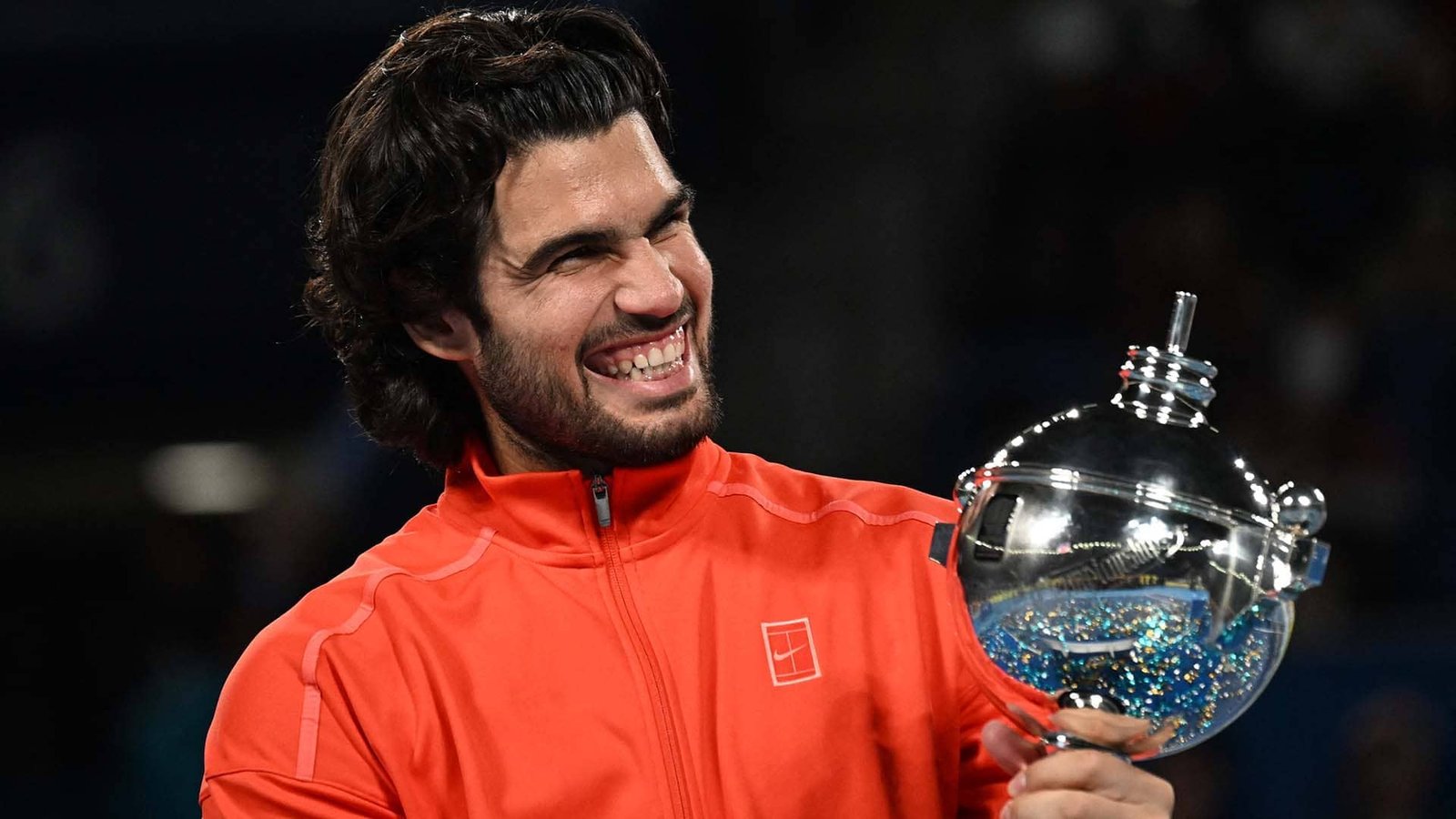
Alcaraz beat Jiri Lehecka 7–6(4), 6–4 in the Tokyo final on October 6. It was his first title since Doha in February and his third of 2026, after the Australian Open and Doha. The tournament was evidence of a comeback advancing from participation to winning. It also required him to solve problems within matches, rather than demonstrate uninterrupted superiority throughout the week.
He needed three sets against Alex Michelsen and Jaume Munar. In the final, Lehecka broke him in the opening game. Alcaraz recovered that break, then turned a 2–4 deficit in the first-set tiebreak into a 7–4 win by taking five consecutive points. In the second set, the decisive break came in the seventh game, according to the official final report.
The video shows the variety that allowed him to keep finding different answers, with attacks from the baseline alongside touches closer to the net. Those selected points support an account of his available skills, while the score sequence establishes when he used them successfully. A highlights reel cannot measure how consistently he produced that level across every game.
Alcaraz vs. Lehecka: the Tokyo final
Credit: ATP Tour / Tennis TV · Event: 2026-10-06
Alcaraz won 33 of 39 points behind his first serve in the final, about 85 percent. When his own service points were so productive, he had more scope to keep searching for the opening on Lehecka’s serve. Winning a close first set and then securing the second-set break showed that he could translate that protection into a title. The result was stronger evidence than an isolated spectacular shot.
The serving figures from Tokyo and Shanghai describe different players against different returners. They cannot measure a decline in Alcaraz by themselves. Their value is to show the circumstances of each contest: in Tokyo, his first serve protected him while he sought a break; in Shanghai, Bergs enjoyed that protection against him. Establishing a lasting change in Alcaraz’s own serving or returning would require comparable results over more matches, with opponents and conditions taken into account.
Shanghai reversed the closing sequence
Bergs presented an opponent whose first serve was effective and whose aggression continued after the serve. The Belgian won about 79 percent of his first-serve points in Shanghai and attacked forward when he could. The match breakdown explains those patterns in more detail. For the comeback question, their importance is that Alcaraz was facing someone capable of denying him comfortable starts to return points.
Alcaraz still recovered when Bergs served for the match at 6–5 in the second set, as the video scoreboard shows. He then drew level at 4–4 in the tiebreak. The opportunity to take the match into a third set was real. Bergs won the final three points instead, ending Alcaraz’s seven-match winning streak. Tokyo’s successful closing burst had been followed by a finish in which he could not produce the same result.
Bergs vs. Alcaraz: the Shanghai turning points
Credit: Tennis TV / ATP Media · Event: 2026-10-12
Alcaraz’s Shanghai reaction focused on his level and the important moments. “In a few important moments I didn’t play my best,” he said. His comments support an execution problem in this match. They do not establish that the wrist caused the loss, or that fatigue from Tokyo explains the result. Those causal claims would require evidence beyond the sequence of tournaments.
What the comeback has established
New York demonstrated that Alcaraz could sustain a demanding major return. Tokyo demonstrated that he could win again, including through difficult situations. Shanghai demonstrated that those achievements do not guarantee successful execution at the end of another close set. Each result answers a different part of the comeback question, and the defeat should be assessed alongside the evidence that preceded it.
The unresolved issue is consistency across those situations. A few important points can decide a match without measuring the entire state of a player’s recovery. Alcaraz has returned with enough competitive range to reach a major quarterfinal and win Tokyo. In Shanghai, Bergs served and attacked well enough to make him prove that range again, and won the closing points when the opportunity was still open.