About this feature: Published September 7, 2026. Statistics, standings and games remaining below reflect play through September 6, 2026.
Munetaka Murakami’s 30th home run did not arrive during the hottest stretch of his first Major League season. It came after 74 consecutive plate appearances without one.
On Saturday night at Rate Field, Minnesota Twins right-hander Taj Bradley threw Murakami a 92.6 mph splitter with a 2-2 count in the first inning. Murakami drove it to left field at 103.6 mph. The ball carried 345 feet and became home run No. 30.
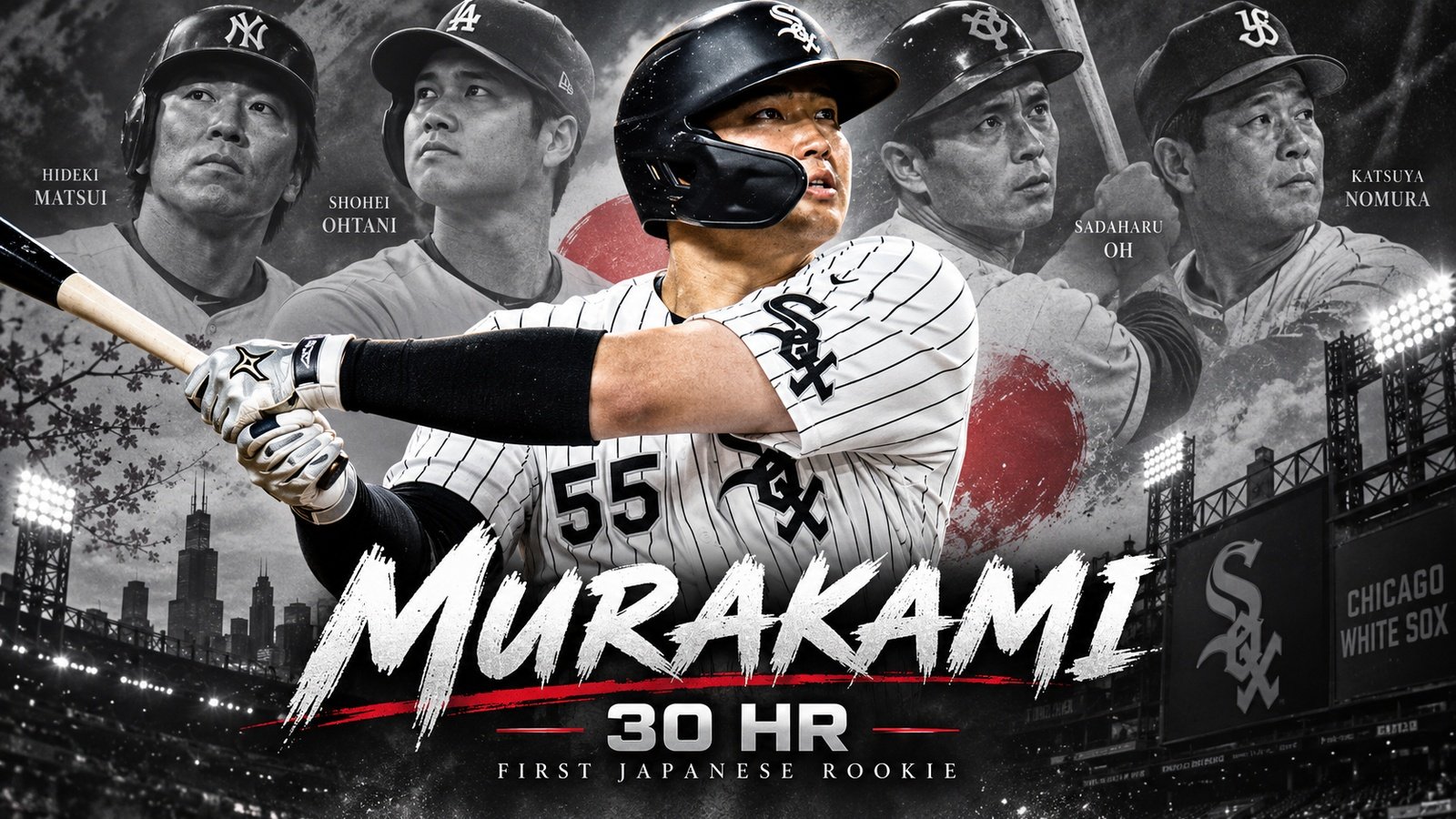
With that swing, Murakami became the first Japanese-born rookie in Major League history to hit 30 home runs. He also joined Shohei Ohtani, Hideki Matsui and Seiya Suzuki as the only Japanese-born players to produce a 30-homer MLB season.
The milestone is more striking because Murakami has not played anything close to a full schedule. A Grade 2 strain of his right hamstring cost him 35 games. After Sunday’s 10-1 win over Minnesota, he has appeared in 108 games and the White Sox have 19 left to play.
Sunday offered a useful reminder that Murakami’s rookie year is no longer only an individual story. His fifth-inning RBI single off Bailey Ober scored Sam Antonacci and gave Chicago a 1-0 lead in a game the White Sox eventually turned into a rout. Chicago improved to 75-68, maintained a 2 1/2-game lead over Cleveland in the American League Central and strengthened its hold on the AL’s No. 2 seed.
Murakami came to Chicago with one basic question hanging over him: would the enormous power that made him a star in Japan survive Major League pitching? Thirty home runs later, that part of the transition looks settled. The more complicated question is what kind of hitter he becomes once the swing-and-miss is accounted for.
Murakami by the numbers
Murakami’s season is built at the extremes. Through September 6, he is batting .211 with a .350 on-base percentage, a .478 slugging percentage and an .828 OPS. He has 30 home runs, 62 RBI, 82 walks and 163 strikeouts in 108 games.
The low batting average and huge strikeout total are impossible to ignore. So is the damage when he makes contact. Statcast has his average exit velocity at 93.9 mph, his hard-hit rate at 57.1 percent and his barrel rate at 19.2 percent. All three are well above the Major League averages published by Baseball Savant. His maximum exit velocity is 114.1 mph.
There is a second extreme in his plate discipline. Murakami’s 17.3 percent walk rate is more than double the MLB average, while his 34.4 percent strikeout rate is far above it. That creates a profile in which many plate appearances end without a ball in play, but the ones that do can change a game quickly.
The most encouraging part for Chicago is that the preseason scouting concern that received the most attention has not become the defining problem. Murakami was expected to struggle against top-end Major League velocity. By late July, MLB’s Statcast analysis found him with a 1.249 OPS in plate appearances decided on pitches of 97 mph or faster, the best mark among 144 qualifying hitters at that point.
That does not mean the adjustment is finished. His recent slump has been severe. Over his last 30 games, Murakami has hit .135 with six home runs and 50 strikeouts. The 30th homer ended his longest home-run drought of the season. The power is real, but pitchers have also found ways to exploit his contact issues for long stretches.
The hitter Chicago was betting on
Murakami did not arrive as an ordinary international free agent. In 2022, at 22 years old, he authored one of the most famous offensive seasons in modern Japanese baseball.
He hit .318 with 56 home runs and 134 RBI for the Tokyo Yakult Swallows, winning the Triple Crown. The 56 homers broke Sadaharu Oh’s longstanding single-season record for a Japanese-born player. Murakami also became the youngest Triple Crown winner in NPB history.
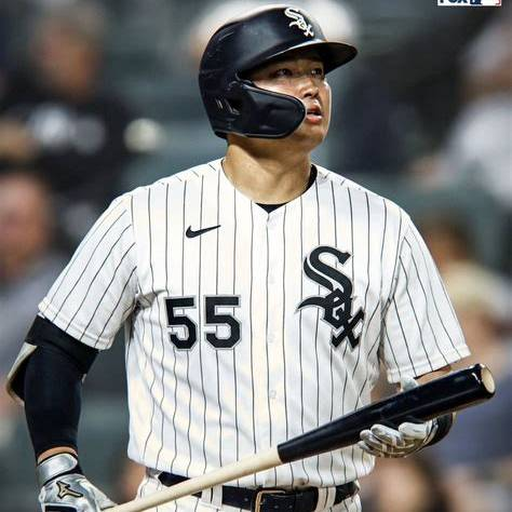
By the time he was posted to Major League clubs in November 2025, the power was not in dispute. The debate centered on how much contact he would make, whether his defense would force him to first base or designated hitter, and how much risk clubs were willing to accept in exchange for a hitter entering his age-26 season.
Those concerns explain why the offseason market is such an important part of the story. The player who looked capable of commanding a nine-figure commitment in November was still unsigned deep into December.
The market that collapsed
Before the winter began, the industry expected Murakami to be one of the biggest free agents available. MLB Trade Rumors ranked him fourth in its class and projected eight years and $180 million. FanGraphs estimated seven years and $154 million. ESPN’s projection was more conservative at five years and $80 million, but even that number was far above the deal he eventually signed.
The list of potential suitors was also impressive. MLB.com identified the Yankees, Mets, Mariners, Phillies, Giants and Red Sox among the clubs expected to have interest. Other reporting connected the Dodgers to the market as well. Those reports established interest, not formal offers, and that distinction matters. The exact competing offers have never been publicly disclosed.
What can be said with confidence is that Murakami had alternatives and that the market came in far below the early forecasts. Concerns about strikeouts, defensive value and the uncertainty of the NPB-to-MLB transition changed the bidding landscape. Chicago saw an opening.
General manager Chris Getz later described a late push that came together near the end of Murakami’s 45-day posting window. The White Sox moved from interested outsider to winning bidder just before the deadline.
The final agreement was two years and $34 million. Murakami received a short contract with another chance at free agency after 2027. Chicago received two prime-age seasons without the long-term risk that had scared off much of the market.
What the contract looks like now
Murakami’s contract guarantees $34 million over two seasons. The deal carries him through 2027, after which he can become a free agent rather than enter arbitration. Because he came through the NPB posting system, Chicago also owed the Yakult Swallows a posting fee tied to the value of the contract.
Eight months later, the short term is no longer simply protection for the White Sox. It gives Murakami leverage. He has already shown that the power plays in the majors, made the All-Star team and produced a 30-homer season before his rookie year is over.
The White Sox know what that could mean. Getz acknowledged in late August that the club has already had conversations about an extension. His public position was straightforward: Chicago would like Murakami to remain beyond the current deal, and the interest appears to be mutual.
Murakami has also spoken positively about Chicago. During All-Star festivities, he described choosing the White Sox as the best decision he had made. That comment carries considerably more weight now than it would have when the contract was announced.
The White Sox season changed around him
Murakami did not sign with a contender. The 2025 White Sox finished 60-102 and last in the AL Central. That was an improvement from the 121-loss disaster of 2024, but the organization still entered 2026 as a rebuilding club.
The standings now tell a different story. Sunday’s 10-1 victory pushed Chicago to 75-68. The White Sox lead Cleveland by 2 1/2 games with 19 left and currently hold the second seed in the American League, a position that would come with a bye through the Wild Card Series.
Murakami is central to that change without being solely responsible for it. Colson Montgomery leads the club with 31 home runs. Miguel Vargas has 30. Murakami’s 30th gave Chicago three 30-homer hitters in the same season, only the fourth time in franchise history the White Sox have had at least three players reach the mark.
Sunday’s win also showed the breadth of the turnaround. Five Chicago pitchers combined to hold Minnesota to four hits. Rookie Sam Antonacci doubled three times. Randal Grichuk and Kyle Teel homered in a five-run eighth. Murakami’s RBI single supplied the first run rather than the last word.
That is important to the larger story. Chicago no longer needs Murakami to be the entire offense every night. It needs him to be one dangerous part of a team that suddenly expects to play meaningful baseball in September.
What people are saying about him
The reaction from opposing teams has shifted from curiosity to respect. Twins manager Derek Shelton said Murakami was “a different animal.” Brewers catcher William Contreras offered an even simpler scouting report: “That guy can hit it a long way.”
White Sox officials have been just as interested in what happens away from the box score. Getz has repeatedly praised Murakami’s work habits and clubhouse fit. The extension talk is the clearest evidence that Chicago sees him as more than a short-term experiment.
Twins manager Derek Shelton on Murakami
Murakami’s own comments have usually returned to the team. After hitting No. 30 in Saturday’s 6-4 loss, he said he was happy about the milestone but more concerned that Chicago had lost. One night later, his RBI single helped send the White Sox to a series-clinching win.
That sequence captures where the season has gone. The story began with a Japanese star trying to prove he belonged in Major League Baseball. It has become a pennant-race story.
The Japanese power lineage
Murakami’s 30th home run put him into a very small Major League club. He is the fourth Japanese-born player to hit 30 home runs in an MLB season, joining Hideki Matsui, Shohei Ohtani and Seiya Suzuki. That is the direct Major League line Murakami has entered this year.
The larger Japanese power tradition is much older. Sadaharu Oh spent his entire 22-season playing career with the Yomiuri Giants and finished with 868 home runs, the most in Japanese professional baseball history. Katsuya Nomura, one of the greatest catchers in NPB history, hit 657 home runs over a 26-season career and won the Pacific League Triple Crown in 1965.
Neither Oh nor Nomura played in Major League Baseball. There is no reason to manufacture a personal explanation for that. Their playing careers remained in Japan and unfolded before the modern NPB-to-MLB route used by stars today. The current posting system did not exist during their careers, and no NPB position player made the move to the Major Leagues until Ichiro Suzuki joined Seattle in 2001.
That distinction matters. Oh and Nomura belong to Murakami’s broader Japanese baseball lineage, while Matsui, Ohtani and Suzuki provide the direct MLB power comparison.
For years, the Major League standard for a Japanese power hitter was Matsui. In 2004, his second season with the Yankees, Matsui hit .298 with 31 home runs, 108 RBI and a .912 OPS. He later became the 2009 World Series MVP and remains one of the most important Japanese position players in MLB history.
Ohtani changed the scale of the comparison. His rookie season with the Angels included 22 home runs, a Japanese-born rookie record that stood until this year. Ohtani has since made 30-homer seasons familiar territory while simultaneously building a career unlike any other modern player because of his work as a pitcher.
Suzuki joined the 30-homer club in 2025, hitting 32 for the Cubs. That made him the third Japanese-born player to reach the threshold before Murakami joined the group this season.
Murakami’s distinction is different. Matsui needed until his second MLB season to reach 30. Ohtani’s rookie record was 22. Suzuki reached 30 later in his career. Murakami has reached the mark immediately, and he did it after missing 35 games.
The milestone does not make him a better player than those names. It does establish that the power which defined him in Japan did not require a long runway to appear in the majors. His rookie season now connects the old Japanese power tradition to the modern MLB path in a way that fits both the history and the moment.
What 30 home runs actually tell us
Thirty home runs do not mean Murakami has solved Major League Baseball. His .211 average and 163 strikeouts make that clear. The recent slump is real, and pitchers will keep forcing him to prove he can shorten the holes in his swing.
But the season has answered the largest question from last winter. His power survived. His patience survived. The fastball velocity that was supposed to overwhelm him has often become something he punishes.
That changes the conversation around the contract. Chicago benefited when the rest of the market became cautious. Murakami benefited by taking a short deal that lets him rebuild his value quickly. After one season, both sides can already see the possibility that the bargain will not remain cheap for long.
There are 19 games left. The White Sox have a division to win, Murakami has a historic rookie season still in progress, and the organization has an extension question waiting behind all of it.
When Chicago signed him in December, the question was whether $34 million was too much risk for a hitter with this much swing-and-miss. Nine months later, the more interesting question is the opposite one: what would Munetaka Murakami cost now?