An average of 26.9 million viewers watched Game 7 of the 2025 World Series on FOX. The Dodgers and Blue Jays produced the network’s largest World Series game audience since 2017. That was the American audience alone, before counting the Canadians following Toronto’s pursuit of a championship.
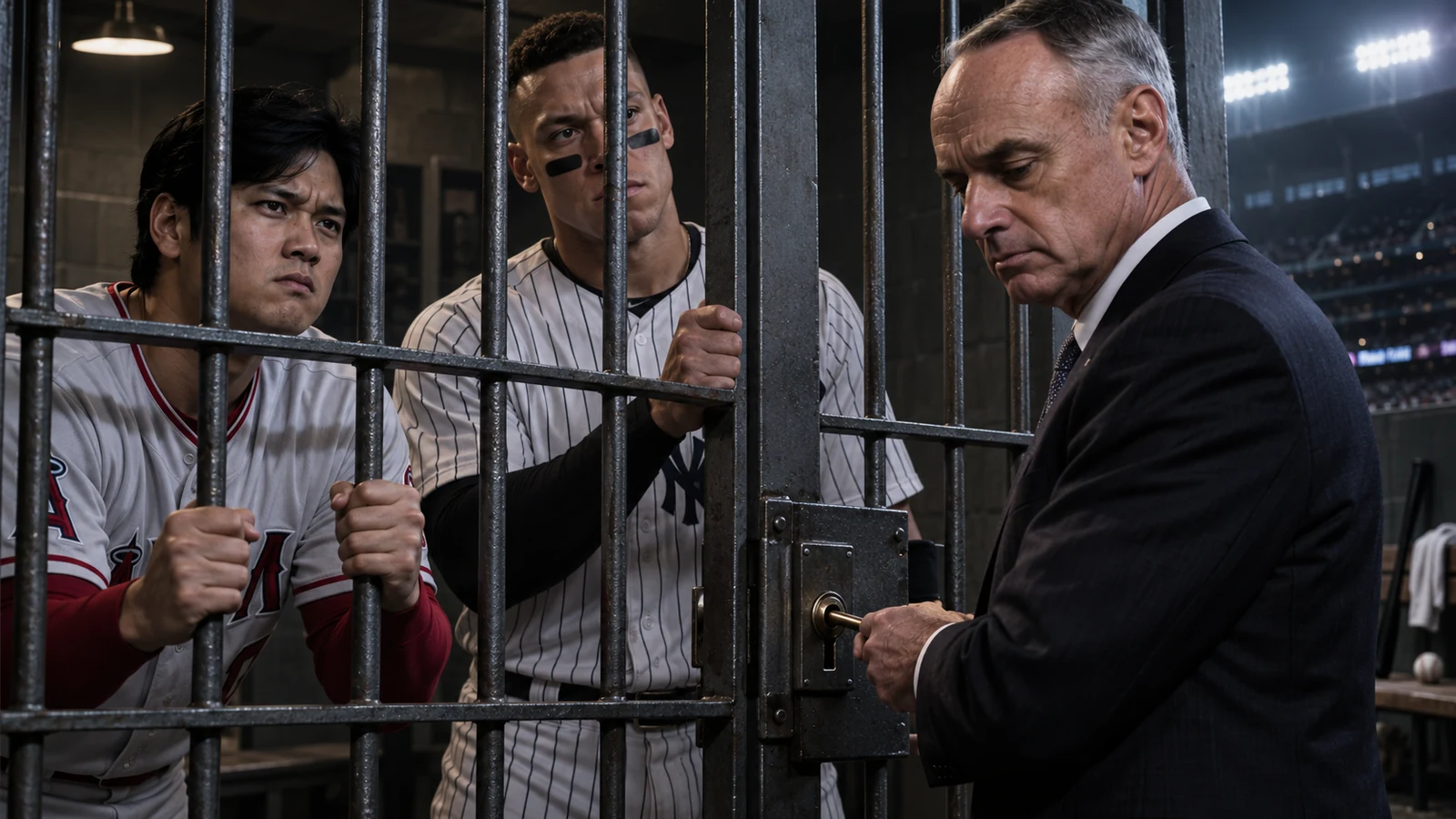
Baseball now faces a negotiation that could take those games away in 2027. Its collective bargaining agreement expires December 1, 2026, and owners are seeking a salary cap the players’ association opposes. The sport’s audience is not the immediate problem. The fight concerns how the money it generates should be distributed, and what restrictions should accompany that distribution.
In his extended examination of the dispute, ESPN’s Jeff Passan reports that all 30 owners declined his requests for an interview. He also reports that some owners would tolerate losing April games to strengthen their bargaining position. His warning is not merely that the offseason could stop, but that the confrontation could reach the season itself.
An offseason lockout would not automatically shorten the schedule. It would, however, require a settlement before spring preparations and the calendar became obstacles of their own. Recent audiences explain what baseball has to protect. The proposals explain why protecting it may be harder than agreeing that everyone wants games played.
Why the salary cap is central to the MLB lockout threat
The owners’ opening offer proposed a 2027 payroll cap of $245.3 million and a floor of $171.2 million. Those figures use luxury-tax payroll accounting, including benefits, rather than simply adding the salaries paid out during a season.
The current competitive balance tax allows spending above a threshold, with penalties. A hard cap would prohibit spending beyond its limit. A floor would require clubs below the minimum to increase qualifying payroll expenditures.
Commissioner Rob Manfred made the league’s argument at the June owners’ meetings: “You just can’t ignore that financial penalties have not gotten it done for us.”
For a supporter frustrated by a low-spending club, a mandatory minimum offers something concrete: an obligation to commit more money to players. The ceiling would restrain wealthy competitors. Neither rule would guarantee good recruitment, but together they would narrow the range within which teams could spend.
The union proposes a different way to press owners to invest. Its May 27 opening package included increased revenue sharing and a competitive-integrity tax on clubs falling below payroll benchmarks. A tax would penalize underspending rather than prohibit it. The union also sought a $1.5 million major-league minimum salary.
“Our goal is to preserve and improve baseball’s market system,” interim executive director Bruce Meyer said in that announcement.
Under the union’s proposal, the base luxury-tax threshold would rise to $300 million in 2027. Players would retain the ability to negotiate with clubs willing to spend beyond it. The league would instead make the upper limit binding.
That is why the disagreement cannot be resolved simply by finding a midpoint between two payroll figures. The players are not bargaining only over how high a cap should be. They are resisting a permanent limit on the market for their services.
MLB’s June proposals added limits on individual contracts. An outside free agent could receive a deal covering up to five free-agent seasons; a club retaining its own player could offer six. Extensions including years before free agency could be longer. The proposal would also limit salaries relative to the team cap and ban new deferred-compensation arrangements.
For established players, those restrictions would change more than the number of clubs able to bid. Contract length determines how much future income can be secured at once. A system that offers higher pay to younger players could still reduce the negotiating options available later in their careers.
The minimum-pay offer also varies by service time. MLB proposed a $1 million minimum for players with at least two years of service. Those below two years would have a $900,000 base, with eligible full-season players receiving another $100,000 from the pre-arbitration bonus pool. That is the pool for players not yet eligible to negotiate salaries through arbitration.
MLB proposed enlarging the pool as well. But some of that increase would fund the service bonuses, so the entire increase would not be additional money available for performance awards. The base salary and the route to the advertised $1 million total need to be understood together.
The league also offered qualified earlier access to free agency for players aged 30 or older with five years of service. Crucially, its acceptance of that change and other player priorities remained conditional on a cap. Apparent agreement on individual benefits does not establish agreement on the package containing them.
Fifty percent of what?
MLB describes its system as sharing baseball revenue equally with players. The union disputes the calculation and what it would leave players with. Before the percentage can settle anything, the parties must establish what enters the revenue pool and which payments count against the players’ share.
On Nothing Personal, former Marlins president David Samson challenges a 55 percent estimate he attributes to Meyer. He argues that the comparison with MLB’s proposed 50 percent depends on the accounting categories, including payments to amateur players. He also distinguishes cash payroll from the figures used for the luxury tax.
The need for consistent definitions is clear. Whether that criticism establishes an error in Meyer’s calculation is a separate question. Meyer said in June that he was using MLB’s definitions of revenue and player compensation, and that applying the proposed system to 2026 would cost players more than $500 million.
MLB’s response concerned a different comparison: it said major-league players would receive more compensation in 2027 than in 2026. A claim about applying new rules to the current season is not answered solely by projecting a larger payment in the following season. The covered groups and payments must also match.
The arithmetic can be illustrated without pretending to have MLB’s private books. Half of a hypothetical $12 billion revenue pool is $6 billion. Allow $1 billion in deductions before dividing it, and the players’ half becomes $5.5 billion. The share is still 50 percent, but the amount received is smaller.
The compensation side presents a similar issue. Raising major-league salaries while reducing amateur bonuses could improve the result for established professionals without increasing overall player compensation. The distinction concerns who benefits, not merely which number looks better in an announcement.
The league’s June amateur-entry proposal would shorten the domestic draft from 20 rounds to 12 and replace negotiated signing bonuses with prescribed payments. Those are changes to the terms on which new players enter professional baseball, not simply adjustments to major-league payrolls.
On July 21, the union proposed retaining a 20-round domestic draft and negotiated signing bonuses, rejecting the league’s proposed restructuring. It also sought broader college eligibility. The financial implications therefore extend to players who have not reached a major-league roster. A comparison restricted to current major-league salaries would leave that part of the dispute out.
The proposed escrow arrangement would withhold part of compensation to reconcile payments with the agreed revenue share. Meyer objects that this would weaken salary guarantees. It introduces a distinction between a contract’s face value and what a player ultimately receives if revenue falls short of projections.
That objection should not be inflated into a claim that clubs could simply cancel contracts. Escrow concerns reconciliation with league revenue; the effect on guarantees depends on the agreement’s language. It nevertheless helps explain why a promised increase in total compensation would not settle the union’s objections to the system.
The publicly available material does not provide a complete set of financial schedules that independently resolves the competing estimates. Both sides’ projections need to remain attributed. A nominally equal division is not enough information to determine whether players would gain or lose.
MLB vs. NBA ratings: The 2025 comparison
The television evidence gives the dispute its wider stakes. The 2025 World Series averaged 15.71 million viewers on FOX, against approximately 10.3 million for the NBA Finals in ESPN’s initial report. Both series lasted seven games.
These figures do not establish the relative size of the leagues’ entire fan bases. They establish something narrower and useful: baseball’s reported championship audience exceeded basketball’s in 2025. The result does not depend on adding Toronto’s Canadian audience to the American total.
The regular season also offers evidence beyond one championship matchup. ESPN’s Sunday Night Baseball averaged about 1.8 million viewers in 2025. ESPN’s NBA regular-season games in the season ending that year averaged 1.32 million, according to Sports Business Journal.
Basketball led in the selected broadcast-network packages. ABC’s NBA slate averaged 2.683 million, while MLB on FOX averaged about 2.04 million. Those packages had different schedules and game selections; none is a combined league average. They show that baseball competes for viewers in significant television settings, not that it wins every comparison.
Canadian viewing adds a separate measure of the World Series’ impact. Rogers reported a 7.5 million series average and 10.9 million for Game 7. The deciding game’s figure covered its reported Canadian television and streaming outlets. The American comparison stands on its own, but the potential cost of interrupting baseball extends beyond that market.
Interest was also evident at the ballpark. MLB reported 71,409,421 in attendance in 2025, its third consecutive annual increase. That does not measure distinct fans, and it does not resolve a payroll dispute. It shows that the audience baseball would be asking to wait is not confined to October.
Can more sharing produce a settlement?
Strong national audiences do not give every club the same spending power. The owners’ opening proposal would centralize local-media revenue and divide it equally. The union also proposes greater sharing of local-media income, but without accepting the league’s cap framework.
This is where the dispute becomes more complicated than high payrolls against low payrolls. Revenue sharing changes the money a club has available. A payroll rule governs how much of that money it must, or may, commit to players. Increasing a transfer does not by itself ensure that the receiving club improves its team.
The union says its proposed revenue-sharing arrangements would initially guarantee small-market clubs at least $240 million in annual revenue, with requirements that funds support competition. It also proposes rewards for successful lower-revenue teams. The objective is to pair additional resources with incentives to use them on the field.
MLB disputes the effect. Responding to the opening offer, the league said the union’s package would reduce transfers to lower-revenue clubs and weaken the luxury tax. Agreement that sharing matters has not produced agreement about which arrangements would narrow the gap.
Nor is there a single uncontested definition of competitive success. Milwaukee led MLB with 97 wins in 2025 before Los Angeles swept it in the NLCS. Regular-season contention and winning a championship are different tests. That season can illustrate the distinction without proving either that spending gaps are harmless or that a cap would have changed the outcome.
An owner arguing for a cap needs to explain why restricting the highest payrolls is necessary, rather than simply desirable for controlling costs. The union’s alternative faces its own test: how would increased transfers and payroll penalties ensure that more clubs compete consistently? Neither question can be answered by pointing to a single successful team.
Passan presents greater local-television revenue sharing as a possible route to a deal without a cap. The distinction is important. A cap and shared television income can be negotiated together, but one is not an accounting prerequisite for the other. The obstacle is obtaining agreement on the combination.
Passan also discusses stronger nonfinancial restraints on high-spending clubs. Draft penalties already exist, so this would be a question of changing their severity or form, not discovering an entirely unused tool. Such restrictions would create a different cost for exceeding the tax threshold while leaving clubs able to do so. Whether the union would accept that trade is another negotiating question.
A workable alternative would have to specify the transfers and the spending obligations together. More shared revenue without effective conditions could leave the same complaints about investment. Restrictions without sufficient resources could leave lower-revenue clubs facing an obligation they argue they cannot support.
For example, a high-revenue owner could be more willing to share income in return for limits on competitors’ spending. Players could favor additional transfers while resisting the condition attached to them. Removing that condition would change the bargain, not merely simplify the document.
Samson offers an explicit defense of an owner seeking greater asset value while controlling labor costs. That perspective helps explain a cap’s appeal beyond the standings. It does not establish that every owner has the same priorities, or that franchise value and annual operating income are interchangeable.
A buyer’s willingness to pay for a team reflects expectations about its future. That is different from the resources available to fund this year’s roster. The negotiation has to address the latter while recognizing the long-term value owners might attach to greater cost certainty. Otherwise, arguments about whether baseball is thriving can talk past the question of which clubs receive the benefits.
Could an MLB lockout cost games in 2027?
The offers are still tied to incompatible starting positions. MLB’s August roster proposals again depended on a cap-and-floor agreement. On September 16, Meyer said the parties continued meeting but remained far apart on core economics. Manfred had said in August that the league was planning to play in 2027.
Their desire to play does not determine how much either side would concede to make that happen. A permanent change in the economic system can be worth more to a negotiator than a temporary loss. That calculation is what makes a dispute dangerous even when both sides would prefer uninterrupted baseball.
Chris Russo, discussing the negotiations with Jimmy Traina, expects an offseason lockout but leaves open a settlement that preserves a full season. His argument identifies a deadline with particular force: the last opportunity to save all 162 games. Once that opportunity disappears, he warns, the immediate pressure to settle can change.
The 2022 agreement shows why an offseason shutdown and a shortened season are different outcomes. A March 10 settlement ended a 99-day lockout. Opening Day moved to April 7, but the agreement preserved the 162-game schedule. That experience is evidence that games can be saved, not a promise that the next dispute will end the same way.
Passan’s account identifies the opposing risk: some owners believe accepting early-season losses could strengthen their position later. If either side treats money already lost as a reason to demand a more decisive victory, the financial damage can prolong the dispute instead of ending it.
The responsibility for starting a shutdown should remain clear. A lockout is imposed by owners; a strike is initiated by players. The 1994 dispute was a strike that cost baseball its World Series. It demonstrates the consequences of a failed negotiation without making a repeat inevitable.
For 2027, Opening Night is scheduled for March 24, with traditional Opening Day on March 25. A settlement must also allow time for preparation. Those dates make the consequences of continued disagreement concrete, even though they do not establish the final deadline for saving a full schedule.
The audience is part of the cost
The media commitments already extend into the threatened season. Agreements announced in November 2025 with ESPN, NBCUniversal and Netflix cover 2026–2028. A stoppage in 2027 would interrupt that period, not arrive safely after it.
The available evidence does not support a precise forecast of lost rights fees or future audience damage. Those outcomes would depend on the length of a stoppage and the contracts involved. What is straightforward is that canceled games cannot deliver the live programming broadcasters bought, or the baseball supporters planned to attend.
The 2025 figures make dismissing that audience difficult. They do not decide whether the league’s cap proposal is justified, but they raise the cost of failing to reach terms. Baseball has demonstrated that it can attract viewers who are often assumed to be watching something else.
Its next agreement must resolve how the sport rewards players and supports competition among clubs. Reaching it without losing games would protect the business both sides are trying to improve. Letting the argument consume the season would instead ask baseball’s supporters to absorb the consequences of a negotiation they cannot influence.