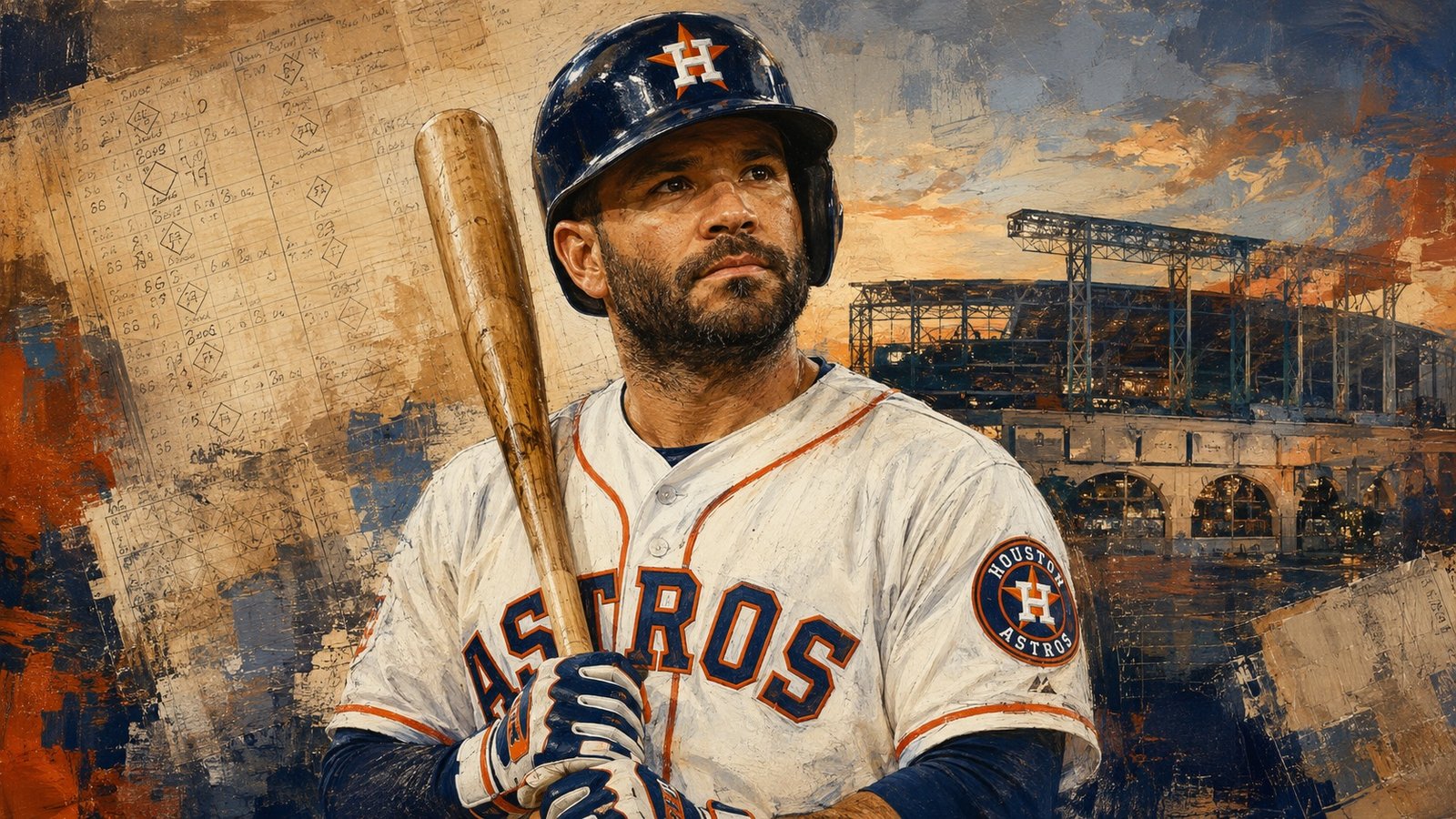
Through September 3, José Altuve has 2,495 career hits — five short of the milestone. He has been circling 2,500 career hits since the middle of August, close enough that the Astros’ game notes started counting down for him, close enough that it stopped being a question of if and became a question of which pitcher and which night.
So let’s skip the countdown. The interesting part was never the last few singles. The interesting part is the other 2,499 — and the fact that in the entire history of this sport, almost nobody gets here.
The Club
| Men who have played in MLB | 23,000+ |
|---|---|
| Men with 2,500 hits | 101 |
| Altuve’s place in line | Would be 102nd |
| Of those 101, how many reached 3,000 | 33 |
Baseball’s obsession with 3,000 has quietly turned 2,500 into a consolation prize. It isn’t one. It’s the toll booth almost no one reaches, and two-thirds of the people who do reach it never make it another five hundred feet down the road.
That last stretch is where careers go to die. It arrives in a hitter’s late thirties, when the bat slows, the legs go, and the body starts filing complaints it never used to.
Where reaching 2,500 would put him on the all-time list:
| Rank area | Player | Hits |
|---|---|---|
| Joe Morgan* | 2,517 | |
| Buddy Bell | 2,514 | |
| Jimmy Ryan | 2,513 | |
| → | José Altuve (milestone target) | 2,500 |
| Mickey Vernon | 2,495 | |
| Fred McGriff* | 2,490 |
*Hall of Famer
Note who’s directly ahead of him. Joe Morgan — arguably the greatest second baseman who ever lived — is roughly one good month away.
Since Jackie
Cut the list to the integration era and it gets thinner still.
| Total members of the 2,500 club | 101 |
|---|---|
| Debuted before April 15, 1947 | 37 |
| Debuted April 15, 1947 or later | 64 |
| Altuve’s place among those | Would be 65th |
Thirty-seven of those names — Cobb, Anson, Lajoie, Hornsby, Ruth — come from a version of the sport that excluded a huge share of the best players alive. Take them out and you’re left with sixty-four men across nearly eighty seasons.
Altuve would make sixty-five. That’s not a milestone. That’s a census.
The Venezuelan Line
| Player | Hits |
|---|---|
| Miguel Cabrera | 3,174 |
| Omar Vizquel | 2,877 |
| Luis Aparicio* | 2,677 |
| José Altuve | 4th |
*Hall of Famer
Aparicio and Vizquel were slick-fielding shortstops who lasted forever. Cabrera was a mountain of a man who hit like a video game.
Altuve is 5-foot-6 and 167 pounds. He was sent home from a tryout in Maracay because of his height. He came back the next day anyway and signed for $15,000.
The Second Base Problem
Second base grinds people up. The pivot, the collisions, the constant lateral movement — it is not a position that produces 2,500-hit careers.
Second-base greats with 2,500 hits, and Altuve’s target:
| Player | Hits |
|---|---|
| Eddie Collins | 3,314 |
| Nap Lajoie | 3,243 |
| Craig Biggio | 3,060 |
| Rod Carew | 3,053 |
| Rogers Hornsby | 2,930 |
| Frankie Frisch | 2,880 |
| Charlie Gehringer | 2,839 |
| Roberto Alomar | 2,724 |
| Nellie Fox | 2,663 |
| Robinson Canó | 2,639 |
| Joe Morgan | 2,517 |
| José Altuve (milestone target) | 2,500 |
Eleven men already there, with Altuve on the doorstep. Five played before World War II. Carew later spent more games at first base. Altuve is closing in during his sixteenth season with one franchise.
His 270 career home runs have already taken him past Joe Morgan’s 268. Morgan finished with 2,517 hits; Robinson Canó had 2,639 hits and 335 homers. Altuve is closing on Morgan’s hit total with the power benchmark already behind him. For a player whose entire scouting report read great contact, no power, that is a remarkable place to end up.
One more from the Astros’ own game notes, and it might be the best line on the whole résumé:
Altuve is one of only three players in MLB history with a career .300 average, 250 home runs and 300 stolen bases.
The other two are Willie Mays and Derek Jeter.
The Recent Arrivals — and the Next in Line
| Player | Date | Age | Career status / final hits |
|---|---|---|---|
| José Altuve | Approaching — not yet reached | 36 | Active |
| Freddie Freeman | June 9, 2026 | 36 | Active |
| Robinson Canó | May 7, 2019 | 36 | 2,639 |
| Miguel Cabrera | 2016 | 33 | 3,174 |
| Carlos Beltrán | May 28, 2016 | 39 | 2,725 |
Look at the middle of that table. Seven years passed between Canó in 2019 and Freeman this past June — seven full seasons without a single new member. Altuve could make it two arrivals in one summer.
The drought isn’t an accident. Velocity is up, bullpens are deeper, defenses are optimized, and strikeout rates keep climbing. The modern game is engineered to prevent exactly this.
Look at the ages, too. Three of the four recent arrivals got there at 36 or older; Altuve is 36 now. This is a milestone you reach by refusing to leave.
Checking the 2026 Tape
Now the honest part.
Altuve, 2026 (through Sept. 3):
| Stat | 2026 | Career |
|---|---|---|
| Games | 114 | 2,090 |
| Hits | 107 | 2,495 |
| Average | .244 | .300 |
| OPS | .701 | .820 |
| OPS+ | 98 | 126 |
| Home runs | 15 | 270 |
| Strikeout rate | 20.3% | 13.5% |
| bWAR | 0.2 | 53.6 |
An OPS+ of 98 means that adjusted for park and league, he has been a hair below an average major league bat this season. For a lifetime .300 hitter with a 126 career mark, that isn’t a slump. That’s decline.
The batted-ball data agrees. His average exit velocity sits at 85.7 mph, his expected wOBA at .275 — neither the reading of a hitter about to reverse course. And that strikeout rate is the highest of his career by a distance; in his 2014 batting-title season he struck out 7.5% of the time.
It hasn’t been a straight line down, though:
- June–July: an extended slump, the worst stretch of his season
- August: .813 OPS, 25 hits, batting over .300 for the month
- September: hitting cleanup nearly every day as Houston chases the division
The 2025 season told a similar story — .265 with 26 homers, but only 0.6 WAR once the defensive metrics were folded in. This is a very good hitter aging into an ordinary one, which is what happens to everyone. It just still feels strange watching it happen to him.
Can He Get to 3,000?
The math, laid out plainly.
| Hits needed from 2,500 | 500 |
|---|---|
| Age | 36 |
| Contract | 5 yrs / $125M, through 2029 |
| Free agent | 2030 |
| Required pace through age 39 | ~160 hits per season |
The problem: he hasn’t hit 160 since 2024.
| Season | Hits |
|---|---|
| 2024 | 185 |
| 2025 | 156 |
| 2026 (full-season pace) | ~152 |
Asking a 37-, 38- and 39-year-old to increase his output over his 35- and 36-year-old seasons is asking for something that essentially never happens.
Three scenarios:
Optimistic — He rebounds to 165–175 a year on full health and a move to DH or a corner that saves his legs. He lands around 2,990–3,020 by the end of 2029. He gets there in the final weeks of the contract, or early in a 2030 victory lap.
Likely — He continues the current glide: roughly 150, then 140, then 130. That’s 420 more hits after 2026, or about 2,920 from a 2,500 starting point — about 2,940 if he adds another 20 hits after the milestone this September. Agonizingly close, and requiring a full extra season at 40 to finish it. Landing spot: mid-2030.
The risk — One significant injury, and he’s had multiple IL stints in recent years, and the conversation quietly ends. He’d retire in the 2,800s. Still one of the great careers of the century. Still would sting.
Verdict: 3,000 is live but off schedule. It requires him to play into his age-40 season and to stop declining at the rate he is currently declining. Call it a coin flip that gets worse every year he doesn’t put up 170.
The Part Where We Say Thank You
Forget the projections for a second.
| MVP | 1 (2017) |
|---|---|
| World Series titles | 2 |
| Batting titles | 3 |
| Silver Sluggers | 7 |
| All-Star selections | 9 |
| Gold Glove | 1 |
| ALCS MVP | 1 |
| Career average | .300 |
| Postseason home runs | 27 |
That last number deserves its own sentence. Twenty-seven postseason home runs — more than all but one player who has ever lived, with an .841 OPS across nine Octobers. Whatever else you believe about these Astros, the small man delivered when it counted, over and over, for the better part of a decade.
His manager, Joe Espada, put it as simply as anyone has. Speaking in April, when Altuve played his 2,000th game in an Astros uniform, Espada — who has been alongside him since 2018 — said “He’s the same guy every day, man.”
That’s the whole career, really. The same guy every day, for sixteen years, in the same uniform.
There will be voters who weigh 2017 against him, and that argument isn’t going anywhere. But the résumé underneath it isn’t a borderline case. It’s a first-ballot case and it deserves to be treated as one.
Some of you will land somewhere else on that, and that’s fair. What shouldn’t be in dispute is what the number represents: sixteen years of showing up, of being underestimated, and of putting the barrel on the baseball more times than all but a hundred men in the history of the sport.
Five more to the toll booth, Tuve. Then go get the next five hundred.
Statistics current through September 3, 2026. Sources: Baseball-Reference, MLB.com, Baseball Savant, Houston Astros game notes. Club totals and debut-era breakdown use MLB’s current career records; historical milestone reports can differ following record revisions.