
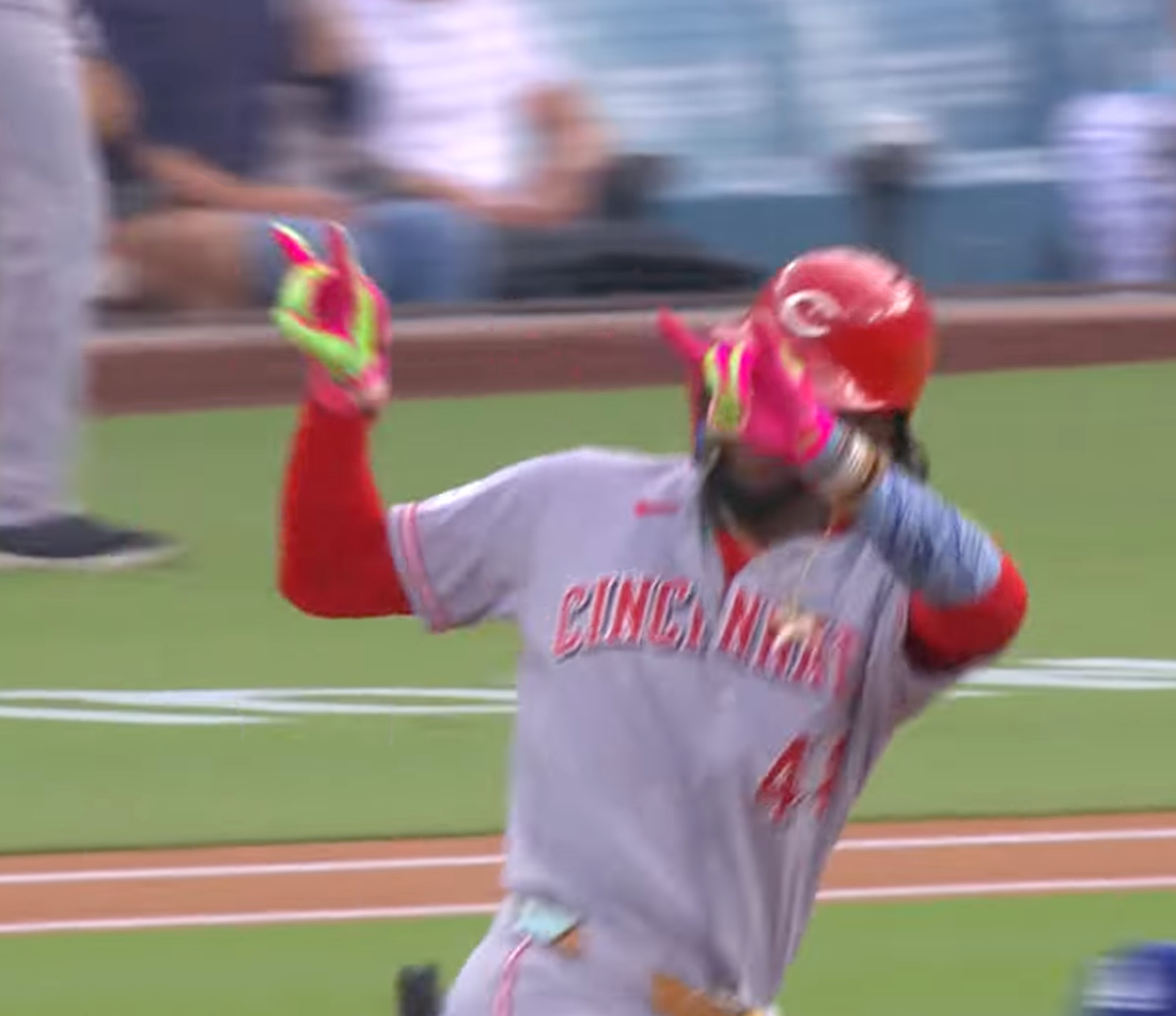
Elly De La Cruz hit a Tarik Skubal changeup a Statcast-projected 444 feet into the left-center-field seats at Dodger Stadium on September 8. The distance was remarkable, but the detail that best explains his season was where he had been standing: in the right-handed batter’s box.
For much of his major league career, turning the Cincinnati Reds switch-hitter around had meant confronting the less productive version of his bat. This season, the numbers against left-handed pitching describe a different matchup, one in which De La Cruz is doing more damage without needing as many opportunities.
The Skubal shot came during a career-best run of five consecutive games with a home run, from September 5 through September 9. The streak ended in Cincinnati’s 20-0 loss at Milwaukee on September 11, but the improvement behind it extends well beyond that week.
Home runs from both sides of the plate
Dustin May gave up the homer that began the streak in Cincinnati on September 5. Six days later, he held the Reds to two hits over six scoreless innings as Milwaukee ended it. De La Cruz went hitless in three at-bats but drew a walk, extending his on-base streak to 18 games.
On September 9, De La Cruz homered off Yoshinobu Yamamoto for his career-high 26th, extending his Reds single-season record for a switch-hitter. The streak stopped two games short of Joey Votto’s Cincinnati record of seven, set in July 2021.
Two of the five home runs came right-handed. Before facing Skubal, De La Cruz had homered against left-hander Kyle Harrison on September 6, driving the ball to right-center. Against Skubal, he sent it to left-center. That gave the streak a useful distinction: he was producing power from his historically weaker side, and he was doing it in both directions.
The numbers against left-handers
In 2024, De La Cruz hit .224 against left-handed pitching with a .661 OPS. A year later, he hit .236 with a .618 OPS. His production against right-handers was substantially better in both seasons, giving opponents a statistical reason to prefer the matchup that put him in the right-handed batter’s box.
Through September 11 this season, he had doubled his 2025 home run total against left-handers despite making 47 fewer plate appearances against them. The improvement also reached beyond home runs, with a higher batting average and on-base percentage.
| Measure | 2025 | 2026 |
|---|---|---|
| Plate appearances | 210 | 163 |
| Batting average | .236 | .350 |
| On-base percentage | .276 | .417 |
| Slugging percentage | .342 | .657 |
| Home runs | 5 | 10 |
The home run rate makes the comparison clearer. He went deep in about 2.4% of his plate appearances against left-handers last season and 6.1% in the 2026 sample. Those rates are calculated from the totals above; the increase is not simply a product of facing more left-handed pitching.
A sample of 163 plate appearances cannot establish that he will keep hitting .350, and individual pitchers will still present different problems. It does establish how much better his results have been. An opposing manager considering a left-hander now has to weigh that improvement rather than rely on last year’s weakness.
What changed in his right-handed swing
In an April 22, 2026 MLB Network breakdown, Mark DeRosa and Sean Casey compared De La Cruz’s right-handed setup with the previous season’s version. They identified a less-open stance and better use of his back hip, alongside the return of his leg kick. Their analysis focused on the stronger position from which he could deliver the swing.
With the earlier toe tap, they explained, he could step away from his back side without fully loading it. The leg kick helped him retain that support and bring his body into the swing. Their emphasis was on rhythm and timing, rather than treating the smallest possible movement as the best solution for every hitter.
Cincinnati’s coaches had already described the change earlier that month. In a report published April 15, 2026, Charlie Goldsmith quoted manager Terry Francona explaining why a shorter right-handed swing was helping De La Cruz make better decisions at the plate.
“He’s a little bit shorter, which allows him to see the ball longer, which allows guys to swing at better pitches.”
Terry Francona, quoted by Charlie Goldsmith in a report published April 15, 2026
Hitting coach Chris Valaika also told Goldsmith in that April report that De La Cruz’s right-handed development needed more repetitions, given his far greater experience batting left-handed. The September swings against Harrison and Skubal provide examples of the improved production, without proving that any single mechanical adjustment accounts for all of it.
Elly De La Cruz’s contract leverage
The financial significance of De La Cruz’s right-handed improvement is that Cincinnati would be negotiating with a hitter who has strengthened what had been a weakness. If he sustains that progress, his case for a long-term contract depends less on what he might become and more on production he has already delivered.
The Reds already tried to buy that future. In January 2026, president of baseball operations Nick Krall disclosed that De La Cruz had rejected an extension offered during spring training in 2025. It would have surpassed Joey Votto’s franchise-record 10-year, $225 million contract. The precise value and duration of the rejected offer were not disclosed, so its rejection cannot establish De La Cruz’s asking price.
For now, De La Cruz’s 2026 major-league base salary is $800,000. Under the current service-time rules, his first arbitration-eligible season is 2027, and he remains under Reds control through the end of 2029. Better performance strengthens his case for higher pay, but an arbitration salary for one season is not the same thing as a multiyear deal buying out future free-agent seasons.
An extension would need to make delaying that first opportunity to choose among bidders worthwhile. Cincinnati could offer substantial guaranteed money before he reaches the market, protecting him against much of the financial risk of injury or declining performance. De La Cruz, in turn, would have to decide how much potential future income he is prepared to exchange for that security.
What can the Reds offer?
The rejected proposal establishes that Cincinnati was willing to consider a commitment above $225 million, not how far beyond that figure ownership would go. Breaking the Reds’ record and making an offer that persuades De La Cruz are different standards.
Ownership approved an above-budget, one-year, $15 million deal for Eugenio Suárez in February. In July, Cincinnati committed $105 million over seven years to Chase Burns, beginning in 2027. Those decisions show that a stated annual budget is not an immutable limit, while the Burns deal adds a long-term obligation to the roster Cincinnati would be financing alongside De La Cruz.
Bobby Witt Jr.’s February 2024 extension guaranteed $288.8 million over 11 years, with his first opt-out after 2030. It offers a useful example of another club retaining a young shortstop with both security and a future exit, not a price tag to copy onto De La Cruz. For Cincinnati, the structure would matter alongside the headline total: when the largest salaries fall and how long De La Cruz agrees to stay before an opt-out.
The much bigger number circulating this month is an opinion. In a social-media post reported by Reds On SI on September 2, Votto floated 12 years and $700 million, writing, “My guess: 12/700.” That is Votto’s projection, not a demand from De La Cruz or agent Scott Boras, and not an offer from the Reds. It should not be treated as proof that an extension is unaffordable.
Public reporting has not established what De La Cruz would accept or Cincinnati’s maximum offer. That leaves a more demanding question than whether the Reds can announce another franchise record: will ownership approve terms that make staying more attractive than waiting for free agency? If the right-handed gains endure, Cincinnati will be trying to secure a more complete hitter, with fewer weaknesses on which to base a discount.