
SOCCER
Ghosts at the Bernabéu: Real Madrid vs Inter Milan, Champions League Matchday One
José Mourinho opens Real Madrid's Champions League campaign against the Inter side he led to the 2010 European Cup, with a depleted midfield and history everywhere.
Tuesday 8 September, Santiago Bernabéu, 21:00 CEST
Archived preview: Published September 8, 2026. The team news, projected lineups and prediction below reflect the pre-match reporting available at publication.
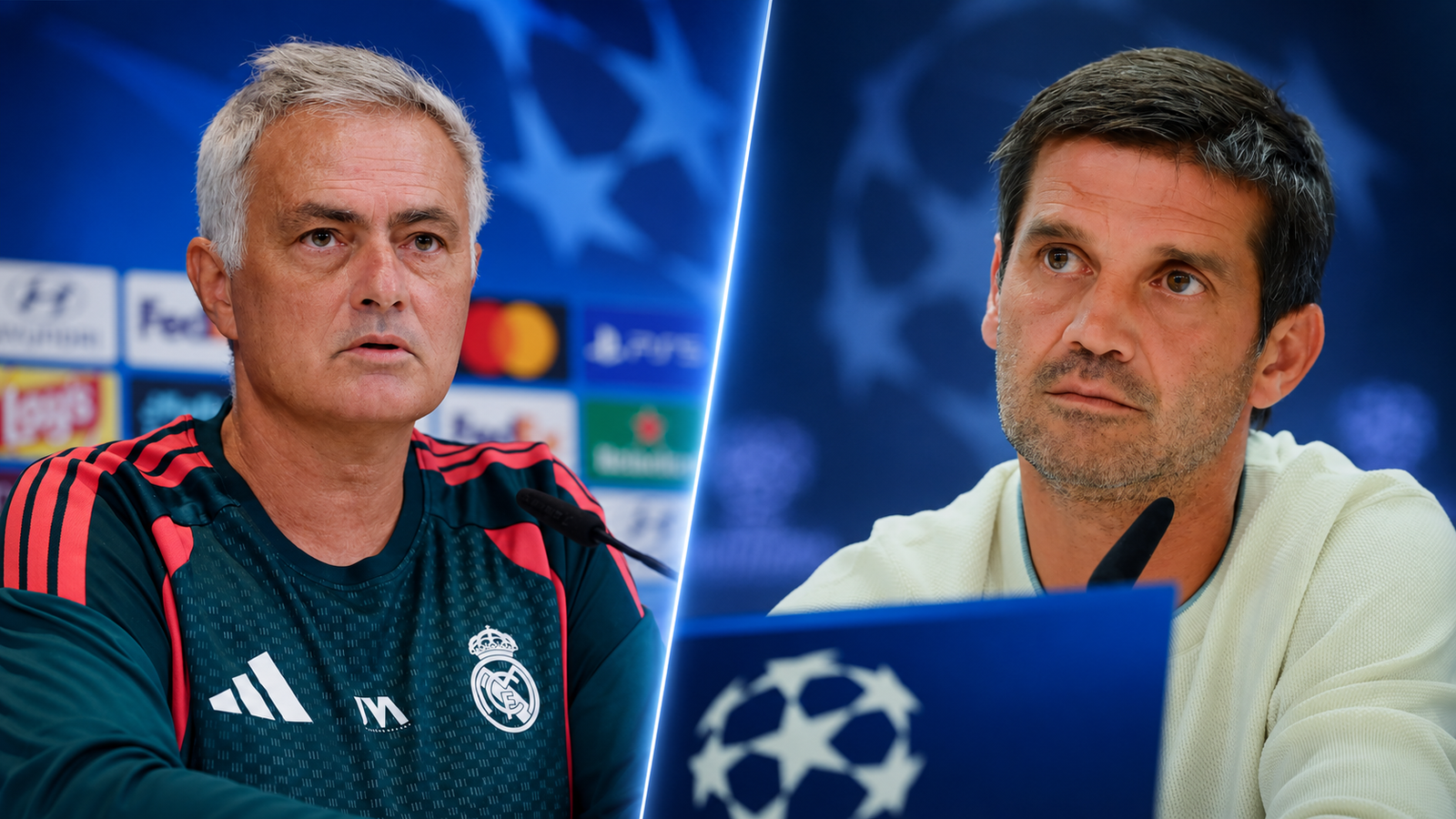
On 22 May 2010, José Mourinho stood on the Santiago Bernabéu turf holding the European Cup he had just won with Internazionale. Diego Milito had scored twice against Bayern Munich. Inter had their first continental title since 1965 and Italy’s first treble. Within days Mourinho was Real Madrid’s manager, and the tears he shed in Madrid that night were for a job he was already leaving.
Sixteen years later he walks out at the same stadium, in the home dugout, against the same club. The man in the away dugout, Cristian Chivu, started that final at left-back in Mourinho’s back four, playing 68 minutes before Dejan Stanković replaced him.
If you were designing a Champions League opener to generate copy, you could not do better. Mourinho, predictably, spent Monday trying to defuse it.
The Manager’s Framing
Asked what kind of match he wanted to see, Mourinho went straight past the aesthetic question to the only thing he cares about, and used Friday night in Seville as his evidence: “I don’t want to play well like we did against Betis and lose.” He wants three points, he said, and repeated it twice more in the same answer.
On the sentimental angle he was flat to the point of dismissiveness. He acknowledged the obvious — “I had the best and worst memories in that stadium,” referencing both the 2010 final and the semi-final he lost on penalties there — and then said he is thinking about neither. That second memory is April 2012, when Bayern Munich won a Bernabéu shootout 3-1 after Cristiano Ronaldo, Kaká and Sergio Ramos all missed from the spot. Mourinho has since called it the worst moment of his managerial career and the only defeat that made him cry. His argument is structural rather than emotional: this is matchday one of an eight-game league phase, it decides nothing, it is not a knockout tie, and he expects both clubs to qualify comfortably. He went further, suggesting the more meaningful meeting between these two is likely to come later in the season when the stakes are real.
That is either genuine perspective from a manager who has been here many times, or expectation management from one who knows his midfield is in pieces. Possibly both.
He was less serene on other subjects. Asked about the calendar, he floated the theory that “maybe the person who made the fixture list was Italian” — a grievance about scheduling that will surprise nobody who watched his first spell. On his own drive, he offered the line that best explains why he keeps taking jobs like this: “It doesn’t renew from season to season, but from match to match.”
Madrid’s Problem: A Midfield Held Together With Tape
The team news is genuinely bad, and it is concentrated in exactly the area Mourinho has spent two months trying to organise.
Eduardo Camavinga, Arda Güler and Bernardo Silva are all suspended, serving bans carried over from last season. Aurélien Tchouaméni is a major doubt with muscular discomfort. Éder Militão, Rodrygo, Ferland Mendy and Thiago Pitarch are injured. Raúl Asencio, Endrick and Marc Cucurella were all to be assessed on the day.
Strip those names out and Mourinho’s carefully constructed “two players per position” squad suddenly has one option in central midfield: Federico Valverde. The likely solution is to drop Jude Bellingham back alongside him — which undoes the single clearest tactical decision of the season so far, since Bellingham playing high as a genuine number ten has been the best thing about Madrid’s opening month. He scored a superb solo goal against Málaga from that role and said afterwards he is enjoying the freedom.
Expect something like: Courtois; Dumfries, Konaté, Huijsen, Cucurella; Bellingham, Valverde; Diomandé, Brahim Díaz, Vinícius Júnior; Mbappé. A two-man midfield base against an Inter side that floods central areas is not where Mourinho would choose to start his European campaign.
The other question is finishing. Madrid lost at Betis having generated 3.16 expected goals from eight shots on target, hitting the woodwork twice and missing a 93rd-minute penalty. Mourinho’s read is that the performance was fine and the conversion was an aberration — he described the missed chances as an anomaly and said the analysis has only made him more convinced the team played well. He also gave a revealing account of the recovery: players wrecked in the dressing room in Seville, reasonably restored by Sunday, normal by Monday. He likes seeing them wrecked.
Inter Arrive Hot
Chivu’s side come to Madrid off one of the results of the young Serie A season. Two-nil down at home to Napoli on Saturday, Inter won 3-2. Lautaro Martínez pulled one back on 56 minutes, Marcus Thuram headed an equaliser on 82, and Lautaro won it in the 91st from a goalmouth scramble. That is a side with a functioning identity and no obvious fear.
They are the reigning Serie A champions and completed a domestic double last season under Chivu, who has managed to take over a mature, successful team and keep it that way. Their injury list is a single name: Djed Spence, still building fitness. The contrast with Madrid’s medical room could not be starker.
The shape is a 3-5-2. A back three of Alessandro Bastoni, Yann Bisseck and Manuel Akanji. Federico Dimarco and Andy Diouf as wing-backs. Hakan Çalhanoğlu controlling, Nicolò Barella running, and Curtis Jones likely rewarded with a start after impressing off the bench against Napoli. Lautaro and Thuram together up front.
That system asks a specific question of this Madrid team. Inter’s wing-backs push extremely high, which pins Madrid’s full-backs and invites a numerical problem in midfield — precisely where Madrid are weakest tonight. Conversely, a back three defending against Vinícius and Mbappé in transition is the oldest problem in football, and Madrid’s best route to goal is almost certainly the direct one: win the ball, go immediately, isolate Bastoni or Bisseck in open grass.
Inter have also never solved this venue. They have not won at the Bernabéu in sixty years. Chivu acknowledged it plainly — “it has been 60 years since Inter won here” — while insisting his team will not abandon their identity to protect a result. In the 19 meetings between the clubs, Madrid have won ten, Inter seven, with two draws.
The Chivu Subplot
Rumours of a rift between Mourinho and his former defender were shut down by both men on Monday. Chivu’s tribute was warmer than the occasion required: “He’s a special person who I was lucky enough to meet in my life,” he said, crediting Mourinho with helping him through a difficult period. He also praised Mourinho’s ability to absorb a club’s reality and transmit his own mentality into it — which, given Chivu has been watching Madrid’s first month from a distance, reads as a professional assessment as much as a compliment.
Chivu did stress that his tactical vision is his own. It is: Inter under Chivu are more proactive than Inter under Mourinho ever were.
What’s Actually at Stake
Under the 36-team league phase, matchday one is genuinely low-leverage. Mourinho is right about that. Eight games, a broad qualification cut, and no group to escape. Opta’s model makes Madrid roughly 56 percent favourites, Inter around 22 percent. UEFA have appointed Michael Oliver, with Andrew Dallas on VAR — a detail Real Madrid’s own website flagged, noting it will be the Englishman’s sixth Madrid match in European competition. The most recent was Real Madrid 1-2 Bayern Munich in last season’s quarter-final first leg, the tie that ended their campaign. Given Mourinho’s remarks about officiating standards after the Betis game, that is its own small storyline.
But the context around it is not low-leverage at all. Madrid have exited in the quarter-finals in each of the last two seasons, most recently to Bayern. Mourinho reached three semi-finals in his first spell and won nothing in this competition here. He has been hired, explicitly, to end a two-season trophy drought at a club that measures itself in European Cups and has fifteen of them.
And there is a detail nobody at Madrid will say out loud yet: the 2027 final will be played on 5 June at the Metropolitano — Atlético’s stadium, in Madrid. Mourinho already knows what it feels like to win this trophy in someone else’s building. The possibility of doing it in his city rivals’ is the kind of narrative that will be raised approximately every week between now and June.
Tonight is not that. Tonight is a hobbled midfield, a striker who missed a penalty four days ago, an Inter side arriving on a comeback high, and a manager insisting the game means nothing while quite obviously wanting to beat the club he left behind.
Prediction: Madrid by a single goal, or a 1-1 that Mourinho calls a good point and nobody believes him. Watch Bellingham’s starting position — it will tell you within ten minutes how worried Mourinho actually is.
Sources and notes
- Source references were embedded in the supplied manuscript as citation-index markers; a full source list was not included with delivery.