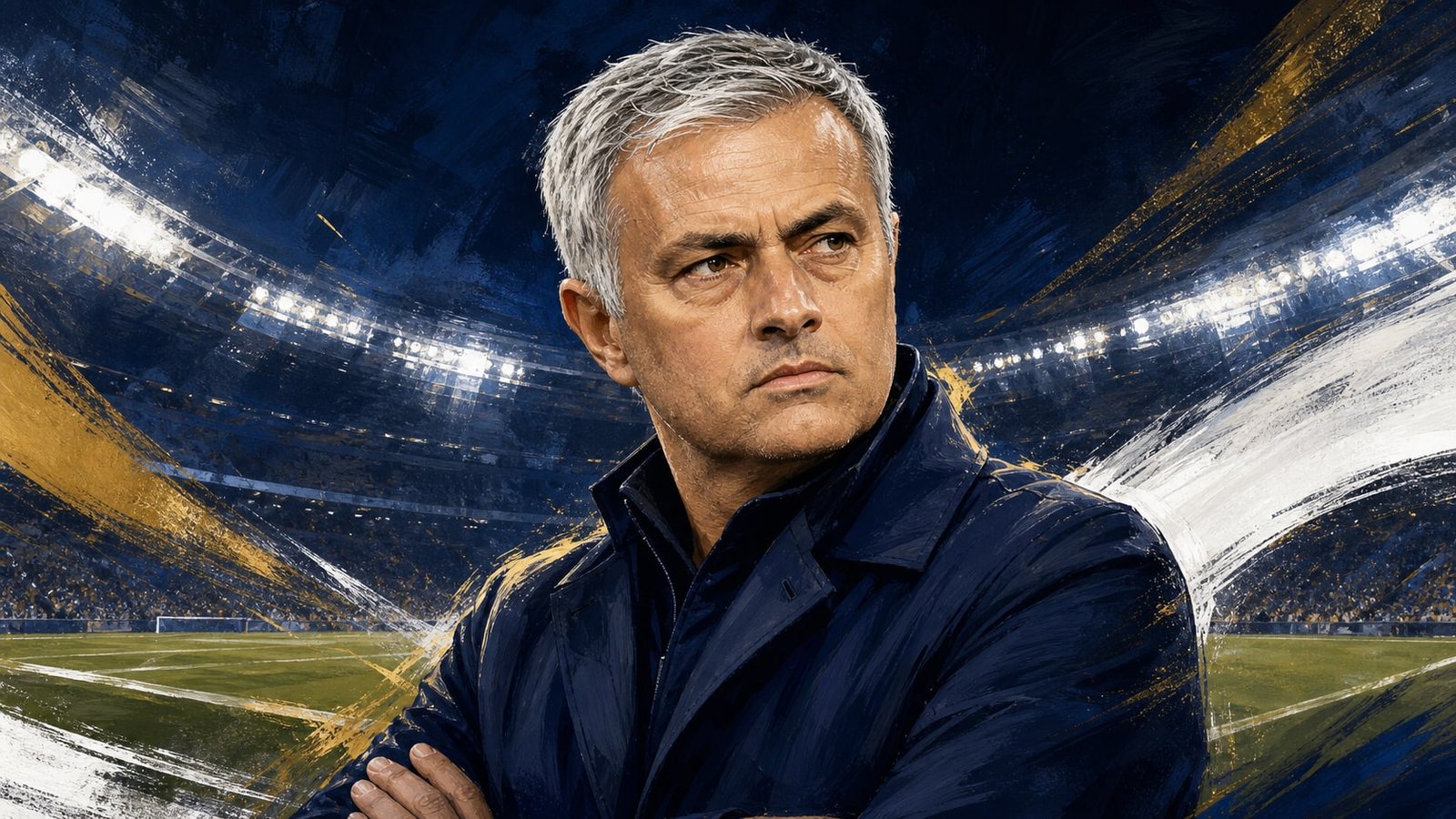
There was no stage. No white shirt held aloft, no scarf, no roar from a packed Bernabéu concourse. When Real Madrid finally made José Mourinho’s return official on 18 August 2026, they did it in a boardroom at Ciudad Real Madrid, with Florentino Pérez and honorary president José Martínez Pirri for company and the cameras of the club’s in-house television channel for an audience. For a club that has spent two decades turning arrivals into spectacle, the restraint was itself a kind of message.
By then Mourinho had already been working for five weeks. He had been appointed on 11 June, four days after Pérez won re-election on a platform that named bringing Mourinho back as a central promise. Madrid paid Benfica €15 million to release him from a contract running to 2027. He signed until 30 June 2029 and reported for preseason on 13 July. The quiet ceremony in August was a formality catching up with a decision that had been made, in spirit, long before.
Four competitive matches later, the picture is clearer than four matches usually allows — because Mourinho has spent every available microphone explaining exactly what he is doing.
What He Says He Wants
The single most revealing thing Mourinho has said since returning was not about tactics or transfers. Speaking to the club’s channel after the presentation, he reached for a Portuguese phrase he said he couldn’t quite render in Spanish: “we should not work at Real Madrid; we should work for Real Madrid.”
That distinction is the organising idea of his second tenure. He has framed the whole enterprise as a mission rather than a job, drawing an explicit contrast with 2010, when he arrived wanting the biggest club in the world for his own résumé. This time, he insists, the emotional weight runs the other way. He also pushed back on the caricature that preceded him — the idea that he was returning as a disciplinarian to impose order on a dressing room that had spent eighteen months coming apart. What he asks for, he said, is common sense: arrival times, gym work, tactical analysis, respect for the profession and the institution.
That framing has a purpose. Madrid’s 2025-26 season was a slow collapse. Xabi Alonso lasted less than eight months before being dismissed midway through the campaign; Álvaro Arbeloa, promoted from the reserves, finished the job and finished it trophyless. It was a second consecutive season without a major trophy, a second consecutive second-place finish behind Barcelona, and a second consecutive Champions League quarter-final exit. Reports of training-ground friction between Aurélien Tchouaméni and Federico Valverde captured the mood better than any league table.
Mourinho’s answer has not been to promise discipline. It has been to promise commitment, in language that occasionally overshoots. Asked in his first press conference about summer signing Yan Diomandé’s pledge to run through walls for him, Mourinho said “I would like him to die for the group, for Real Madrid.” He was careful, though, to add that words are the easy part, and to concede that the group is not perfect and that problems will come.
On the eve of the opener at Espanyol he was asked, inevitably, about pressure. “I don’t feel pressure from debuts or any football match,” he said, describing what he feels instead as adrenaline. Two decades of doing this, he noted, has taken the novelty out of first days.
The Squad He Built
Mourinho did not inherit this team so much as commission it. Pérez sanctioned a summer of spending that pushed past €500 million in gross outlay, and Mourinho was in the room for it.
The headline was Yan Diomandé, the 19-year-old Ivorian winger signed from RB Leipzig on 6 August after Madrid outbid Paris Saint-Germain and Liverpool. The reported structure is €125m guaranteed plus up to €15m in bonuses, on a seven-year deal to 2033; if the add-ons trigger, it becomes the most expensive transfer in the club’s history, past Bellingham and Hazard. Leipzig had bought him from Leganés a year earlier for €20m. He was the source of most of the criticism the window attracted.
Around him came value: Ibrahima Konaté (four-year deal) and Bernardo Silva (two years) both arrived on free transfers from Liverpool and Manchester City respectively, continuing Madrid’s recent mastery of the Bosman market. Marc Cucurella came from Chelsea in a reported €60m deal, and Denzel Dumfries added competition at right-back. Carlos Espí, a 21-year-old, 6ft 4in centre-forward from Levante, was identified, signed and playing a friendly inside a week — the clearest fingerprint of a manager who knew what shape he wanted before he arrived.
One piece of context sits underneath all of this: the 2026 World Cup. It compressed the summer, delayed several arrivals — Cucurella, Bernardo Silva and Konaté all joined after the tournament — and left Bellingham, Tchouaméni and Mbappé on post-tournament rest for much of preseason. It is why Mourinho keeps returning, unprompted, to the fact that his players had wildly different preparations.
The exits were as significant. Dani Carvajal and David Alaba both left as free agents at the end of their contracts, closing eras. Carvajal’s departure, announced in May after 23 seasons in the club’s structure, means Madrid no longer have a single player from the side that won the 2016, 2017 and 2018 finals. Federico Valverde has taken the captaincy. Dani Ceballos and Nico Paz left. Gonzalo García and César Palacios followed Arbeloa to Fulham for a combined €50m. Madrid raised over €200m from academy-developed players alone.
Two targets got away, and both sting. Rodri chose Barcelona. A €150m bid for Julián Álvarez was rejected by Atlético. Mourinho’s public response was to declare the work finished: “I would be most happy to keep the squad as it is.”
His description of what he built is worth attending to, because it doubles as a warning to the players. He has repeatedly described the squad as balanced rather than bloated — roughly two players per position within a single model of play, so that the man on the bench today can reasonably expect to start tomorrow. That is not a boast about depth. It is a statement about leverage.
The Shape
Preseason pointed consistently at a 4-3-3, and the league games have largely confirmed it, with rotation built in from the start rather than introduced under duress.
Thibaut Courtois remains in goal. The back four has cycled through Trent Alexander-Arnold and Dumfries at right-back, a centre-back pool of Konaté, Dean Huijsen, Antonio Rüdiger and Éder Militão, and Cucurella competing with Álvaro Carreras on the left. Mourinho has been explicit that this is by design; he name-checked Cucurella starting with Carreras in reserve as an illustration of how he intends the squad to function.
Midfield is where the interesting problem lives. Tchouaméni sits, Valverde runs, and Jude Bellingham has been pushed forward into the advanced role he occupied before Kylian Mbappé’s arrival reshaped the attack. Bernardo Silva is the wildcard — Mourinho tried him in a deep pivot alongside Eduardo Camavinga in preseason with Valverde left out entirely, which suggests he sees the Portuguese as a genuine deep-lying option rather than a luxury. The unresolved question is progression: a Valverde-Tchouaméni pairing is disciplined but not naturally incisive under pressure, and Arda Güler’s ability to solve that from deep is the most interesting subplot of the autumn.
Ahead of them, Mbappé through the middle, Vinícius Júnior — now signed through 2032, his summer of Arsenal speculation resolved — on the left, and Diomandé on the right. Espí, an actual target man, gives Mourinho a structural alternative he has not had in this squad before.
Four Games
Espanyol (a) 2-1, 22 August. Madrid’s first match of the season, though technically matchday two — their matchday one fixture against Real Sociedad was postponed and played later. Bellingham headed Madrid ahead in the ninth minute. Álex Calatrava equalised. Espí, a substitute, won it in the 90th. Mourinho’s assessment afterwards was generous to the opposition and specific about his own bench, which he credited for the win — a theme he has returned to repeatedly.
Real Sociedad (h) 4-1. The rescheduled matchday one, and a comfortable first night back at the Bernabéu.
Málaga (h) 4-0, 30 August. Five changes, Alexander-Arnold’s first start. Bellingham scored a solo goal past three defenders in the 19th minute, then forced an own goal off goalkeeper Alfonso Herrero. Mbappé volleyed home an Alexander-Arnold cross for his fourth of the season before half-time. Güler tapped in a late fourth. Three-nil inside 30 minutes was Madrid’s fastest since 2019. Bellingham left to a standing ovation and said afterwards that he has freedom to move higher or deeper as required, and that he is enjoying himself.
Mourinho’s own verdict pointed somewhere else entirely. He noted that a clean sheet had been an explicit objective, and added: “it’s also about going home thinking that we’re a solid unit.” Three-nil at half-time and the manager’s takeaway was the shutout. That is the whole man in one sentence.
Real Betis (a) 0-1, 4 September. The reckoning. Madrid dominated — ESPN logged eight shots on target and an expected-goals figure of 3.16, though some outlets recorded seven on target — with Vinícius and Mbappé both striking woodwork. Troy Parrott scored on 81 minutes. Espí had an acrobatic equaliser ruled out for offside. Mbappé then had a 93rd-minute penalty saved by Álvaro Vallés. It was the first time Madrid had lost one of their opening four league games since 2014-15.
Mourinho was, by turns, baffled and combative. “We deserved to win clearly, but deserving doesn’t get you points,” he said, and elsewhere that “sometimes you lose and cannot explain how.” He declined to blame Mbappé for the penalty. He declined to criticise anyone individually.
And then he did. “The Betis players are smarter than those of Real Madrid, who are pure, naive,” he said — a complaint not about finishing but about game management, about knowing how to work a clock and a referee. He questioned the officiating standard, noting pointedly that “Betis reached half-time without a single card” while Güler had been booked. He accepted his own yellow with a shrug and stopped short of blaming the result on any of it.
That performance drew the reaction such performances always draw: half the internet delighted that the old Mourinho was intact, half calling it sore losing.
The Vinícius Project
The most consequential thing Mourinho has done off the pitch is adopt Vinícius Júnior’s cause as his own. After the Espanyol game he argued the Brazilian is subjected to something excessive — “Vinicius is no saint, but what they’re doing to him was too much” — and framed it as bullying by opponents and crowds alike. He also told Vinícius, in his own telling, that “he has to have great emotional control” and to be careful even in celebration.
Days later he extended it into a shot across Barcelona’s bow, comparing opponents testing Vinícius to “little children, who go as far as you allow them” while professing trust in Spanish refereeing in a tone nobody mistook for sincere.
The complication is that in February, as Benfica manager, Mourinho publicly assigned Vinícius partial blame during a racism controversy involving his own player, who was later banned six matches by UEFA. Mourinho has acknowledged that history exists. He has simply changed sides, and he knows everyone noticed.
What to Expect
Madrid sit third with nine points from four, level with Betis, three behind a Barcelona side that has won all four. The Champions League begins at home to Inter Milan. The derby and the Clásico both arrive early.
The realistic case for optimism is that this squad is deeper and more coherent than last season’s, that Bellingham looks liberated, that Mbappé has four goals already, and that the Betis defeat was a performance rather than a problem — a 3.16 xG night that ended 0-1 is variance, not decay. The clean sheet against Málaga mattered more to Mourinho than the four goals for a reason.
The case for doubt is longer. Jorge Valdano, no neutral observer given their history, questioned the logic out loud: “I don’t know what the point is for Jose Mourinho to return.” He added that football, society, Pérez and Mourinho himself have all changed in fifteen years. Mourinho’s tenures follow a well-worn arc — brilliant first year, tense second, combustible third — and he has signed for three. The midfield’s ability to progress the ball under pressure is unresolved. And Barcelona, having added Rodri, are not obviously waiting.
Mourinho’s own framing of the standard is the one to hold him to. Asked before Betis what it would take to win in Seville, he said: “Real Madrid needs to be great; otherwise, it won’t win.”
They weren’t. They didn’t. That is the whole season in miniature, and it arrived in week two.