

History · NFL
The AFL–NFL Merger: From the 1966 Agreement to One League in 1970
The 1966 agreement, a contemporary federal statute and the 1970 conference structure mark separate steps in the AFL–NFL merger.
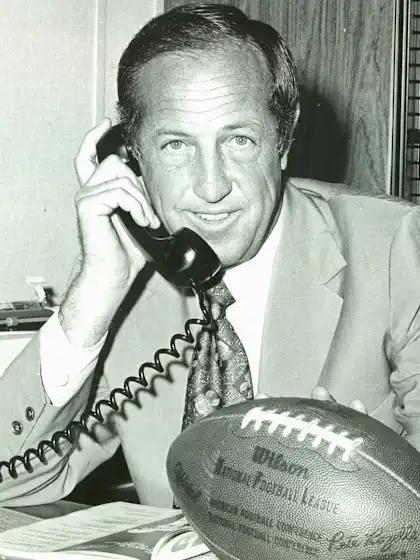
The AFL–NFL merger has two essential dates: the agreement announced in 1966 and the unified league that began play in 1970. Between them, the leagues had to turn an agreement among owners into an operating structure. A contemporary federal statute shows that the transition also had a legal dimension.
On June 8, 1966, Pete Rozelle announced the merger following negotiations involving Kansas City’s Lamar Hunt and Dallas’ Tex Schramm. The Pro Football Hall of Fame chronology records the commitment to preserve existing franchises, keep them in their metropolitan areas and expand the combined membership. That meant the arrangement was designed around retaining clubs, rather than eliminating the rival league’s teams.
An agreement followed by legislation
The legislative record supplies a useful check on the distinction between announcing a merger and implementing one. Public Law 89-800, approved November 8, 1966, included a football provision within a broader tax measure. Section 6 amended the 1961 sports-broadcasting legislation to address a joint agreement combining professional football leagues into a single expanded league.1
The provision was conditional. It addressed an agreement that increased, rather than decreased, the number of operating professional football clubs, together with provisions directly relevant to that combination. It did not simply declare every future activity of the resulting league immune from scrutiny.
The expansion and franchise-retention promises therefore had both an organizational and a legal context. The statute conditioned its treatment on adding clubs, while the agreement preserved existing franchises.
A championship before a common league
Green Bay and Kansas City met on January 15, 1967, in the first AFL–NFL championship game. The Packers won 35–10. The matchup established a championship between the two leagues before they became the conference structure of a single league.
In 1969, Baltimore, Cleveland and Pittsburgh agreed to join the AFL clubs in the American Football Conference. The Hall of Fame record places the merged 26-team league in 1970. Those steps distinguish the competitive bridge between the leagues from the eventual reorganization.
The 1966 deal settled the framework. Common championship competition followed in January 1967, and regular-season play in the combined league began in 1970. The championship game and the unified conference structure mark different stages of the merger.
Sources and notes
1. Public Law 89-800, section 6, 80 Stat. 1515–1516, approved November 8, 1966. Contemporary statutory text establishes the conditional football combination provision. This is a historical account, not advice about current law.
2. Pro Football Hall of Fame, 1960–1979 chronology. Later institutional chronology supplies the announcement, championship and conference sequence. It is distinguished here from the contemporary statute.