
NHL
Schaefer vs. McKenna: No. 1 Picks Meet as Islanders Visit Maple Leafs
Gavin McKenna returns after a long stretch on Toronto's bench. Matthew Schaefer arrives carrying a major workload for the Islanders as the past two No. 1 picks meet again Saturday.
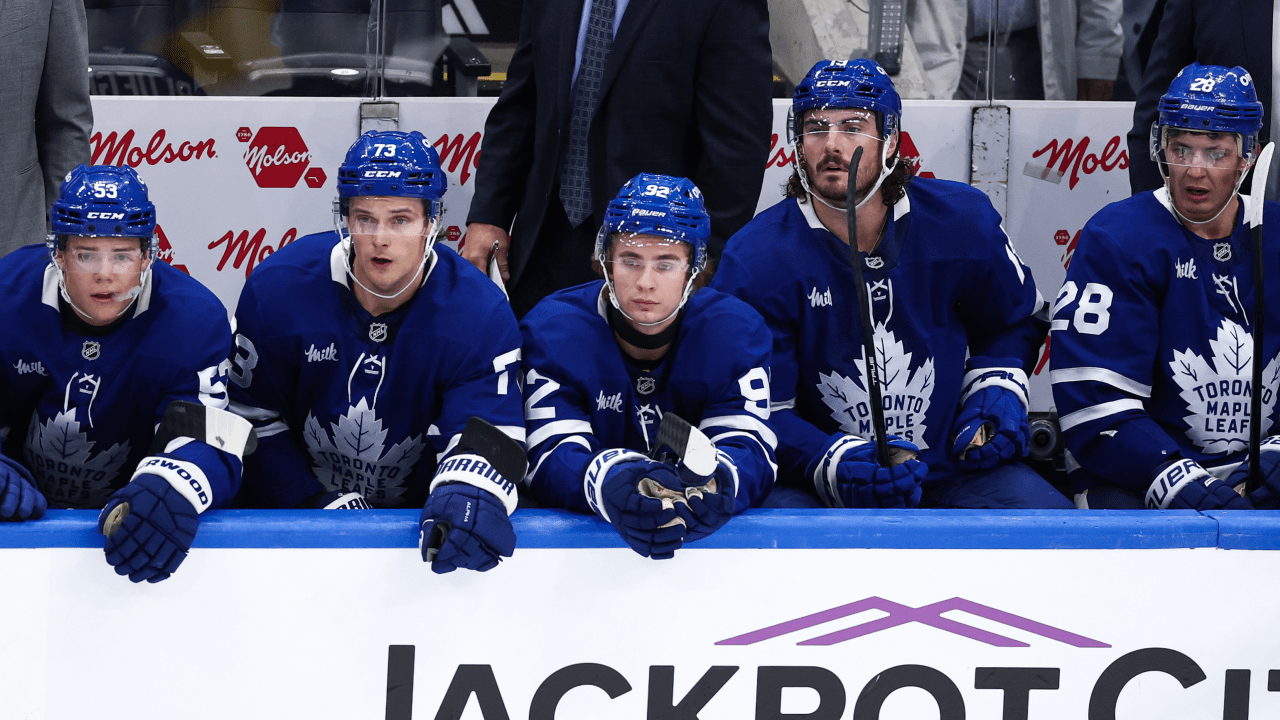
Matthew Schaefer arrives in Toronto after playing nearly half a game in Ottawa. Gavin McKenna returns to the same rink where he spent most of Thursday’s second half watching from the Maple Leafs’ bench. Their meeting Saturday brings together the last two first overall draft picks at markedly different stages of earning responsibility in the NHL.
Schaefer, the Islanders’ 19-year-old defenceman, already carries a leading role on his team’s blue line. McKenna, Toronto’s 18-year-old winger, is eight games into finding his place in an NHL lineup. The interest in their meeting goes beyond the draft order. Their recent games provide a specific question for Saturday: how much will each coach ask his young player to do when the result is still unsettled?
Islanders at Maple Leafs: how to watch
| Date and time | Saturday, October 17, 2026, at 7 p.m. ET |
|---|---|
| Arena | Scotiabank Arena, Toronto |
| Canada | Sportsnet Ontario, Sportsnet West and Sportsnet Pacific; Sportsnet+ |
| Islanders’ local broadcast | MSGSN; MSG+ on DAZN |
The game is part of Sportsnet’s Saturday Night Hockey coverage.
Schaefer’s responsibility grows with an injured defence
The Islanders’ challenge is managing how often they turn to Schaefer. Alexander Romanov’s season-ending knee injury has already changed their defensive arrangements, leaving coach Pete DeBoer with fewer options while he tries to establish his preferred structure.
Andrew Gross reported in Newsday on October 9 that Schaefer remained on his off-side alongside fellow left-handed shot Logan Stanley. Schaefer also directs the first power-play unit. DeBoer has deliberately reduced another assignment to help control the overall workload.
“We’ve taken his penalty-killing away and used other guys,” DeBoer told Newsday.
That choice matters when watching his minutes. A large total does not mean every responsibility has been increased together. The Islanders are deciding where his shifts will do the most good, with a separate calculation about how much the rest of the defence can absorb.
Schaefer acknowledged the physical demand in that same report. “There can be times where it’s a very long shift and I’m a little gassed,” he told Newsday.
His 29:29 against Ottawa on Thursday shows how substantial the assignment can become even without a full penalty-killing role. The Islanders’ Saturday preview identified it as the third-highest total of his career.
Toronto can test the decisions that follow those minutes. A young defenceman who carries the puck out of his zone must judge when a passing option is available and when an attempted advance exposes his partner. The useful evidence Saturday will come in the shifts after extended defensive work, when Schaefer has to recover quickly enough to contribute to the next possession.
McKenna’s next assignment follows Thursday’s benching
McKenna’s immediate context is different. He played 6:36 in Thursday’s 5-4 overtime loss to Buffalo and did not appear during the final 32:54. Toronto surrendered a 4-2 lead, leaving the handling of the rookie among the questions Hiller faced afterward.
“I probably should have got him out there early in the third. I didn’t,” Hiller said, according to Luke Fox’s Sportsnet report carried by CityNews.
Hiller described a sequence that began with penalties, continued through an intermission and ended with him deciding the winger had been sitting too long to re-enter. His explanation places a significant part of the episode on the coach’s management of the bench.
Fox also reported a limitation in McKenna’s play: difficulty slowing opponents through the neutral zone. That is a specific area to watch against an Islanders team featuring a defenceman capable of carrying possession through that part of the ice. McKenna’s response when Toronto loses the puck will matter alongside the opportunities he creates with it.
Captain Auston Matthews offered support after the Buffalo game, saying “we’ve all got his back.” McKenna was not made available for a postgame interview, Fox reported.
Saturday should offer a clearer view of what follows it. His placement in the lineup, the frequency of his shifts after a mistake and any late-game assignment will each help establish whether Thursday was an isolated interruption or the beginning of a more restricted role.
The production needs the context of the minutes
The NHL’s season statistics, through the games of October 15, show the different workloads:
| Player | GP | G | A | Points | Average ice time |
|---|---|---|---|---|---|
| Matthew Schaefer, NYI | 7 | 0 | 6 | 6 | 26:01 |
| Gavin McKenna, TOR | 8 | 2 | 3 | 5 | 13:57 |
Schaefer’s season average is 12:04 higher than McKenna’s, which helps explain why similar point totals can conceal very different levels of responsibility. Schaefer plays defence and is already a central outlet for New York. McKenna works within Toronto’s forward combinations, with fewer minutes available to influence a game. Their team situations also create different opportunities on the power play and different consequences when a shift breaks down.
For McKenna, there is already an example of how quickly an opportunity can become a contribution. Against Nashville on October 6, he assisted on a John Tavares goal before scoring his first NHL goal in the same period. Toronto recovered from a three-goal deficit and won 5-4 in overtime.
The Canadian Press reported that McKenna finished that game with four shots in 14:45. Hiller praised the execution of his shot after a pass from Matthews. The production came during a normal night of work, well short of the heavy minutes Schaefer is receiving.
“Every single game I’ve been trying to get better,” McKenna said after the Nashville win.
McKenna can draw on teammates who have experienced the attention attached to being picked first. Matthews was the first selection in 2016, while Tavares went first in 2009. The Canadian Press reported that McKenna is living with Tavares this season, giving the rookie a connection to an established teammate away from the rink as well.
“I’ve learned so much from those two,” McKenna said of Tavares and Matthews. He described watching how they conduct themselves on and off the ice. That support gives the rookie people to consult between games, when the questions raised by a night such as Thursday’s can be discussed outside the immediate pressure of a shift.
Both coaches are setting limits
The different workloads should not obscure a similarity between the teams. DeBoer also shortened the opportunities of young players in Ottawa. Gross reported in Newsday’s assessment of the Islanders that Cal Ritchie did not play the final 11:30 of regulation or overtime.
“The players make those decisions for me,” DeBoer said in that report, pointing to puck-management problems and penalties.
There is an immediate distinction to watch Saturday: Schaefer’s extensive use has to coexist with the standards being applied around him. McKenna’s next opportunity will arrive within a Toronto team trying to prevent another lead from disappearing. Each coach is making development decisions while still pursuing the points available that night.
Toronto won the clubs’ first meeting 2-1 at Scotiabank Arena on September 30. Cowan scored Toronto’s winner on the power play. Saturday’s rematch gives both young players another encounter with the same opponent, after several more games of evidence about the demands of their roles.
Schaefer played 27:45 in that first meeting; McKenna played 15:32. Neither recorded a point, according to the NHL’s event summary.
An effective Toronto forecheck can put pressure on Schaefer before he has a clean outlet, while an Islanders breakout can force McKenna to turn and defend. Following those sequences through the neutral zone will show how each influences the other’s available space. That remains useful evidence on shifts that produce no scoring chance, particularly immediately after either team turns the puck over.
For Schaefer, watch whether the Islanders can keep returning to him without losing pace on their next shift. For McKenna, watch whether a useful early shift brings a regular place in the rotation later. Their effect on those decisions will give Saturday’s draft connection substance beyond the scoring summary.