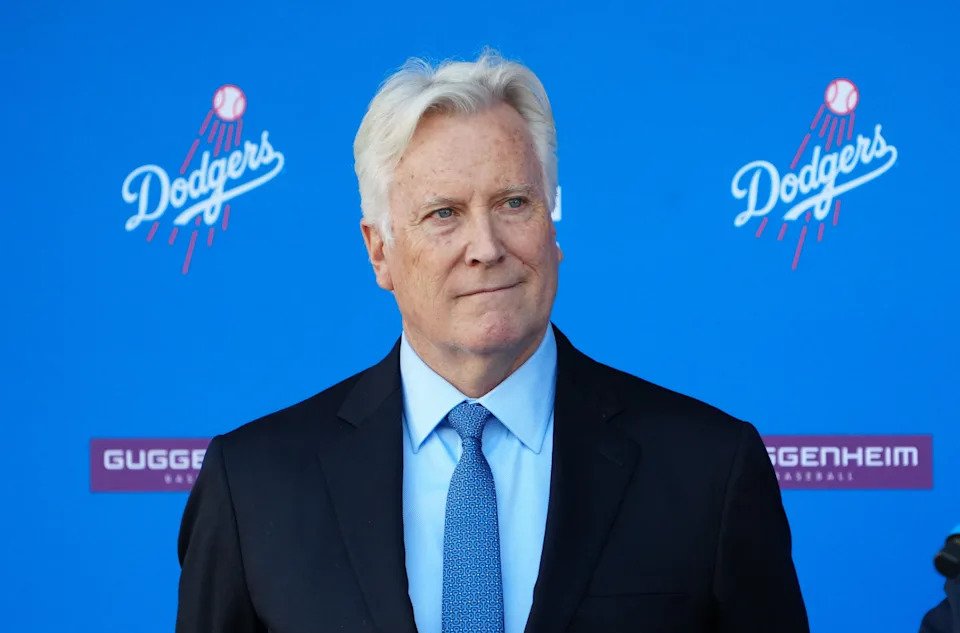
Ira Rosner says leaving an insurer controlled by Dodgers owner Mark Walter cost him $116,575.53. In a federal complaint filed September 16, the Florida policyholder alleges that Delaware Life sold him an annuity without disclosing an investigation that would have changed his decision to buy it. When he subsequently surrendered the contract, he says, a surrender charge and a market-value adjustment reduced the money returned to him by that amount.
His allegation turns on a short interval within a long-term retirement arrangement. According to the complaint, he received the contract in April, his penalty-free cancellation window ended in May, and the company disclosed the investigation in June. He contends that withholding the information deprived him of the chance to leave without paying to do so.
Group 1001, Delaware Life’s parent group, disputes the implication of wrongdoing. In a September 17 statement to Front Office Sports, it said no court had found that Group 1001 or Delaware Life had done anything wrong and promised to “defend the case vigorously.” Rosner filed a proposed class action; the allegations are not judicial findings.
Walter’s insurance businesses have become a subject for sports readers as he arranges exits from prominent holdings. His agreement to sell his Lakers interest to a group led by Joshua Kushner and Bob Iger has been followed by Chelsea’s announcement that Clearlake will acquire his interest there. The Lakers deal remained under league review in Associated Press reporting on September 18.
The financial documents explain why those ownership changes warrant attention, but they do not establish where every dollar from a sports sale will go. The central issue is the relationship between investments supporting insurance obligations and businesses connected to the insurer’s owner. Delaware Life has acknowledged that it failed to identify and report some of those relationships properly.
The retirement promise behind the dispute
An annuity is an insurance contract under which a customer pays money in exchange for specified benefits. It can provide income for a defined period or for life. The National Association of Insurance Commissioners explains that payment schedules and guarantees depend on the product. A customer purchasing a fixed or fixed-indexed annuity is not simply buying shares in the insurer’s investment portfolio.
Rosner’s contract illustrates the stakes. Front Office Sports reported that he put more than $1 million into a Delaware Life annuity after exchanging an existing policy. The new contract promised annual lifetime income for him and his wife beginning in 10 years, backed by the issuing insurer’s financial strength and claims-paying ability. His objection concerns the institution supporting that promise, rather than a stock-market loss in an investment he personally selected.
The corporate structure places that institution inside a much wider business. In its August statement announcing the proposed asset exchange, TWG Global described interests spanning financial services and sports, including Group 1001 and ties to Guggenheim Partners. Delaware Life is a Group 1001 company. A recognizable team name therefore represents only one part of the network under examination.
An insurer investing money to support future payments is performing an ordinary part of its business. The question is whether its investments are appropriate for those obligations and whether the relationships behind them have been disclosed. An investment can be economically attractive to the owner’s wider organization without automatically being suitable on the same terms for the insurer.
For a policyholder, the distinction has practical consequences. The prospect of a valuable sports franchise becoming more valuable is not a contractual guarantee that an insurer will pay retirement income. Equally, a company’s participation in a financing arrangement does not make its customers owners of that team. The relevant promise remains the one made by the company that issued the policy.
What changed in the disclosures
Delaware Life’s audited financial statements say it and Clear Spring Life and Annuity received federal grand-jury subpoenas in February 2026. The U.S. attorney’s office in Manhattan was investigating, with a parallel Securities and Exchange Commission inquiry. An internal review identified errors in the treatment of related-party investments.
The correction substantially changed the disclosed picture. AM Best reported that Delaware Life’s affiliated investments at year-end 2025 were reclassified from 3% to 42%. Those investments had not all suddenly appeared when the correction was published. Previously reported assets were being recognized as more closely connected to affiliated businesses than earlier disclosures indicated.
The accounting test reaches beyond direct ownership of a borrower. Its accounting policy treats investments as related-party investments when their returns depend predominantly on related parties, defining that dependence as greater than 50%. The name on a loan agreement may therefore be different from the business whose performance ultimately supports repayment.
Consider a hypothetical insurer lending to several intermediaries. Each intermediary has a different name, but each relies mainly on money from businesses under the insurer owner’s control. Separate borrowers would not necessarily provide the independence that their names suggest. Assessing the investments would require looking through the intermediaries to the underlying sources of repayment.
That example describes the accounting concern, not a reconstruction of every transaction in Walter’s network. Delaware’s insurance holding-company law requires fair and reasonable terms and accurate transaction records. Specified transactions also face advance regulatory review. An affiliated investment is therefore not automatically prohibited; the relationship supplies information needed to examine its terms and potential conflicts.
The first-half rise and quarterly decline
The subsequent portfolio figures show why the amount and the percentage both matter. Delaware Life’s published comparison uses general-account invested assets as the denominator. The figures below concern Delaware Life alone, rather than a combined total for both insurers.
| Reporting date | Affiliated assets | General-account invested assets | Affiliated share |
|---|---|---|---|
| Dec. 31, 2025 Restated | $18.251 | $43.883 | 42% |
| March 31, 2026 | $19.799 | $48.184 | 41% |
| June 30, 2026 | $19.148 | $49.336 | 39% |
Source: Delaware Life’s September 11 update. Dollar changes below are TSP calculations.
Between year-end and June, the affiliated share fell from 42% to 39%, while the dollar amount rose by $897 million. The percentage declined because the overall portfolio grew faster than the affiliated holdings. Reading only the percentage would miss that increase in exposure.
The second-quarter comparison shows an actual reduction: affiliated assets fell by $651 million between March and June. Both the share and the dollar amount declined during that quarter, although the dollar total remained above its year-end level.
Those are different observations, not competing versions of the same result. The first-half comparison describes where Delaware Life stood relative to December. The quarterly comparison captures a more recent change in direction. Together they show a quarterly reduction that had not yet brought the exposure below its December level.
The $19.148 billion figure is the recorded value of affiliated assets, not an established loss. It does not mean that borrowers have failed to repay that amount or that an equivalent sum is missing from the insurer. It identifies the scale of a category whose relationships require scrutiny.
Why the assessment of financial risk changed
AM Best’s July 31 action identified a consequence beyond the disclosure itself. The agency said the reclassification materially reduced the group’s risk-adjusted capitalization under its own capital-adequacy measure. It also raised concerns about financial-reporting controls and the difficulty of carrying out the proposed restructuring.
At the same time, AM Best affirmed the A− financial-strength ratings for Delaware Life and Clear Spring Life and Annuity, while moving their outlooks from positive to negative. An outlook change is not the same as a downgrade of the rating. The decision recorded concerns about risk without declaring either insurer insolvent.
The distinction between an accounting total and a risk assessment helps explain the company’s response. Delaware Life says the corrections left reported capital and surplus and earnings for 2024 and 2025 unchanged. That statement can coexist with the rating agency’s less favourable assessment: the recorded amount of capital can remain the same while the understanding of the risks it supports changes.
The NAIC’s explanation of risk-based capital describes the broader regulatory principle that capital requirements depend partly on an insurer’s risk profile. This regulatory framework is separate from AM Best’s proprietary measure. Neither should be presented as a simple subtraction of all affiliated investments from available capital.
For illustration, an insurer holding several exposures dependent on the same business may be more vulnerable to a problem there than an insurer holding genuinely independent exposures. Knowing the connection changes the assessment even before a borrower misses a payment. That is why accurate classification matters to evaluating the financial cushion, rather than merely to completing a disclosure form.
What the sports agreements establish
The NBA approved Walter’s controlling Lakers purchase on October 30, 2025. The subsequent agreement with the Kushner and Iger group puts another ownership transition in motion less than a year after that approval.
The Wall Street Journal reports a $12.5 billion franchise valuation for the new agreement. That is not Walter’s disclosed cash receipt. It also does not establish his profit: calculating a seller’s return requires the interest sold and the relevant costs, rather than subtracting one whole-franchise valuation from another.
Chelsea’s September 16 announcement says Clearlake affiliates will acquire the interests of Walter and Todd Boehly, giving Clearlake full control. Hansjörg Wyss will remain a stakeholder, and the club said its day-to-day operations and strategy would not change. Full control does not mean ownership of every share.
The Financial Times reported £950 million in combined cash consideration for Walter and Boehly’s holdings, with completion scheduled by year-end. That is a combined payment to two sellers, denominated in pounds, not Walter’s individual proceeds in U.S. dollars.
TWG has rejected the characterization of its sports transactions as a fire sale. In an August 26 response reported by Reuters, it denied fraud and said the Dodgers were not being sold. Associated Press subsequently reported the Dodgers’ continued insistence that Walter had no plans to sell the baseball club.
Selling a valuable investment could provide financial flexibility while an owner reorganizes other businesses. The price alone cannot establish whether that flexibility was necessary, however, and the timing cannot identify the destination of proceeds. Connecting a sports sale to repayment of a particular insurer investment requires the payment trail between the relevant companies.
The Dodgers links that can be traced
One documented connection appears in Delaware Life’s first-quarter investment schedule. Schedule D, Part 4 lists Dodger Tickets LLC senior secured notes among disposals of affiliated corporate bonds. A March 31 redemption records $734,517 in consideration.
The entry establishes that an investment bearing the Dodger Tickets name was recorded in that affiliated category. It is a transaction entry, not the complete financing agreement. The redemption amount cannot be substituted for the original loan’s size or the insurer’s total remaining holdings. Nor does the schedule identify spending on a particular player’s contract.
A separate financing relationship was examined in TSP’s earlier reporting on EquiTrust and the Dodgers, drawing on Pablo Torre and Hunterbrook. That history matters, but it involves a different insurer and a different period.
Hunterbrook reported that EquiTrust acquired $350 million of American Media Productions debt in 2014. The company was behind SportsNet LA, the Dodgers’ local television network. Guggenheim still owned EquiTrust when the debt was acquired, although Magic Johnson’s planned purchase had been announced. The transaction therefore preceded Johnson’s control of the insurer.
Hunterbrook also examined EquiTrust’s investment in JLC Infrastructure Fund I and overlapping relationships involving Johnson and Eric Holoman. The outlet acknowledged that incomplete information prevented a definitive determination that the classifications it questioned were improper. It disclosed that its associated investment business, Hunterbrook Capital, held short positions in specified securities when the investigation was published.
Those qualifications remain material. TSP has not independently reconstructed the complete EquiTrust transactions, and Delaware Life’s acknowledged reporting errors do not establish that EquiTrust committed the same error. The Dodger Tickets entry and the television financing are separate connections; they should not be presented as one continuous flow of money without the records to join them.
What the $6.5 billion exchange would change
Delaware Life’s second-quarter filing records an August 17 agreement with TWG Global, LLC to exchange up to $6.5 billion of investments dependent on affiliates for up to $6.5 billion of non-affiliated investments. Closing requires regulatory approval. The agreement describes an exchange of assets, not simply a cash payment into the insurer.
The distinction identifies the work the transaction is intended to do. As TWG described it in its announcement, the holding company would take investments tied to affiliated entities, while the insurer would receive independent assets. The relevant exposure would move out of the insurance portfolio rather than disappear throughout the wider organization.
Delaware Life projects an affiliated share of approximately 26% after the full exchange, depending on how certain assets are held. With additional purchases, its September 11 plan targets 20%–25% by year-end and below 10% by June 30, 2027. The company says no regulatory requirement or external mandate imposes that timetable. These are announced targets, not results already achieved.
A simplified calculation illustrates the proposed first step. Subtracting $6.5 billion from June’s $19.148 billion of affiliated assets leaves $12.648 billion. Holding the $49.336 billion overall portfolio unchanged would put the affiliated share at about 25.6%. That broadly explains the projected 26%; it is not a forecast of the actual closing portfolio.
The replacement assets still need examination on their own merits. Independence from an affiliate does not determine whether a borrower is creditworthy, or whether its repayment schedule fits the insurer’s obligations. Exchanging equally valued assets can change the sources of repayment without increasing the amount available to meet claims.
Its control-remediation plan calls for stronger counterparty checks and internal-audit monitoring before filing the year-end statements. Those changes address a different problem from reducing the holdings: how the insurer recognizes relationships before it reports them.
An effective review would therefore examine both the transferred investments and the process used to classify what remains. A lower affiliated percentage would measure progress against one stated target. It would not, on its own, explain why the earlier reporting failed or demonstrate that the same weakness cannot recur.
The questions a team sale cannot answer
Rosner’s lawsuit presents an alleged cost associated with leaving a contract, not a finding that all policyholders have suffered investment losses. The complaint names Walter and financial companies, not the Dodgers or his other sports teams. The companies’ responses contest wrongdoing while acknowledging that investment reporting needed correction.
The transactions supply identifiable connections between insurance finance and sports ownership interests. They do not justify treating an entire team’s payroll as money improperly taken from retirement customers. For policyholders, the more immediate issue is whether the investment portfolio supporting their contracts has been accurately described and appropriately managed.
The records needed to assess the response are the completed exchange documents and subsequent investment statements, alongside whatever the legal proceedings establish about the earlier conduct. A franchise can change owners before those questions are answered. The distinction matters because the obligation to pay retirement benefits remains with the insurer, regardless of whose name appears on a team’s ownership announcement.