

Boxing · Comics · 1978
When the Greatest Fought Superman
An oversized comic gave Muhammad Ali equal billing with the Man of Steel—and made the heavyweight champion Earth’s last line of defence.
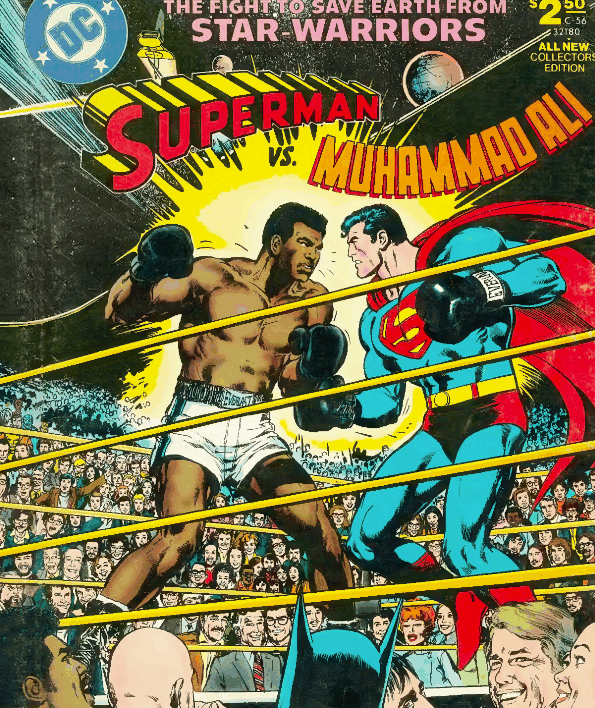
Cover art for Superman vs. Muhammad Ali. Neal Adams / DC Comics, 1978. © DC Comics and respective rights holders. Reproduced here for editorial identification and commentary.
In the spring of 1978, Muhammad Ali entered a contest stranger than anything a promoter could have arranged. The opponent was Superman. The venue was an oversized comic book. The stakes, naturally, were the survival of Earth.
Superman vs. Muhammad Ali appeared as All-New Collectors’ Edition No. C-56, a tabloid-sized DC special built around two men whose public identities already exceeded their professions. Superman was the most recognizable superhero in American popular culture. Ali had made himself something equally difficult to contain: heavyweight champion, political figure, entertainer, dissenter and global celebrity.
The story begins when an alien people called the Scrubb demand that Earth choose one champion to face their fighter, Hun’Ya. Superman volunteers. Ali objects. Before either can represent the planet, they must settle the question between themselves.
The solution is wonderfully literal. Superman temporarily gives up his powers beneath a red sun and trains under Ali. In the ring, skill matters more than mythology. Ali wins. The plot then expands from prizefight to invasion story, and the rivals become partners: Ali faces the alien champion while Superman attacks the Scrubb fleet.
That balance is the comic’s enduring idea. Ali does not need superpowers to share the title. He brings discipline, speed, nerve and an intelligence sharpened by years of studying opponents. Superman may be stronger, but Ali understands the ring.
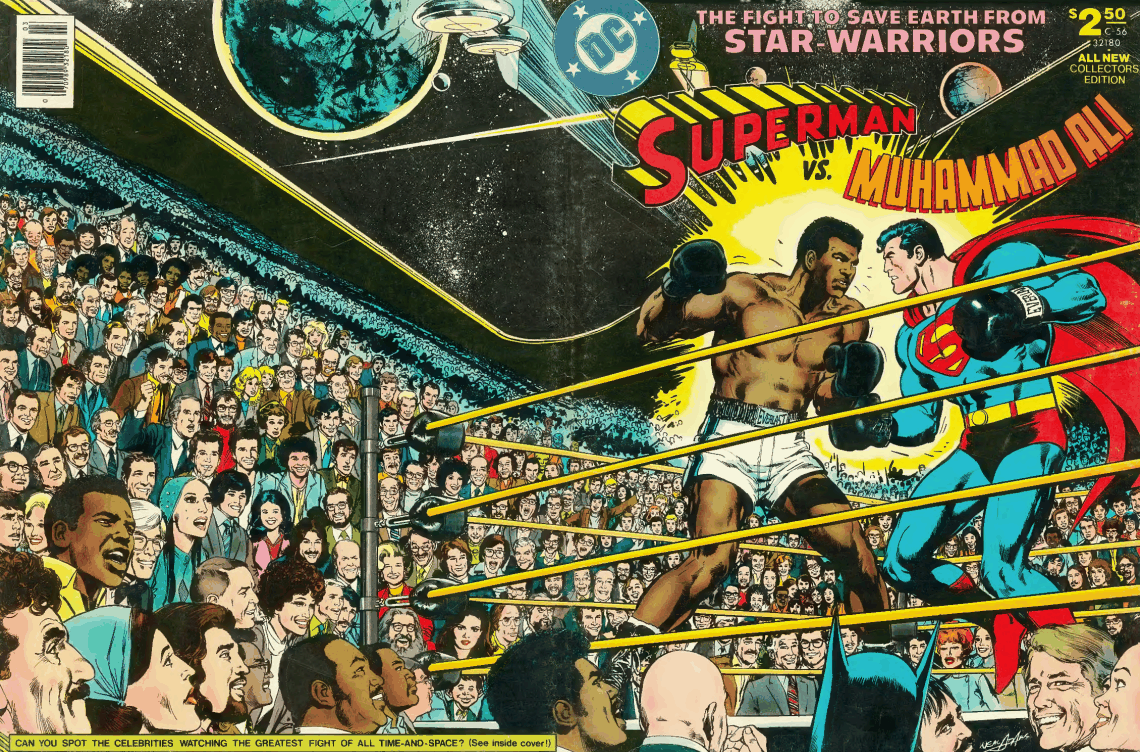
Neal Adams developed the story and supplied the defining artwork; Denny O’Neil shared the writing credit, with Dick Giordano and Terry Austin contributing to the art and Gaspar Saladino lettering the book. Adams’s wraparound cover packed the audience with famous faces, inviting readers to treat the impossible bout like the century’s largest public event.
The premise was promotional fantasy, but the respect was real. DC did not ask Ali merely to stand beside its hero. It allowed him to outbox Superman, save the world and remain unmistakably himself. For one exuberant issue, “The Greatest” was not a nickname awaiting proof. It was the story’s starting point.
Sources and image note
- DC, “Superman vs. Muhammad Ali,” October 26, 2010.
- DC, “Superman vs. Muhammad Ali Facsimile Edition,” official synopsis and credits.
- The cover images are copyrighted comic artwork. Their use in this preview is limited to identifying and discussing the work; publication counsel or the rights holder should review use on a commercial launch.