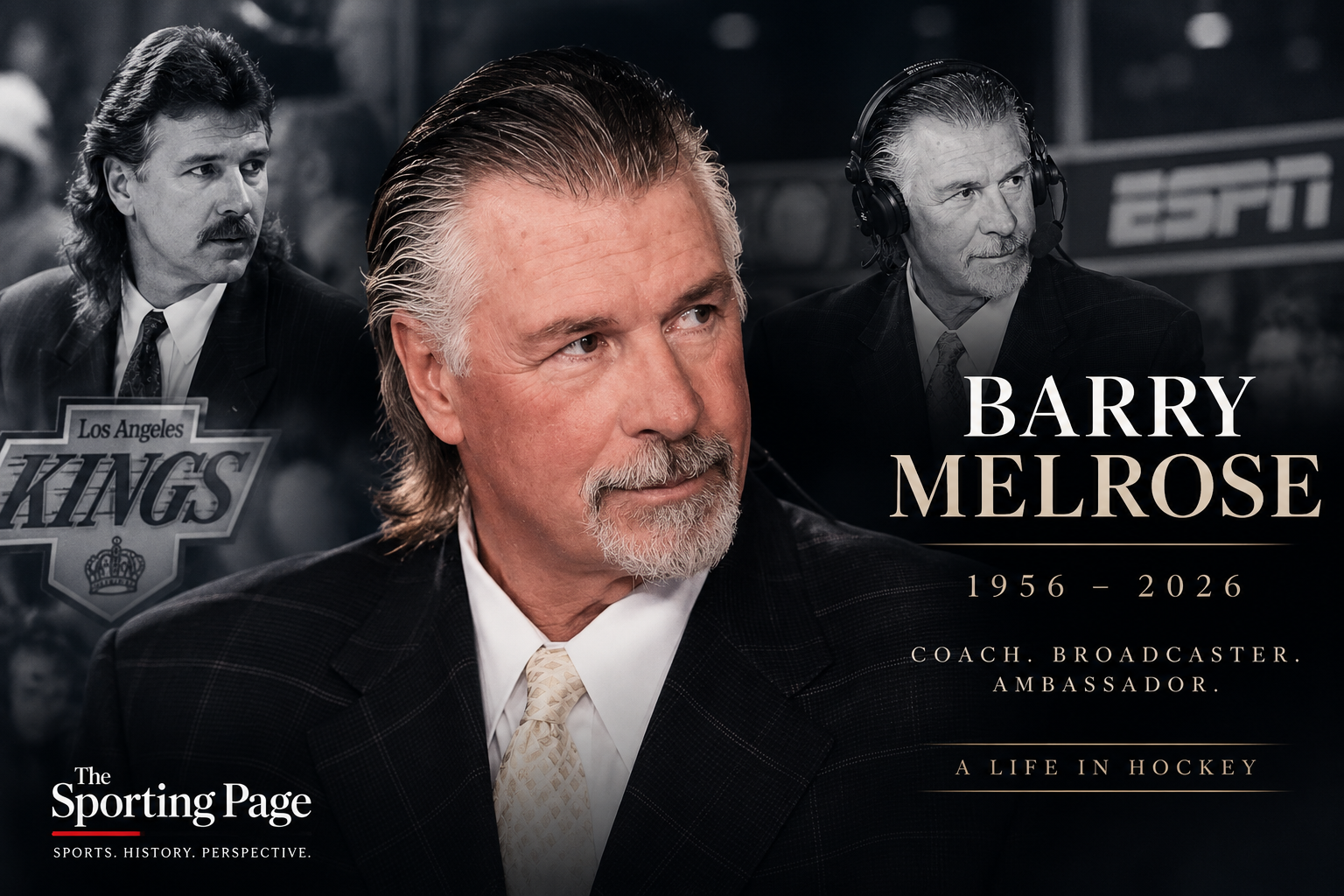
Barry Melrose was part of an unforgettable hockey spring before he became part of the way so many people watched the game.
In 1993, he was the first-year NHL head coach taking Wayne Gretzky and the Los Angeles Kings to the franchise’s first Stanley Cup Final. His subsequent television career brought him into the homes of American sports fans who knew hockey well, and others who were still being introduced to it. Reaching that second audience was something he consciously worked at and took pride in.1, 2
Melrose died September 9 at 70. His wife, Cindy, informed ESPN, where he had become one of the sport’s most recognizable personalities.3
The Sporting Page remembers him with particular gratitude for his contribution to hockey in the United States. He was an ambassador in the everyday sense of the word: someone whose enthusiasm encouraged other people to take an interest in the game he loved.
The recollections of his colleagues, alongside the affection of fans who grew up watching him, help explain why that contribution deserves to be remembered beyond the particulars of his coaching record.
A place in an unforgettable season
The 1992–93 season belongs among the great years in NHL history. Its place in hockey’s memory is substantial enough to have inspired an entire book, Todd Denault’s A Season in Time, devoted to the remarkable events and personalities of that year. Melrose belongs in that account as a central figure in the Kings’ run.4
He had earned his opportunity in Los Angeles through years of work elsewhere. A defenceman from Kelvington, Saskatchewan, Melrose spent 11 years in professional hockey before establishing himself behind the bench. His coaching accomplishments included the 1988 Memorial Cup with the Medicine Hat Tigers and the 1992 Calder Cup with the Adirondack Red Wings.5, 6
The personality that would later become familiar on television was already backed by considerable experience. Coaching Gretzky was a much more public assignment, but Melrose arrived having won championships at two other levels.
The Kings’ first appearance in the Stanley Cup Final gave him an enduring place in the franchise’s history. His own recollections also tell us something about what that spring meant beyond the rink.1
During an ESPN media conference call on June 4, 2014, Melrose remembered going out in Los Angeles during the 1993 run.
“My wife and I would go to a restaurant at night and walk in and the place would start clapping,” he said.7
Steve Levy, participating in the same conversation, described people approaching Melrose years afterward to say that Gretzky and the 1993 Kings had made them fall in love with the team. Melrose himself spoke of that group’s contribution to demonstrating that hockey could succeed in warm-weather cities.7
Those memories connect the coach to the broadcaster he became. He had experienced the excitement of a team drawing people into hockey, and he would spend much of his subsequent career addressing an audience that included potential new fans.
Keeping hockey in the conversation
Melrose’s full-time ESPN career began in October 1996. He worked on game broadcasts and became familiar to viewers through studio coverage, including NHL 2Night. A brief return to coaching with Tampa Bay interrupted his television work in 2008, before he returned to ESPN in early 2009.1
An important part of his broadcasting contribution came during the years when ESPN was no longer televising NHL games. After the network relinquished its rights in 2005, Melrose continued discussing hockey on SportsCenter and covering the Stanley Cup Final alongside Levy. The sport still had a representative speaking to an audience gathered for more than hockey alone.8
Melrose understood the distinction between appearing on a hockey network and appearing in front of general sports viewers.
In a May 2010 interview with Sports Media Watch, he explained that reaching people who were not already hockey fans was a responsibility he deliberately cultivated. Describing his work the previous day, he counted 12 hockey contributions across ESPN’s platforms, beginning at 9 a.m. and ending at 1 a.m.2
That was the work behind the familiar television presence. Representing the game meant being available throughout the day, including for appearances that were much shorter than a full broadcast.
“We’ve got to entertain more, we’ve got to inform more, with our less time on the air,” Melrose said.2
His approach was an invitation to keep watching. The audience did not have to arrive with the same knowledge or attachment that he possessed.
He also wanted viewers to know more about the people playing. During the 2014 conference call, Melrose argued that television should reveal more of players’ personalities and the personal stories behind their careers. He believed the sport had compelling people whose experiences deserved greater attention.7
The affection in the fan tributes suggests how closely his own personality became associated with watching hockey.
“If you were a ’90s kid and loved hockey, Barry was part of your childhood,” the hockey account Barn Hockey wrote on September 9, recalling his presence on ESPN and SportsCenter.9
That is a different kind of legacy from a championship. A broadcaster can become attached to the experience of discovering a sport, until remembering those years also means remembering the person who helped explain what was happening.
For viewers who made that connection with Melrose, the memories belong to their own hockey lives.
The colleague behind the television personality
The tributes from people who worked with Melrose describe someone whose contribution extended beyond what appeared on screen.
On September 9, the Dan Patrick Show shared again Patrick’s October 16, 2023 remarks advocating for Melrose’s inclusion in the Hockey Hall of Fame. Patrick’s argument concerned his contribution to the game, but it also rested on his experience of Melrose as a colleague.10
“I’ve never met a more professional person in my career at ESPN than Barry Melrose,” Patrick said.11
Patrick recalled someone who arrived ready to work and made himself available whenever the network needed hockey coverage. He credited Melrose and Levy, along with John Buccigross, with fighting to keep the sport represented on SportsCenter during the years when ESPN did not hold its television rights.12
That recollection gives the Hall of Fame endorsement its substance. Patrick was describing a commitment he had witnessed, including work that viewers would have had no reason to know about.
Scott Van Pelt’s tribute offered a more personal view of the same workplace.
“To hang out with coach talking hockey on the set, or even better, in one of our green rooms, during the playoffs, was a joy,” Van Pelt said.13
“And I say better off the air, simply because not every story is meant to be shared with the world.”
Van Pelt remembered the laughter and the seemingly endless stories, drawn from a life that had taken Melrose from Saskatchewan to coaching Gretzky in Los Angeles. The pleasure was in spending time with him, without needing every conversation to become a television segment.
That is an especially affectionate way to remember a broadcaster. The public knew the personality through the work. His colleagues also knew the company he provided when the work paused.
Van Pelt’s tribute reached its most moving point when he spoke about the place Melrose held among the people at ESPN.
“I pray he knew, and he had to know, that his name is etched on the hearts of his ESPN teammates forever.”13
Remembering an ambassador
Melrose stepped away from ESPN in 2023 after being diagnosed with Parkinson’s disease.14
In the NHL’s September 9 statement following his death, commissioner Gary Bettman acknowledged the distinctive appearance that made Melrose immediately recognizable. He then turned to what happened when someone actually spent time listening to him.
“You were even more fortunate if you engaged him in conversation or listened to his analysis, because he never failed to boost your love of the game of hockey,” Bettman said.5
That observation gets close to the reason The Sporting Page wanted to remember him.
His contribution was not confined to explaining a result. He made room for enthusiasm and gave people a reason to stay interested. The coach from one of hockey’s great seasons became someone audiences could return to as the game continued changing around him.
The well-known hockey fan account Jari the Hutt expressed that lasting attachment in its tribute: “Barry ain’t out of our lives yet – we will speak of him for a long time.”15
There will be ample reason to do so, whether remembering the Kings in 1993 or the years when a familiar Canadian voice appeared on American television to talk hockey.
The Sporting Page is grateful for what Barry Melrose gave the game, particularly for the welcome he offered to people still discovering it. We extend our sincere condolences to his wife, Cindy, their sons Tyrell and Adrien, and everyone who loved him.5
Source notes
2. Sports Media Watch, “SMW Q&A with Barry Melrose,” May 2010.
4. Todd Denault, A Season in Time. Book description and publication record.
5. National Hockey League, “Commissioner Bettman Statement on the Passing of Barry Melrose,” September 9, 2026.
7. ESPN Press Room, media conference call with Barry Melrose and Steve Levy, June 4, 2014.
8. Sports Media Watch, coverage of Barry Melrose’s death and ESPN career, September 2026.
9. Barn Hockey (@BarnHockey), tribute posted on X, September 9, 2026.
10. The Dan Patrick Show (@dpshow), September 9, 2026 X post sharing the show’s October 16, 2023 remarks about Melrose.
13. Scott Van Pelt, ESPN tribute to Barry Melrose; transcribed remarks.
14. ESPN, “ESPN’s Barry Melrose retires after Parkinson’s disease diagnosis,” October 2023.
15. Jari the Hutt (@kurri_jari), hockey fan account, tribute posted on X.