Opinion
The NBA unveiled 30 new Cup court designs Tuesday, ahead of the tournament’s October 30 start. The announcement gives Adam Silver’s competition another distinctive look while keeping its place in the league’s calendar.
Silver’s in-season tournament will continue. In our view, it is also a ploy to condition North American fans to accept the parallel competitions familiar to European soccer and basketball, displacing the NBA’s traditional focus on the regular season and playoffs.
That is the larger issue behind another set of painted floors. Silver has effectively said goodbye to basketball as a national institution in favor of a global entertainment property. The clubs still play in North America, but the commissioner’s ambitions increasingly treat that established basketball culture as one market within a much larger business.
A European model inside the NBA calendar
The European influence is documented. Silver has likened the tournament to soccer cups, an idea that introduces another trophy alongside the championship supporters already understand. Calling that a fresh source of excitement does not answer whether fans wanted the league to reorganize the meaning of its season around another branded competition.
The traditional NBA season has a clear destination. Teams pursue a playoff place, then compete for the championship. A separate cup asks the audience to attach importance to an additional result, with its own presentation and commercial identity. That can create interesting games, but it also teaches fans to value a different competitive structure.
There is a reasonable case for the tournament. An extra competition can make otherwise ordinary dates feel more consequential, and supporters are free to enjoy it. The NBA still awards its established championship. European inspiration does not automatically make a basketball idea bad.
Those points do not make the change culturally neutral. The league is asking an existing audience to accept another definition of success while presenting the new competition as an enhancement to what fans already bought into. A trophy can be commercially valuable before it acquires the sporting meaning that decades of competition give a championship.
The Cup belongs in a wider global strategy
The connection extends beyond the NBA’s own schedule. The NBA and FIBA are pressing ahead with plans for a European league after EuroLeague owners rejected a merger proposal. That rejection has not ended the project, although planning is not the same as a finalized competition with a settled lineup of clubs.
The NBA Cup and the proposed European league are separate projects. The Cup announcement does not prove that one was secretly created to deliver the other, and it would be wrong to present that as a disclosed league plan. They do, however, fit a consistent direction: a basketball business that wants to operate across markets and make additional competitions part of the audience’s normal expectations.
That is why the conditioning argument matters. A familiar domestic season gives way to a calendar that can support more branded properties, and the audience is encouraged to treat each new addition as another natural part of following basketball. The global ambition becomes easier to sell once the competitive habits that support it feel ordinary.
North American fans should be able to assess that direction without being told that every new product is an unquestionable improvement. Enjoying a Cup game does not require accepting the commissioner’s entire vision for the sport. New courts can refresh a television picture; they cannot settle whether this expanding collection of competitions serves basketball’s tradition or the business built around it.
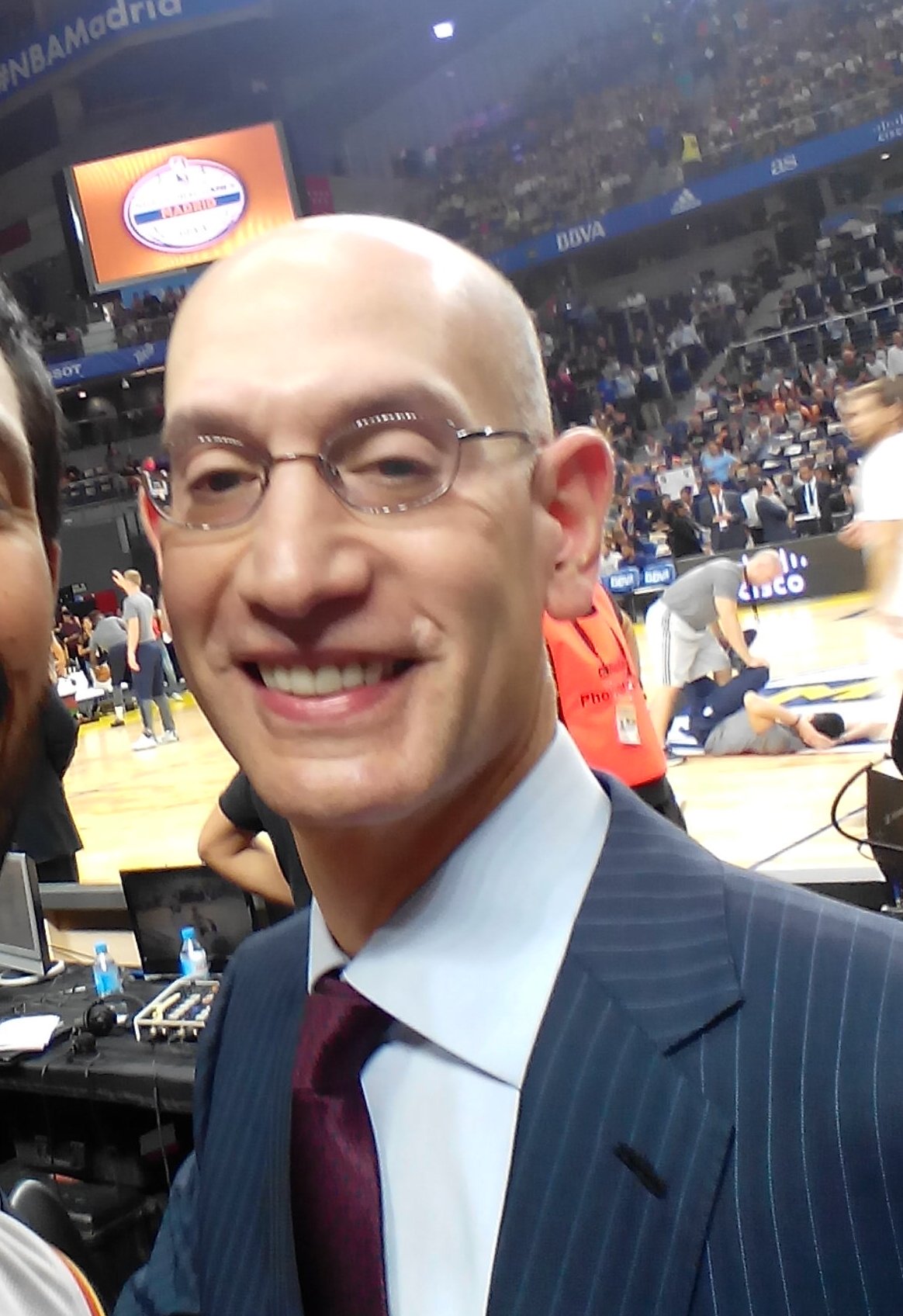
Archival cover photograph: Adam Silver in Madrid, October 3, 2016. Patrickpedia / Wikimedia Commons, CC BY-SA 4.0. The photograph is reproduced without added text; site thumbnails may crop it for display. The photograph remains available under the same license.