

History MLB
Seven Games, Not Fifty-Five Runs
The Yankees outscored the Pirates 55–27 in the 1960 World Series. That famous imbalance explains the shape of the Series. It does not prove that Pittsburgh’s championship was a mistake.
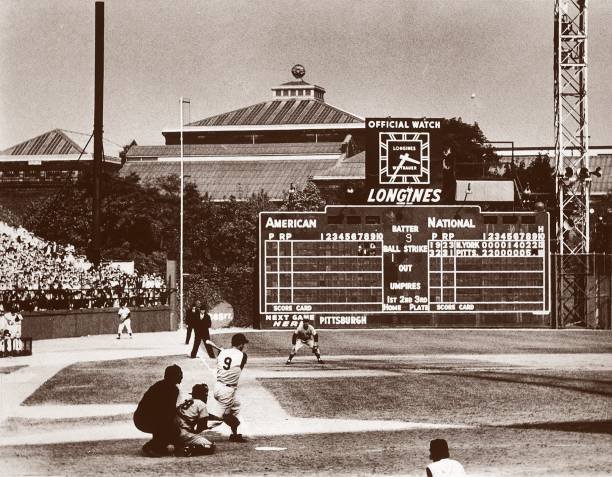
Bill Mazeroski was not waiting for a home run. He was not even waiting in the on-deck circle.
The score was tied 9–9 in the bottom of the ninth inning of Game 7 on October 13, 1960. Mazeroski, due to lead off for the Pittsburgh Pirates, later remembered sitting on the bench until a teammate reminded him that he was up. His intention was modest: “Get a base hit, line drive somewhere.”1
Ralph Terry’s first pitch was high for ball one. The next was a slider that did not move as intended. Mazeroski drove it toward the ivy-covered wall in left field. He ran hard because Forbes Field’s left-centre gap stretched 406 feet and he was not certain the ball would clear it. When he saw the umpire circle a hand above his head, he knew the World Series was over.1
The home run made a 10–9 winner of Pittsburgh and produced the only walk-off homer ever hit in a seventh game of the World Series.2 It also sealed one of baseball’s favourite statistical riddles: New York lost a seven-game Series in which it outscored Pittsburgh by 28 runs.
That sentence is the cleanest explanation of the result. It is not the only one. The box scores show how the imbalance happened. The regular-season record also shows why the familiar claim that “the wrong team won” asks more of the numbers than they can answer.
Two pennant winners
The 1960 Yankees were formidable. They finished 97–57, scored an American League-best 746 runs and allowed 627, a run differential of plus-119. Roger Maris won the league’s Most Valuable Player award after hitting 39 home runs, while Mickey Mantle hit 40.3
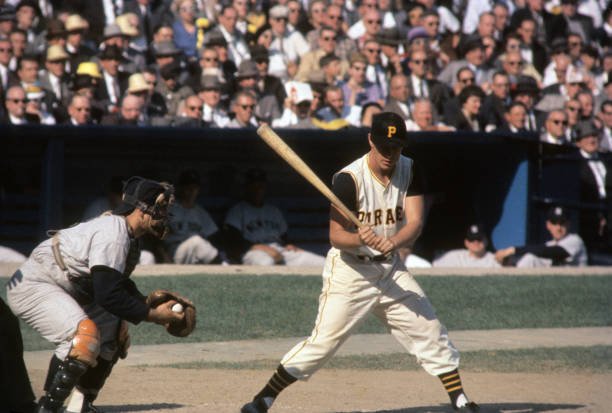
Pittsburgh was not a weak club waiting for October to become lucky. The Pirates finished 95–59, scored 734 runs and allowed 593. Their plus-141 run differential was better than New York’s. Baseball-Reference’s Pythagorean estimate, which converts runs scored and allowed into an expected record, places Pittsburgh at 92–62 and New York at 89–65.3
Those figures do not settle which champion was stronger. The leagues did not play interleague games, and an unadjusted run differential is not a universal power ranking. They do settle a narrower point: the Pirates entered the Series on merit. The Yankees carried the aura of a dynasty that had won seven of the previous eleven World Series, but Pittsburgh’s regular season does not support treating the National League champion as an accidental finalist.4
How 55–27 happened
New York’s three victories were annihilations: 16–3 in Game 2, 10–0 in Game 3 and 12–0 in Game 6. The Yankees scored 38 of their 55 Series runs in those three games and allowed only three. Whitey Ford supplied two complete-game shutouts.5
Pittsburgh’s first three wins had a different shape: 6–4, 3–2 and 5–2. Roy Face finished all three, recording saves in Games 1, 4 and 5 under modern scoring. Those victories carried no surplus. Every late out remained connected to the result.5
Add the games together and the Yankees dominate. Keep them separate, as the format does, and three landslides remain three wins. A baseball team cannot transfer unused runs from Tuesday to Wednesday. Once a blowout is secure, additional scoring widens the Series run differential without changing the Series standing.
This does not make the extra runs meaningless. They show how completely New York controlled the games it won. They help explain why Yankees players and supporters believed the better club had lost. But total runs are a description assembled after seven separate contests. They were not the rule used to award the championship.
The seventh game
Game 7 refused the pattern established by the first six. Pittsburgh led 4–0. New York answered with seven runs across the fifth, sixth and eighth innings. Yogi Berra’s three-run homer put the Yankees ahead 5–4 in the sixth, and two more runs in the eighth stretched the lead to 7–4.6
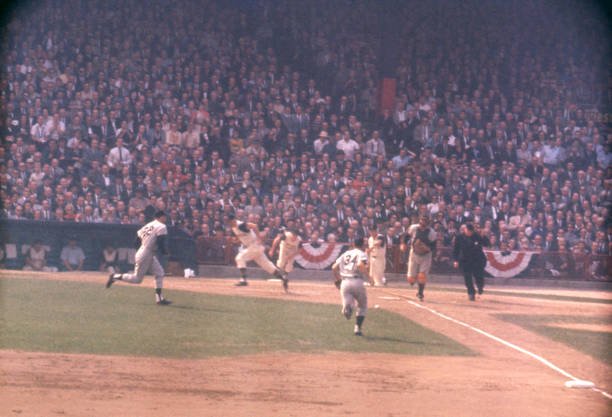
Then the game turned on a ball that never reached the outfield. With two Pirates aboard and nobody out in the bottom of the eighth, Bill Virdon hit a potential double-play grounder toward shortstop Tony Kubek. The ball took a bad hop and struck Kubek in the throat. Dick Groat scored, Kubek left the game and the inning remained alive.6
Dick Groat’s single, Roberto Clemente’s infield hit and Hal Smith’s three-run homer eventually put Pittsburgh ahead 9–7. New York tied the score in the ninth. The key play belonged to Mantle, who avoided a tag by first baseman Rocky Nelson and scrambled safely back to the bag while Gil McDougald scored. The manoeuvre prevented what could have been a Series-ending double play.6
Mazeroski then ended the game with Terry’s second pitch. NBC radio announcer Chuck Thompson captured the result in real time, though in the excitement he named the wrong pitcher and soon gave the wrong final score. The mistakes are part of the surviving call, a reminder that the clean historical symbol was first experienced as confusion.7
The men attached to the moment
Mazeroski played seventeen seasons, all for Pittsburgh. He won eight Gold Glove awards and entered the National Baseball Hall of Fame in 2001. His career batting average was .260; his reputation rested primarily on defence. That made the famous home run an enduring irony, but not the whole explanation for his election.8
His Hall of Fame induction speech lasted only a few minutes before emotion overtook him. He spoke about defence deserving the same respect as pitching, thanked the people who had brought him to Cooperstown and stepped away from the microphone before completing his prepared remarks.9
Terry found his own ending two years later. In Game 7 of the 1962 World Series, he protected a 1–0 Yankees lead against the San Francisco Giants. With two outs in the ninth and runners in scoring position, Willie McCovey lined to second baseman Bobby Richardson. Terry had completed the shutout and later said the victory erased “two years of worry, two years of doubt.”10
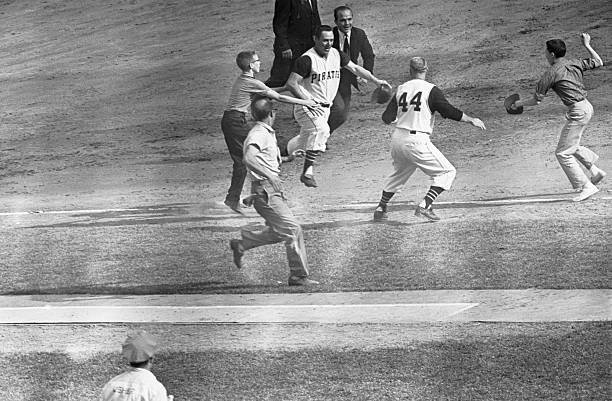
Mazeroski remained tied to October 13, 1960, for the rest of his life. When he died in Lansdale, Pennsylvania, on February 20, 2026, at 89, the Pirates and the Hall of Fame led their tributes with both halves of his public identity: the second baseman whose glove made him great and the hitter whose one swing made him permanent.11
What the numbers can say
The 55–27 total is not a lie. It is evidence that the Yankees’ offence reached a level Pittsburgh never matched during three games, and that New York’s victories contained far more excess scoring than Pittsburgh’s.
It is not evidence that the Pirates were an inferior regular-season team. Their record, run prevention and run differential say otherwise. Nor can Pittsburgh’s victory be reduced to a repeatable ability to win close games. One-run records and Pythagorean gaps can reflect bullpen quality, sequencing and tactics, but they also contain variance. The 1960 Pirates outperformed their Pythagorean estimate by three wins, not five, and the Yankees outperformed theirs by eight.3
The best explanation is therefore narrower than destiny and more satisfying than accident. New York concentrated overwhelming production in three victories. Pittsburgh kept four games within reach and won each of them, once on a bad hop, once through ninth-inning escape, and finally on a second baseman’s 11th home run of the year.2
The Yankees won the arithmetic of the Series. The Pirates won the Series.
Sources & Notes
- Bill Ladson, “Bill Mazeroski’s 1960 World Series-winning walk-off home run,” MLB.com, directly reviewed August 24, 2026. Mazeroski’s account is a retrospective recollection. ↩
- National Baseball Hall of Fame, “Mazeroski’s walk-off blast clinches title for Pirates”; Hall of Fame player record, “Bill Mazeroski.” ↩
- Baseball-Reference, “1960 Major League Baseball Team Statistics,” directly reviewed August 24, 2026. Runs allowed are total runs, not earned runs. Pythagorean records shown are Baseball-Reference’s published estimates. ↩
- National Baseball Hall of Fame, “A-Maz-ing Career,” February 21, 2026. The Hall notes New York had won seven of the previous eleven World Series. ↩
- MLB.com, “1960 World Series recap”; Major League Baseball, “1960 postseason history.” ↩
- Society for American Baseball Research, “October 13, 1960: Bill Mazeroski’s heroic homer brings World Series championship to Pittsburgh”; MLB.com, “1960 World Series recap.” ↩
- Library of Congress, National Recording Preservation Board, “Radio Broadcast of Game 7 of the 1960 World Series,” essay by Don Zminda and David J. Halberstam, directly reviewed August 24, 2026. ↩
- National Baseball Hall of Fame, “Bill Mazeroski,” career record and biography. ↩
- MLB video archive, “Bill Mazeroski delivers Hall of Fame speech in 2001”; National Baseball Hall of Fame, “A-Maz-ing Career.” ↩
- Society for American Baseball Research, “Ralph Terry,” by C. Paul Rogers III, including the 1962 Game 7 account and contemporaneous quotation. ↩
- Pittsburgh Pirates, “Pirates mourn the passing of National Baseball Hall of Famer Bill Mazeroski,” February 21, 2026; National Baseball Hall of Fame, “A-Maz-ing Career.” ↩
About the reporting
This historical game essay was checked against MLB and Hall of Fame records, Baseball-Reference’s 1960 team table, SABR’s Game 7 and Ralph Terry research, the Library of Congress essay on the preserved radio broadcast, and the Pirates’ 2026 death announcement. Retrospective recollections are identified as such. The original draft’s incorrect runs-allowed, run-differential and Pythagorean claims were removed. The Sporting Page confirmed applicable Getty editorial licence coverage for the four supplied images on August 24, 2026.