
NFL
Houston’s Extra Lineman: What the Plays With Blake Fisher Show
With Blake Fisher reporting eligible, Houston combined first-down runs, deep throws and direct snaps to a tight end. Eighteen marked plays show how the extra tackle fit into the offense against Jacksonville.
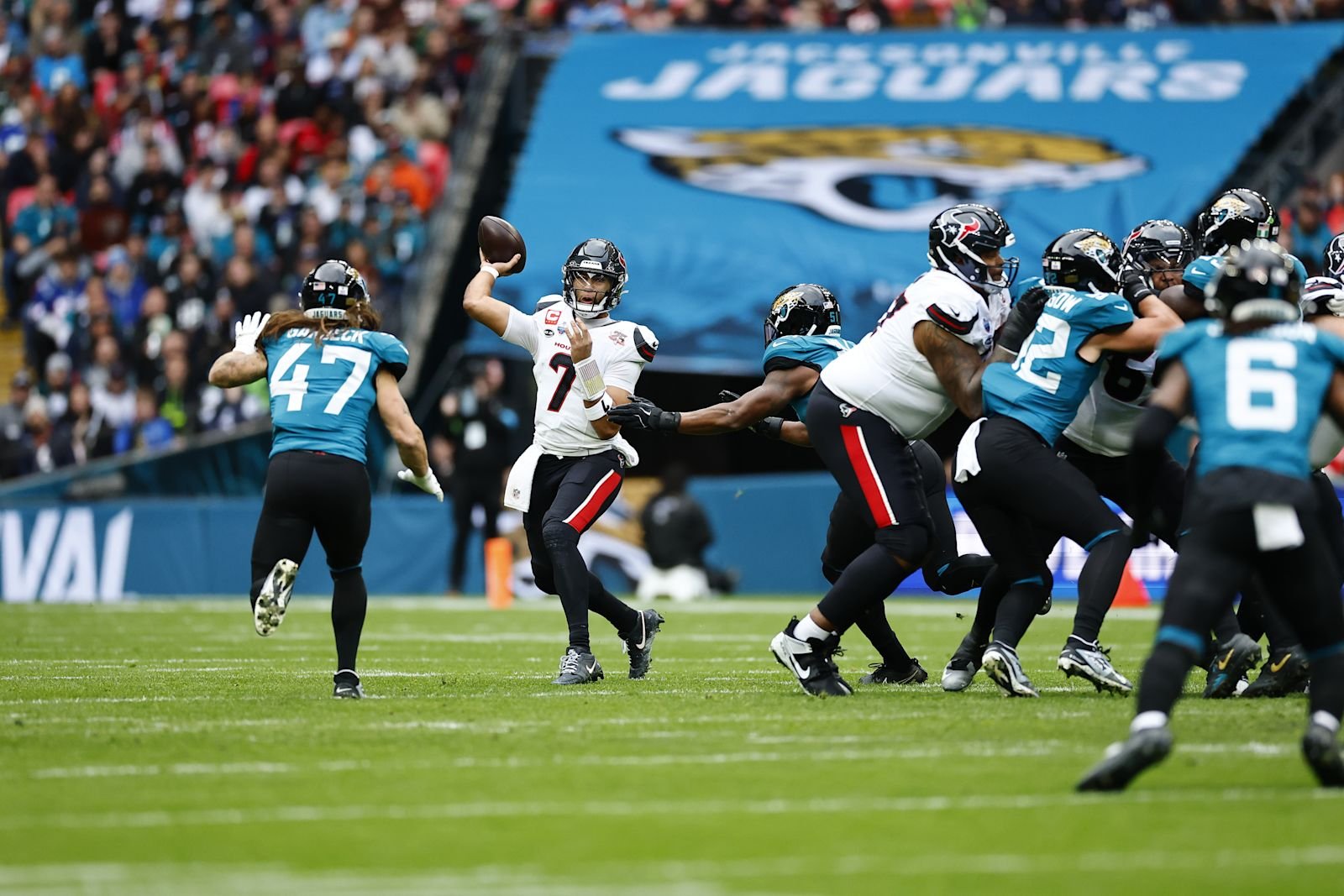
With 6:50 left in the first quarter at Wembley Stadium, Houston faced first-and-10 near midfield with Blake Fisher reporting eligible. C.J. Stroud threw a 42-yard completion to Nico Collins, and two plays later the Texans scored their opening touchdown. The long completion was an early example of the passing options Houston retained with another tackle on the field.
The Texans listed Fisher alongside their five regular offensive-line positions in the starting lineup for their 34-31 win over Jacksonville. According to Next Gen Stats, Houston used six-plus offensive linemen on 35.6% of plays, the season’s highest rate. Stroud finished with 312 passing yards, while Houston added 114 on the ground. [1][2]
The official gamebook explicitly records Fisher reporting eligible on 18 counted plays, providing a bounded sample of his involvement. Those entries include runs, passes and direct snaps to a tight end. The sample excludes special teams and plays nullified by penalties. An entry without the note does not establish that Fisher was absent or that Houston used only five offensive linemen, so these 18 plays cannot stand in for the complete Next Gen Stats personnel count.
| Measure | Recorded value |
|---|---|
| Counted plays with explicit eligibility note | 18 |
| Rushing attempts | 13 |
| Rushing yards | 76 |
| Pass attempts | 5 |
| Completions | 1 |
| Passing yards | 42 |
| Interceptions | 1 |
All 18 counted offensive plays explicitly identifying Blake Fisher as reporting eligible. This is a documented subset. A missing annotation does not establish a five-lineman play or Fisher’s absence.
Source: NFL final gamebook, October 18, 2026. No-play penalties and special teams excluded.
What reporting eligible changes
Fisher is listed by the Texans as a 6-foot-6, 312-pound tackle wearing No. 57. In the starting offense, he joined left tackle Aireontae Ersery, left guard Keylan Rutledge, center Evan Brown, right guard Ed Ingram and right tackle Trent Brown. Houston also listed Stroud, running back Woody Marks, tight end Foster Moreau and receivers Collins and Xavier Hutchinson. [1][3]
The NFL’s rules allow a player wearing an offensive-lineman number to report a change of status to the referee and line up in an eligible position. The referee informs the defense, and the player must report his status again before each play while continuing in that role. Houston could therefore use Fisher in a position normally occupied by an eligible receiver without changing his number. [4]
That declaration does not require a pass to follow, and Houston did not target Fisher on any of the five passing attempts carrying his eligibility note.
A first-down role in the running game
The 18 marked plays produced 13 rushes for 76 yards, two-thirds of Houston’s rushing yardage on slightly more than half its 25 attempts. Marks carried seven times for 29 yards within the marked set, Jawhar Jordan four times for 42 and Cade Stover twice for five. Ten of those 13 runs came on first down. [1]
Houston used Fisher’s eligible role across the field while starting or advancing drives. The marked entries include first-down runs from Houston’s 5, 20, 33, 38 and 47, as well as from Jacksonville territory. They place his appearances within ordinary offensive work, beyond the short-yardage calls that might be expected with an additional tackle.
Jordan supplied the largest running gain, a 25-yard touchdown with 50 seconds left in the third quarter. Fisher was declared eligible before Jordan ran off left tackle. That touchdown accounted for a substantial part of the production: the other 12 marked rushes gained 51 yards, an average of 4.3.
Two third-and-1 calls with different outcomes
Stover’s two runs came on third-and-1 in the fourth quarter. On each, Fisher reported eligible and the tight end took a direct snap before running toward right guard. The first attempt, from Houston’s 42 with 9:54 remaining, gained five yards and a first down. On the next play, another marked Fisher entry, Marks gained seven off right tackle. Different ball carriers advanced consecutive calls on a drive that eventually reached Jacksonville’s 4.
The second Stover attempt came from Jacksonville’s 32 with 47 seconds left. Foye Oluokun and Travon Walker stopped him for no gain, and replay upheld the ruling that he was short. Houston eventually sent Ka’imi Fairbairn out for the winning 49-yard field goal. [1]
The limits of the passing results
The five marked passing attempts produced one completion, the 42-yarder to Collins, along with three incompletions and an interception. Houston also tried a deep throw to Collins on its opening offensive snap from its own 6, with Fisher reporting eligible. The incompletion and the later long gain show Houston taking downfield opportunities from different field positions within the marked set.
The interception carried the greatest immediate cost. With 3:59 left, Houston faced second-and-4 at Jacksonville’s 4, leading 31-28. Fisher reported eligible before Stroud attempted a short pass toward Hutchinson, which Travis Hunter intercepted in the end zone. Jacksonville declined an ineligible-downfield penalty against Ersery, kept the turnover and subsequently tied the game. [1]
The eligibility note alone cannot explain what went wrong on the interception; that would require the route, protection and defensive assignments.
Houston officially allowed no sacks, but DeMeco Ryans described Jacksonville bringing pressure in his postgame availability. He credited Stroud and the line with responding and said the quarterback made important plays even when a defender came free. His account does not establish a pressure rate for Fisher’s appearances. [5]
Across the full game, Houston completed 24 of 34 passes and distributed catches among 10 players. [1][6]
Sources and notes
[1] NFL official final gamebook, Houston Texans at Jacksonville Jaguars, October 18, 2026. Starting lineup, final team and individual statistics, and complete counted Houston play-by-play reviewed. The marked-play figures are calculated from entries explicitly identifying Fisher reporting eligible. This is a gamebook analysis, not a full-game film or personnel-tracking study.
https://static.www.nfl.com/image/upload/v1792342441/gamecenter/aab56e82-4feb-11f1-abca-2c54536568a9.pdf
[2] NFL.com, “2026 NFL season, Week 6: What We Learned from Sunday’s games,” Next Gen Stats insight via NFL Pro. The season-high wording retains the report’s October 18 cutoff. Its underlying snap denominator was not independently obtained.
https://www.nfl.com/news/2026-nfl-season-week-6-what-we-learned-from-sunday-s-games
[3] Houston Texans, Blake Fisher official player biography.
https://www.houstontexans.com/team/players-roster/blake-fisher/
[4] NFL, 2026 Rulebook, Rule 5, Section 3, Article 1, Reporting Change of Position.
https://static.www.nfl.com/image/upload/fl_attachment/league/tqivdkzt9mu6wdgsh1ku.pdf
[5] Official Houston Texans postgame availability, October 18, 2026. Ryans’ answer concerning play calling and pressure, 1:17-1:59, reviewed through the original source-provided caption track. No direct quotation is reproduced.
https://www.youtube.com/watch?v=f7Loa0XG15s
[6] Houston Texans, “C.J. Stroud’s Big Game Just One of Many Standout Performances For Texans in London,” October 18, 2026.
https://www.houstontexans.com/news/cj-stroud-franchise-record-london-texans-jaguars-week-6