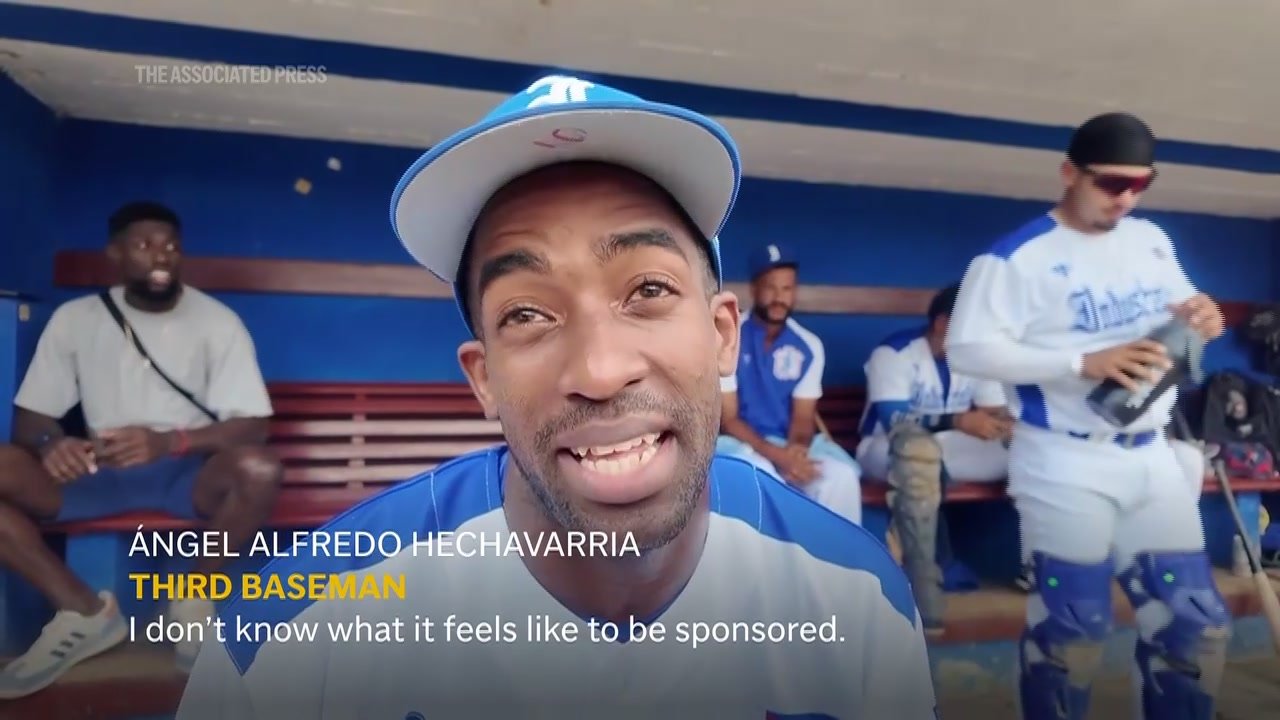
Industriales’ familiar white-and-blue uniform now carries an unfamiliar addition: a private sponsor’s advertisement. An Associated Press report filmed in Havana on October 7 captures the first such arrangement in Cuba’s National Baseball Series, and the people wearing the jersey respond with cautious hope.
AP identifies the sponsor as A Granel, a privately owned Cuban fuel-distribution company. Its branding also appears at Estadio Latinoamericano. AP’s October 8 report places the change against Cuba’s longstanding rejection of advertising and private sponsorship in sport.
Hechavarria is waiting for the benefit
Third baseman Ángel Alfredo Hechavarria acknowledges that being sponsored is unfamiliar. In AP’s English translation, he says, “I hope it pays off.” His emphasis is on whether the arrangement produces something useful for the team.
That response gives the story its most grounded perspective. The visible logo establishes that a commercial agreement has reached the field. It does not demonstrate what players have gained. Hechavarria’s willingness to wait for results is a sensible way to judge a change whose promise is easier to display than its eventual effect.
Carmona welcomes a practical experiment
Manager Guillermo Carmona sounds more affirmative. He presents sponsorship as a new way to help and puts the question of whether it is capitalist behind the goal of moving the country forward. His reaction makes the team’s practical needs central to the discussion.
The two responses complement each other. Carmona supplies the argument for trying the arrangement; Hechavarria supplies the test it should eventually meet. Neither interview offers a reason to measure success merely by the presence of an advertisement.
The terms matter as much as the logo
AP’s accompanying account says the contract details are unknown. That limits any conclusion about the money involved or the scale of the benefit. The footage documents the change and the speakers’ expectations, rather than a completed assessment of the agreement.
A useful next step would be disclosure of what the sponsorship provides, how long it lasts, and how the team will assess its effect. Those questions follow directly from the gap between a public advertisement and undisclosed terms. They would let players and supporters compare the original promise with what actually arrives.
For now, Industriales offers a concrete example of a changing relationship between Cuban baseball and private business. The strongest part of AP’s video is the way it leaves room for both enthusiasm and uncertainty: a manager welcomes an opportunity, and a player hopes it proves worthwhile.
Source: the supplied AP Archive video and Andrea Rodríguez’s AP report. Interviews were recorded October 7, 2026; AP published its report October 8. These short excerpts retain AP’s English subtitles.