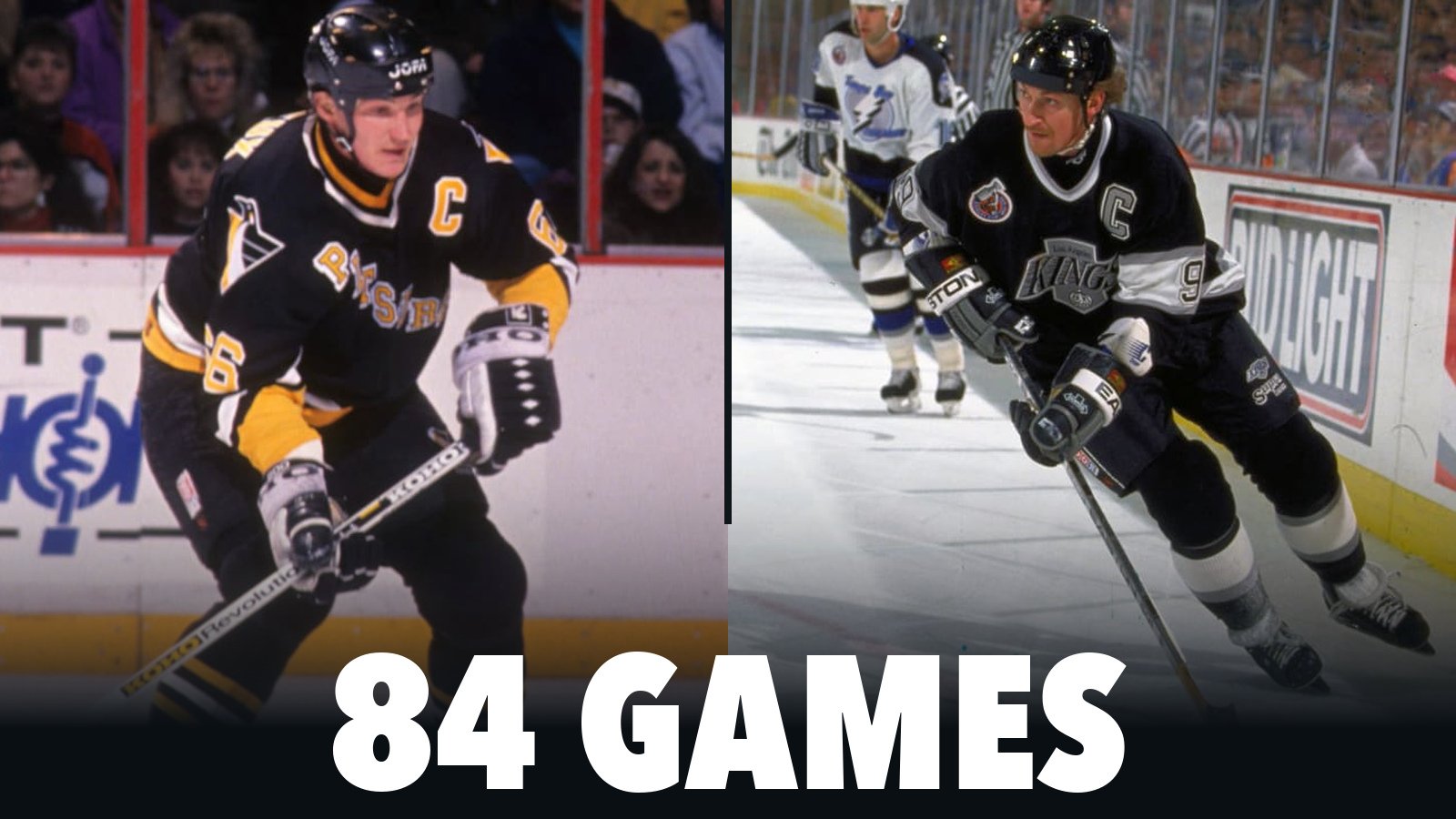
When I hear “84-game season,” I think of Teemu Selanne in a Winnipeg jersey, visor down, with another goaltender trying to keep up. I think of Hollywood Gretzky making one more run at the Stanley Cup, and of Patrick Roy waiting at the other end. The number brings back the hockey of 1992–94 before it brings up a calendar.
The NHL returns to 84 games in 2026–27, with the season opening September 29. Each team gets two additional divisional games, while the preseason becomes shorter. There are practical reasons for the change, beginning with a more balanced divisional schedule and another home date to sell.
For those of us who remember the earlier version, there is something else to enjoy. Those two seasons left enough behind that the return of 84 feels like good hockey mojo. With Sidney Crosby and Alex Ovechkin still playing alongside the generations that followed them, this seems a particularly good time to welcome it back.
Why the NHL is playing 84 games
The change was negotiated in the NHL and NHL Players’ Association’s new collective bargaining agreement, ratified on July 8, 2025. The simplest explanation lies in the divisional arithmetic: seven opponents, four games against each, with two meetings in either building.
Under the 82-game format, the divisional allocation was 26 games. A team met five divisional opponents four times and the other two three times. The new allocation is 28, eliminating that uneven rotation. It adds two meetings overall, not two against every rival.
| Opponents | Meetings / allocation | Total |
|---|---|---|
| Seven divisional opponents | 4 | 28 |
| Eight other same-conference opponents | 3 | 24 |
| Sixteen opposite-conference opponents | 2 | 32 |
| Season | 42 home, 42 away | 84 |
Every team still visits every other team, preserving the annual opportunity to see opponents from the other conference. The league’s schedule announcement confirms that each club’s additional divisional appearances are one home game and one road game.
Across 32 teams, that produces 32 additional regular-season contests, taking the league from 1,312 to 1,344. Each club receives another home date, with the associated ticket sales and arena spending. Owners and players retain their equal share of hockey-related revenue, so both sides have a financial interest in the extra games.
The other side of the bargain is less exhibition hockey. The new preseason standard is four games, replacing schedules that generally ran from six to eight. The 2026 exhibition window runs from September 19 through September 26, allowing meaningful games to begin before October.
NHLPA executive director Marty Walsh made the negotiating positions clear in a July 2025 interview with RG’s James Murphy: “going to 84 games, the league wanted that.” The union sought a shorter preseason and training camp, with Walsh pointing to the wear associated with additional regular-season and international hockey.
That trade-off does not make an exhibition appearance equivalent to a regular-season game for every player. It does mean the additional games arrive with less preparation time, rather than simply being added to an unchanged preseason. The league gains two regular-season games per team; the players secure fewer exhibitions and a shorter training camp.
How 80 became 84, then 82
The NHL’s first 84-game season began in 1992, when the league expanded its schedule from 80. Ottawa and Tampa Bay were new franchises, but neither had a different allowance: all 24 teams played 84 games in 1992–93.
Two games per team were designated neutral-site contests, taking regular-season hockey beyond the league’s home arenas. The expansion from 80 therefore included two conventional games as well as the two neutral-site appearances. These were not exhibitions added to the end of the schedule; their points counted in the standings.
The arrangement followed the April 1992 players’ strike, with owners and players sharing the proceeds. Gretzky’s Kings offered an obvious attraction, although his back injury kept him out of their neutral-site games that autumn.
The programme staged 50 games across two seasons. Hamilton received eight; Sacramento and Saskatoon each received six. These audiences could watch games that counted without travelling to an NHL city.
In John Matisz’s 2019 retrospective for theScore, former defenceman Joe Cirella described the players’ experience: “For both teams, it was a road game.” The unfamiliar facilities could add inconvenience to an already demanding itinerary.
Alan May recalled a February 1994 Washington-Philadelphia game in Richfield, Ohio, when a bench door came off and play stopped for repairs. Taking a rivalry to a new audience also meant coping with a different building.
The NHL was changing its map at the same time. Anaheim and Florida joined for 1993–94, and the Minnesota North Stars became the Dallas Stars. The second 84-game season had 26 teams rather than 24. A fan following the league across those two years was watching expansion unfold alongside the scoring races.
The 1994–95 lockout interrupted the arrangement, leaving a 48-game season. In May 1995, the governors approved Gary Bettman’s recommendation to remove the neutral-site dates. Contemporary reporting recorded that the NHLPA would receive compensation for the revenue it was surrendering.
The full schedule that followed in 1995–96 was 82 games. The league had not gone back to its previous number; it had kept two of the four games added in 1992. That compromise became the familiar standard for roughly three decades. This time, the extra games belong to the divisional schedule rather than a separate travelling showcase.
The night that captures 1992–93
On the morning of March 2, 1993, Mario Lemieux received the last of 22 radiation treatments for Hodgkin lymphoma. That evening, he played against the Flyers in Philadelphia. Before the night was over, another arena would be celebrating a record that had survived for 15 years.
He had missed 23 games. His return brought a standing ovation from the Philadelphia crowd, then a goal and an assist in the Penguins’ 5–4 defeat. The next day, UPI reported that his doctors considered the cancer in remission. They also explained that follow-up would continue, a reminder of the medical reality behind the extraordinary return.
Lemieux was already discussing the scoring race. Pat LaFontaine had moved ahead while he was away, and Lemieux wanted to catch him. What might have been remembered simply as an emotional comeback became the beginning of a remarkable closing stretch.
In his final 20 games, including the return in Philadelphia, Lemieux produced 56 points. He finished with 69 goals and 91 assists in 60 appearances, winning the Art Ross Trophy by 12 points over LaFontaine. He averaged 2.67 points per appearance despite the interruption to his season.
Meanwhile, on that same March 2 evening, Selanne was passing Mike Bossy’s rookie goal record in Winnipeg. A hat trick against Quebec took him to 54. The game’s scoresheet gives the progression: his 52nd goal in the opening minute, his 53rd late in the second period, and the record-breaker in the third.
The celebration became inseparable from the achievement. Selanne tossed his glove into the air and pretended to shoot it with his stick, a moment described in The Hockey News’ contemporary coverage. The rookie had moved past a record that had stood since 1978, with weeks of hockey still to play.
He finished with 76 goals and 132 points. Yet even that did not give him the goal-scoring championship outright. Alexander Mogilny matched the 76 in just 77 games for Buffalo, leaving the league with two players at a level most scorers never approach.
Mogilny and LaFontaine together supplied Buffalo with 129 goals and 275 points. LaFontaine’s 148 points were not merely the losing side of Lemieux’s story; they were an extraordinary season of their own. The same scoring table placed Adam Oates third with 142 points, including 97 assists, and Steve Yzerman fourth with 137.
Oates scored 45 goals as well as providing those assists, while Yzerman scored 58. Selanne’s 132 points left him level with Pierre Turgeon behind them, while Luc Robitaille supplied 63 goals and 125 points for Los Angeles. Mark Recchi reached 123 points in Philadelphia. A great season could be several places down the list.
Pavel Bure’s 60 goals in Vancouver added another player whose speed and visor became part of the period’s visual identity. The European presence was not confined to prospects waiting for opportunities. These players were already changing the scoring races, and Bure would score 60 again in 1993–94.
The standings show how uneven the league was around those stars. Ottawa won 10 games in its inaugural season and conceded 395 goals; second-year San Jose won 11 and allowed 414. Detroit scored 369 goals and Pittsburgh 367. Those mismatches belong in the account of the scoring environment, alongside the exceptional players taking advantage of it.
Across the league, 21 players reached 100 points and 14 reached 50 goals. Earlier seasons had higher scoring rates, but the 1992–93 race placed Lemieux’s return from cancer treatment alongside a rookie who scored 76. Even within that crowded scoring table, their seasons remain difficult to comprehend.
The company they kept, and the springs that followed
The Sporting Page’s cross-check of the 1992–93 participants against the Hockey Hall of Fame’s elected players identifies 60 names as of September 17, 2026. That includes 59 already inducted and Keith Tkachuk, whose induction is scheduled for November 9, 2026. Tkachuk was completing his first full NHL season beside Selanne in Winnipeg.
That is a retrospective count, not 60 finished Hall careers in 1993. Scott Niedermayer was in his first full season. Nicklas Lidstrom was in his second, and Joe Sakic had yet to play for a Stanley Cup winner. Their greatest seasons were still ahead, alongside the established careers that had brought many fans to the game.
Gretzky and Lemieux shared the league with rookie Eric Lindros. Ray Bourque and Paul Coffey were established stars while Niedermayer and Lidstrom were finding their places. Roy and Grant Fuhr were there while Dominik Hasek was still establishing his NHL career. The overlap becomes richer with hindsight, but it was worth watching before anybody could know the ending.
The regular season did not supply a reliable guide to that ending. Pittsburgh earned a league-leading 119 points, then lost to the Islanders in Game 7 overtime of the second round. Lemieux’s scoring title and the Penguins’ first-place finish could not carry them into the conference finals.
Gretzky’s Kings took the other route. His back injury had limited him to 45 regular-season games, but Los Angeles advanced through Calgary and Vancouver before facing Toronto. That series went seven games, and Gretzky scored a hat trick in the deciding game as the Kings won 5–4.
It was Hollywood Gretzky on the biggest stage again, now taking Los Angeles to its first Stanley Cup Final. He finished the playoffs with 40 points in 24 games, including 15 goals. His regular-season absence had given way to the defining postseason of his Kings years.
Montreal had Roy, and a remarkable capacity to survive overtime. After losing the opening two games of their first-round series against Quebec, the Canadiens won the next four. They eventually won 10 consecutive overtime games during the championship run, including three against Los Angeles in the Final.
The final scores of those three games were 3–2, 4–3 and 3–2. In a season remembered for extravagant offence, the championship could still turn on the next save. Roy finished the playoffs with a 16–4 record and a 2.13 goals-against average, earning his second Conn Smythe Trophy. Montreal beat the Kings in five games.
In 1993–94, Gretzky won the scoring title with 130 points, while Sergei Fedorov scored 56 goals and 120 points. Fedorov won the Hart Trophy and the Selke, receiving recognition as the league’s most valuable player and its best defensive forward in the same season.
Gretzky also passed Gordie Howe with his 802nd goal on March 23, 1994. Martin Brodeur won the Calder Trophy in his first full NHL season, and Hasek won the Vezina with a 1.95 goals-against average. Both awards belong to 1993–94: the second 84-game season was introducing another set of careers to the league’s major honours.
That spring belonged to Mark Messier’s Rangers, who defeated Bure’s Canucks in a seven-game Final. The NHL had gone from Gretzky against Roy to New York against Vancouver, leaving two distinct championship stories attached to the same schedule length. Those are the associations that survive longer than the details of the neutral-site programme.
When the goals became harder to find
What the people watching in 1993 could not know was how quickly the scoring environment would change. Many of those same players would remain in the league as the game moved towards the years now called the dead-puck era.
The decline was already visible in the second 84-game season. Goals per team per game fell from 3.63 in 1992–93 to 3.24 in 1993–94. By 1997–98, the rate was 2.64. That is a substantial difference in the hockey being played, not just in the number of dates available to accumulate statistics.
| Season | Goals per team, per game |
|---|---|
| 1992–93 | 3.63 |
| 1993–94 | 3.24 |
| 1995–96 | 3.14 |
| 1997–98 | 2.64 |
| 2003–04 | 2.57 |
| 2025–26 | 3.08 |
These Hockey-Reference league averages are per team, not the combined scoring total for a game. The distinction also keeps the schedule change in perspective: two extra games create more opportunities to reach a milestone, but they do not themselves increase the frequency of scoring.
The descent was not uninterrupted. Scoring rebounded in 1995–96 from the lockout-shortened season before declining again. Nor did the talent suddenly disappear. Some of the young players on the 1993 rosters were approaching their best years as finding room to produce became harder.
Special teams were part of that earlier scoring environment. Hockey-Reference records 5.28 power-play opportunities per team per game in 1992–93, compared with 2.88 in 2025–26. Power-play goals averaged 1.03 then and 0.61 last season. Those figures do not explain the entire difference between eras, but they show how much more frequently the 1993 scorers had an extra skater to work with.
The NHL’s response when it returned from the 2004–05 lockout shows what it wanted to change. For 2005–06, it removed the centre red line from the two-line passing restriction, reduced goaltending equipment and prevented teams from substituting after icing. A stricter standard against obstruction was intended to give players more freedom to move.
Schedule length and scoring conditions are different measures. At the same rate, a player on a 50-goal pace over 82 games would be on a 51.2-goal pace over 84. The extra dates offer a little more room to reach a milestone. By contrast, the fall from 3.63 goals per team per game in 1992–93 to 2.64 in 1997–98 amounts to about 27 per cent, using the rounded league averages. That changed how often spectators saw goals, not just the totals at the end of the season.
At 3.08 goals per team per game in 2025–26, the league was comfortably above its 2003–04 rate of 2.57, although below 1992–93. The new 84-game season therefore arrives during a higher-scoring period than the late dead-puck years. It does not need to reproduce every number from 1993 to give us plenty to enjoy.
Enjoy the overlap while it is here
The most satisfying connection to the present is that Crosby and Ovechkin are still in the lineup. Both enter their 22nd NHL seasons, with Ovechkin returning on a one-year extension. The careers that began together in 2005–06 are not yet stories told entirely in the past tense.
They are still producing, too. Crosby had 74 points in 68 games in 2025–26, while Ovechkin scored 32 goals. Their familiar names sit on the same season scoring table as Connor McDavid’s 138 points and Nikita Kucherov’s 130. Nathan MacKinnon reached 127, and Macklin Celebrini had 115 in his second season.
Their own arrival came with plenty of scoring. In 2005–06, Ovechkin had 106 points and Crosby 102, finishing third and sixth in the league. Selanne was still there, scoring 40 goals and 90 points for Anaheim. The rookie whose Winnipeg season remains attached to the number 84 was an established star when these newcomers arrived. Now we are watching Crosby and Ovechkin provide that continuity for another generation.
Crosby and Ovechkin provide careers we know intimately; Celebrini provides the uncertainty of how much more might be ahead. The veterans are still extending their records while he establishes his own. Their presence together makes an ordinary regular-season meeting something more interesting than another date on the schedule.
Matthew Schaefer’s 59-point rookie season adds another developing career to follow. Connor Bedard had 75 points in 69 games, although shoulder surgery is expected to keep him out until November. His return will be another development to follow as Chicago builds around him.
Crosby also connects the eras directly: he played alongside Lemieux as a rookie. The teammate who watched Super Mario from within the Penguins’ dressing room is now the veteran sharing the league with players who were not born when he made his debut.
For my money, the NHL is better when scoring is up. Roy’s place in this story leaves plenty of room for great goaltending, but I want to see attacking talent rewarded and a trailing team given a realistic chance to come back. That is the hockey I hope fills the additional dates.
The return of 84 gives me a reason to revisit Selanne’s Winnipeg season without wishing away the present. We still have Crosby and Ovechkin, and we have an entire season ahead of the players arriving behind them. I am happy to take the extra games and hope the goals keep coming.