

Boxing · Culture · January 15, 2026
The Greatest, Delivered
Louisville placed Muhammad Ali on a new kind of canvas: a Forever stamp designed to carry his fighting stance—and his public legacy—across the country.
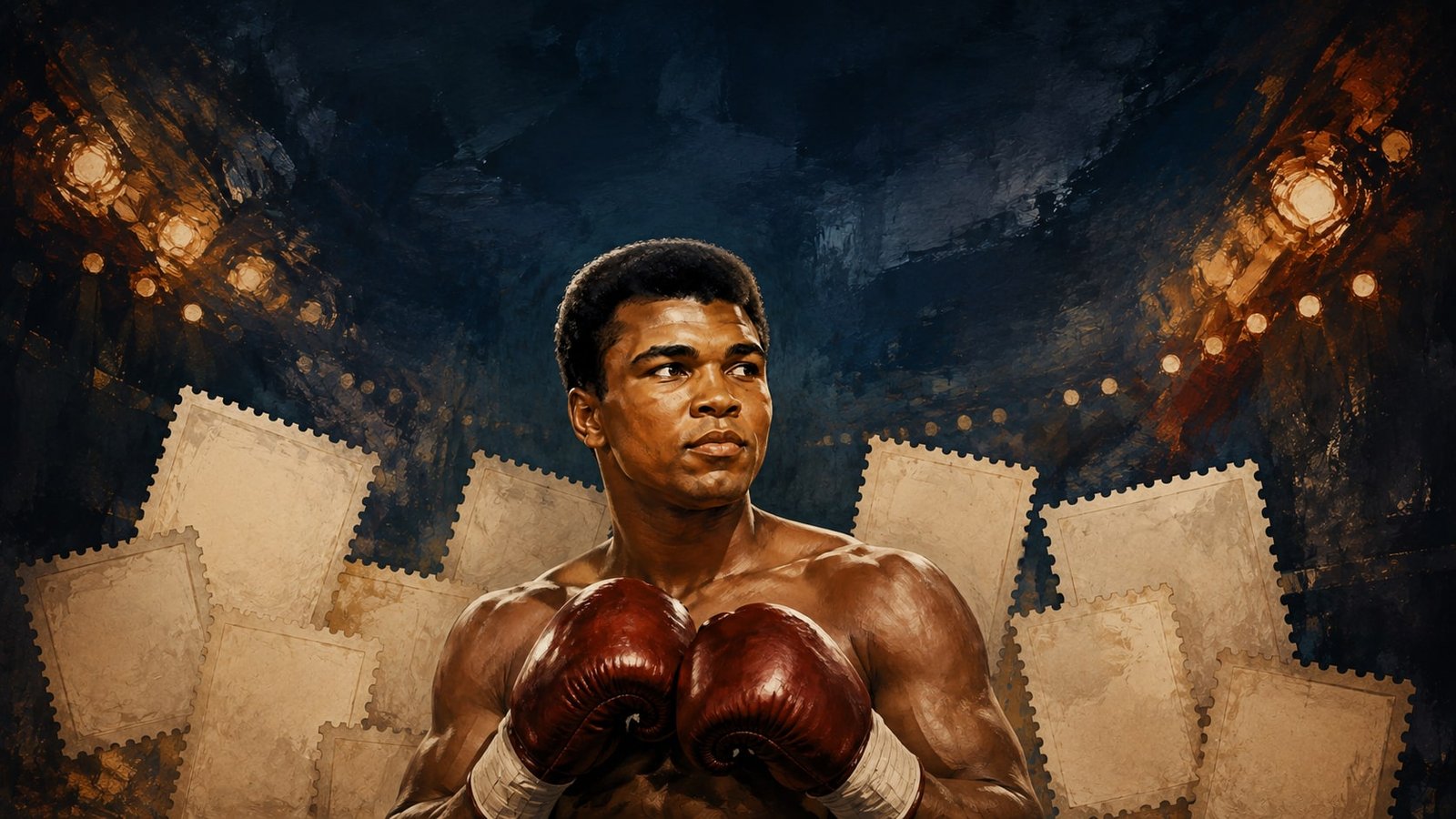
On January 15, 2026, Muhammad Ali returned to circulation. The United States Postal Service issued two Forever stamp designs in Louisville, the city where Ali was born and where his public story began.
The stamps use a cropped black-and-white Associated Press photograph from 1974. Ali stands in a boxing pose, gloves raised, his name arranged beside him in heavy lettering. One design places the photograph above the name; the other reverses the order. Together they resemble both a fight poster and the chants that followed Ali around the world.
USPS art director Antonio Alcalá designed the pane. The Postal Service issued it as a sheet of twenty, making Ali the subject of an official stamp in the tenth year after his death. The dedication brought the ceremony home: Louisville had shaped Ali, and Ali had spent a lifetime reshaping how the world understood Louisville.
The choice of image is direct. It remembers the athlete first—the three-time heavyweight champion, the 1960 Olympic gold medallist, the fighter whose movement made still photography look temporary. Yet the official presentation also emphasized the life beyond the ropes: Ali’s advocacy for peace, justice, faith and humanitarian service.
A postage stamp is among the smallest public monuments. It does not remain fixed to a wall or wait for visitors. It travels. Ali’s portrait will pass through post offices, homes and hands—an image of a man who understood better than most how far a name could move.
Sources and media note
- U.S. Postal Service, “Stamp Announcement 26-2: Muhammad Ali Stamps.”
- U.S. Postal Service, “USPS Honors Boxing Champion Muhammad Ali with Forever Stamps,” January 15, 2026.
- USPS, “Watch a video about the life of Muhammad Ali,” January 15, 2026.
- The supplied MOV is included in this private preview at the user’s request. Its creator/source is not identified in the file metadata; do not publish it until those rights are documented.