

NHL Biography
Curtis Joseph
The undrafted goaltender who gave overlooked teams a chance—and finished with 454 NHL victories.
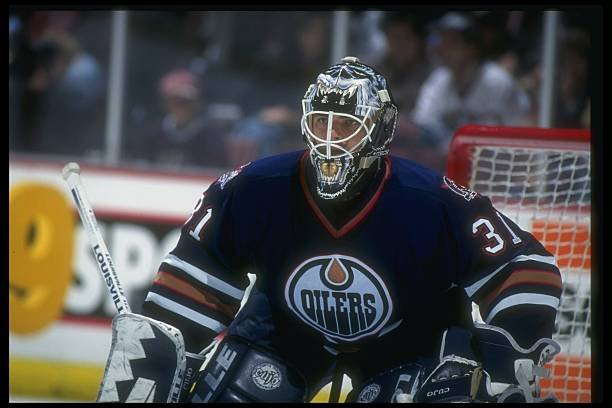
“I just dove across and got it with the underside of my blocker. … Moments later, we went down and scored.” — Curtis Joseph, recalling Game Seven against Dallas, April 29, 19971
The puck came to Joe Nieuwendyk with Curtis Joseph on the other side of the Edmonton crease. It was overtime in Game Seven of the 1997 Western Conference quarterfinals—and Joseph’s thirtieth birthday—and the Dallas Stars, a 104-point team, had expected to dispose of the Oilers well before then. Darryl Sydor’s wraparound attempt struck Joseph’s blocker and dropped loose. Nieuwendyk shot at what appeared to be an open net. Joseph threw himself back across the blue paint, turned his right arm downward, and stopped the puck with the underside of his blocker. He covered it. On the next shift, Todd Marchant raced down the right side and scored at 12:26 of overtime.2
Joseph made 38 saves that night. The last of them preserved a series that Edmonton was not supposed to win; Marchant’s goal finished it. Some Oilers rushed toward Marchant, others toward their goaltender. The split celebration suited Joseph. He played the most individual position in hockey, yet much of his career was spent giving undermanned teams a chance to remain together. No National Hockey League club had drafted him. By the time he made that save, he had already been passed over, traded, and left unsigned. The NHL had been slow to find Curtis Joseph, and for nineteen seasons it had difficulty getting past him.
Curtis Shayne Munro was born on April 29, 1967, in Keswick, Ontario, near the southern shore of Lake Simcoe. His birth parents, Wendy Munro and Curtis Nickle, were teenagers. Four days after the birth, Wendy placed the child with Jeanne and Howard Eakins, a couple she knew through her work at a nursing home. The boy was called Curtis for his father and carried his mother’s surname.3
Howard Eakins called him “Tiger,” carried him around the house, and watched Hockey Night in Canada with him. The arrangement did not last. After Jeanne and Howard separated, she married Harold Joseph and moved the family to Gormley and then Sharon, north of Toronto. Jeanne and Harold operated Martin Acres, a special-care home for men who had been released from psychiatric institutions. Roughly seventeen residents lived there at a time. Curtis and his adopted brother Grant lived among them.4
In his 2018 autobiography, Cujo: The Untold Story of My Life On and Off the Ice, Joseph described a childhood without dependable care. Jeanne struggled with addiction, food was scarce, and the cats used his mattress on the floor as a litter box. “Mom treated her animals better than she treated her kids,” he wrote.5 The patients at Martin Acres could be unpredictable, but the neglect around Joseph was more constant than any single frightening episode. He learned to feed himself, to leave the house, and to depend upon adults outside it.
Sport offered both escape and company. Joseph was ten before he began playing organized hockey, late by the standards of southern Ontario, and he initially imagined himself scoring goals rather than preventing them.6 He played in the East Gwillimbury minor-hockey system and attended Whitchurch Highlands Public School and Huron Heights Secondary School. Coaches, teammates’ parents, and local families supplied rides, meals, equipment, and encouragement. Joseph did not present himself as a prodigy. He was an awkward skater and an undersized goaltender in a province crowded with prospects, but he kept finding a place to play.
The place that changed his prospects was almost 2,500 kilometres from home. With little interest from major-junior teams, Joseph went to Athol Murray College of Notre Dame in Wilcox, Saskatchewan, to play for the Notre Dame Hounds. He lived with teammates in a trailer and used worn equipment. The Hounds, in their first season in the Saskatchewan Junior Hockey League, advanced to the 1988 Centennial Cup, Canada’s Junior A championship.7
Their road through Western Canada nearly ended in Calgary. Notre Dame trailed the Calgary Canucks three games to one before winning twice to force Game Seven. With the Hounds leading 3–2 and five seconds remaining, a Notre Dame defender deliberately dislodged the net during a Calgary attack. Dean Larson was awarded a penalty shot. Joseph stopped it. Larson had spat in Joseph’s eye earlier in the game, Joseph told reporter Rob Vanstone afterward, and the goaltender remembered one thought: “There was no way I was going to let that one in.”8 Notre Dame survived the faceoff, advanced to the national tournament, and won the Centennial Cup.
One scout, David McNab of the Hartford Whalers, made a habit of writing to overlooked players. His letters and the occasional promise of a team cap or media guide sent Joseph running through the Saskatchewan cold to check the mailbox. McNab later explained that some undrafted players simply needed to hear that someone in professional hockey considered them good enough.9 His encouragement helped Joseph believe that college hockey remained possible.
Joseph enrolled at the University of Wisconsin for the 1988–89 season. In 38 games as a 21-year-old freshman, he went 21–11–5 with a 2.49 goals-against average and was selected to the All-WCHA team.10 NHL scouts watched, but every club passed on him in the 1989 draft. Free agency gave them another opportunity. On June 16, 1989, Joseph signed with the St. Louis Blues.11 Around that time he legally took the surname by which he had long been known.
A knee injury in his first training camp delayed the beginning. Joseph played 23 games for the Peoria Rivermen of the International Hockey League, then joined St. Louis during the 1989–90 season. His first NHL start came on January 2, 1990, against the Edmonton Oilers. By the playoffs, he had moved ahead of Vincent Riendeau and helped the Blues eliminate Toronto in five games. The undrafted rookie had entered the league as an injury replacement and finished his first spring as a starting goaltender.
He did not secure the position permanently until 1991–92, when he played 60 games and led the NHL with 1,778 saves. He led the league in saves again in each of the next two seasons. In 1992–93 he faced 2,206 shots, stopped 2,006 of them, and led the NHL with a .911 save percentage. The volume mattered. Joseph’s technique was less economical than that of many contemporaries; he reacted, recovered, and competed through broken plays. A team that allowed the puck to remain in its own zone gave him repeated chances to influence the game.12
That season the Blues faced the Chicago Blackhawks in the first round. Chicago had won the Norris Division and allowed the fewest goals in the NHL. St. Louis swept the series. Joseph then took Toronto to seven games, including consecutive double-overtime contests. He played all 11 of the Blues’ postseason games and recorded a .938 save percentage, the best of any goaltender in the 1993 playoffs. He finished third behind Ed Belfour and Tom Barrasso in voting for the Vezina Trophy.13
The Blues had once been willing to surrender Joseph. When they signed restricted free agent Brendan Shanahan from New Jersey in 1991, St. Louis proposed Joseph, Rod Brind’Amour, and two draft choices as compensation. Devils general manager Lou Lamoriello rejected the package. An arbitrator awarded New Jersey defenseman Scott Stevens instead.14 The episode later became part of Joseph’s underdog story, but at the time it was evidence that even his own organization had not settled upon his value.
Joseph went 36–23–11 in 1993–94, appeared in the NHL All-Star Game, and finished fourth in Vezina voting. The relationship with St. Louis deteriorated after Mike Keenan became coach and general manager in 1994. Keenan changed goaltenders frequently, criticized Joseph publicly, and signed Grant Fuhr in July 1995. Joseph and Keenan argued in the coach’s office; Joseph later admitted that during one confrontation he cleared the contents from Keenan’s desk.15 On July 14, the Blues traded Joseph’s rights to Edmonton. He left St. Louis with 137 victories in 280 regular-season games.
The trade did not immediately give him an NHL job. Edmonton still employed Bill Ranford, and Joseph remained unsigned when the 1995–96 season began. He joined the Las Vegas Thunder of the IHL and went 12–2–1. The Oilers finally signed him on January 11, 1996, the day they traded Ranford to Boston. Joseph was twenty-eight, in his seventh professional season, and again had to establish that he belonged in the league.16
Edmonton was no longer the wealthy champion of the Wayne Gretzky years. Its young roster included Doug Weight, Ryan Smyth, Jason Arnott, and Marchant, but the club operated on a smaller budget than many of its opponents. Joseph faced 2,117 shots in 1996–97, more than any other NHL goaltender, and won 32 games. In the first round Dallas outshot Edmonton in six of seven games. The series still reached overtime in Game Seven, where Joseph’s save on Nieuwendyk became the defining image of his Oilers career.
Colorado eliminated Edmonton in the following round, then met the Oilers again in the opening series of 1998. The Avalanche led three games to one. Joseph allowed one goal over the final three games and shut out Colorado in Games Six and Seven, the first time an Oilers goaltender had recorded consecutive playoff shutouts. Edmonton won the deciding game 4–0 in Denver.17 In two springs, Joseph had taken the Oilers past teams that finished 22 and 15 points ahead of them. He became a free agent with his reputation at its highest point.
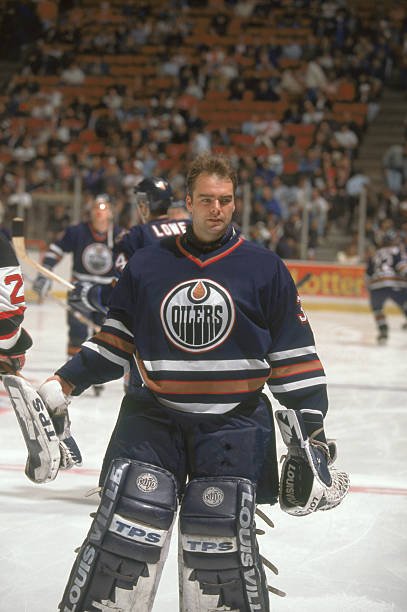
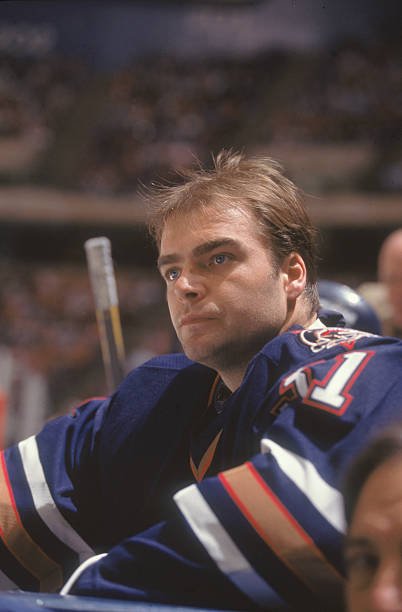
On July 15, 1998, Joseph signed with the Toronto Maple Leafs. The move angered some Edmonton supporters, but it placed an Ontario goaltender with a conspicuous mask in the country’s largest hockey market. Toronto had missed the playoffs in each of the previous two seasons and was moving from the Western to the Eastern Conference. With Pat Quinn as coach, Mats Sundin at centre, and Joseph in goal, the Leafs improved by 28 points and reached the 1999 conference final.18
The nickname had begun in St. Louis, where defenseman Robert Dirk shortened Curtis Joseph to “Cujo.” Joseph connected it to the rabid dog in Stephen King’s novel and placed a snarling animal on his mask. He retained the motif as the colours changed from St. Louis to Edmonton, Toronto, Detroit, Phoenix, and Calgary. “I kept the mask the same so it was always recognizable,” he said.19 In Toronto, where goaltending masks had long formed part of the team’s visual history, the dog became inseparable from the player.
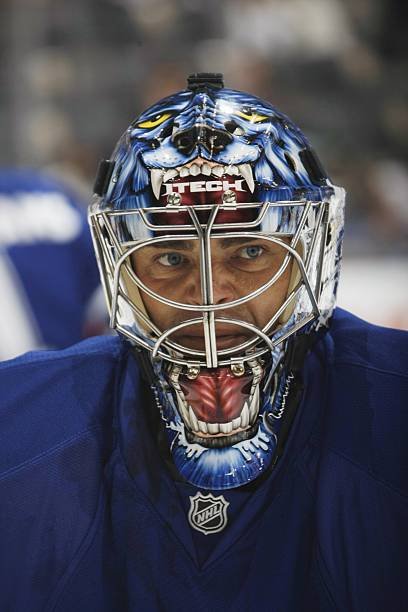
Joseph’s first Toronto season included another second-place finish in Vezina voting, this time behind Dominik Hašek, and a place among the five finalists for the Lester B. Pearson Award, voted on by the players. Toronto eliminated Philadelphia and Pittsburgh before Hašek and the Buffalo Sabres ended its season in five games. Joseph played every minute of the Leafs’ 17 playoff games and posted a .907 save percentage.
During that season he also stood in goal for the final game at Maple Leaf Gardens, a 6–2 loss to Chicago on February 13, 1999. The ceremony and the presence of generations of former players nearly overwhelmed the game itself. One week later, Joseph started the first Maple Leafs game at the Air Canada Centre, a 3–2 overtime victory against Montreal.20 He had arrived in Toronto at the moment when the franchise changed buildings but rediscovered the postseason.
In 1999–2000, Joseph won 36 games, played in his second NHL All-Star Game, and finished third in Vezina voting behind Olaf Kölzig and Roman Turek. The NHL awarded him the King Clancy Memorial Trophy for leadership and humanitarian work. His Cujo’s Kids program brought sick children to games in a private suite, while donations helped create Cujo’s Crease, an anesthesia room at the Hospital for Sick Children designed to resemble a Maple Leafs dressing room. A later corporate initiative associated with Joseph raised $1 million for the hospital.21
The programs were not an ornamental extension of celebrity. Joseph had grown up in a home nominally devoted to care while experiencing neglect inside it. His agent, Don Meehan, later connected that childhood to the time and money Joseph directed toward SickKids.22 The hospital’s Department of Anesthesia and Pain Medicine still carries a Curtis Joseph and Harold Groves endowed chair.23
Toronto returned to the conference final in 2002. The Leafs survived seven games against the New York Islanders and then fell behind Ottawa three games to two. Joseph allowed three goals over Games Six and Seven, both Toronto victories, to send the club into the final four. Carolina eliminated the Leafs in six games, with the final contest decided in overtime. Across his first four Toronto seasons, Joseph went 133–88–27 with a .912 save percentage. In 60 playoff games, he was 32–28 with a .919 save percentage.24
The year also brought an Olympic gold medal and disappointment. Joseph entered the Salt Lake City Games as Canada’s starter, but Sweden defeated Canada 5–2 in the opener. Martin Brodeur started the rest of the tournament, including the gold-medal victory over the United States. Joseph accepted the backup role and received the medal, but the change followed him back to Toronto because Quinn coached both teams.25
Joseph became an unrestricted free agent after the season. Toronto offered three years; he wanted four. On July 2, 2002, he signed a three-year, $24-million contract with the Detroit Red Wings, the reigning Stanley Cup champions. Dominik Hašek had retired, leaving Joseph to replace one of the greatest goaltenders of the era. Detroit won its division and Joseph recorded 34 victories, but Anaheim swept the Red Wings in the first round. Joseph stopped 110 of 120 shots; Detroit scored six goals in four games.26
Hašek then announced that he was returning. Detroit exercised the option on his contract and attempted to trade Joseph, whose own contract and ankle surgery complicated any deal. Joseph spent part of the 2003–04 season on a conditioning assignment with the Grand Rapids Griffins. Hašek’s groin injury reopened the Detroit net, only for Joseph to sprain his ankle in February. Manny Legace began the playoffs, but Joseph took over in the first round. In nine postseason games he posted a 1.39 goals-against average and a .939 save percentage, both career bests, before Calgary eliminated Detroit in the second round.27
The 2004–05 lockout consumed the last year of Joseph’s contract. He signed with the Phoenix Coyotes in August 2005 and, at thirty-eight, won 32 games. On October 28 he became the ninth NHL goaltender to record 400 victories. His 424th, on March 28, 2006, moved him past Tony Esposito on the career list. Joseph returned for a second season in Phoenix but did not sign with another team during the summer of 2007.
Canada invited him to the Spengler Cup that December. Joseph helped win the tournament, then signed with the Calgary Flames in January 2008. His most consequential Calgary appearance lasted less than a full game. Miikka Kiprusoff allowed three goals in the first 3:33 of Game Three against San Jose, and Joseph entered in relief. He stopped all 22 shots he faced while Calgary rallied to win 4–3. The decision made Joseph the first goaltender to win a playoff game with five NHL franchises.28
Toronto brought him back on July 1, 2008, as the backup to Vesa Toskala. On December 30, after entering a game against Atlanta in relief, Joseph stopped every shootout attempt and earned his 450th victory. He appeared in 21 games during his final season and finished with 454 wins. On January 12, 2010, he announced his retirement at the Air Canada Centre. “I’m a lucky guy to do what I love to do for a living for 19 years,” he said.29
Joseph’s regular-season record was 454–352 with 90 ties and six overtime losses in 943 games. He recorded a 2.79 goals-against average, a .906 save percentage, and 51 shutouts. In 133 playoff games he went 63–66 with a 2.42 goals-against average, a .917 save percentage, and 16 shutouts. His 63 postseason victories remain the most by a goaltender who never won the Stanley Cup.30
The totals produce an unusual Hall of Fame argument. Joseph was eighth in NHL history in regular-season victories at the end of the 2025–26 season, after Sergei Bobrovsky passed him in March 2026, and remained ahead of Hall of Fame goaltenders including Terry Sawchuk, Jacques Plante, Tony Esposito, Glenn Hall, Grant Fuhr, and Hašek.31 He was an undrafted free agent who twice finished among the top three in Vezina voting and raised his save percentage in the playoffs. He also never won the Vezina, never made a postseason First or Second All-Star Team, never reached the Stanley Cup Final, and spent much of his career in the same era as Hašek, Brodeur, Patrick Roy, and Ed Belfour.
After retiring, Joseph devoted much of his time to his family. He worked as a goaltending consultant in the Carolina Hurricanes organization in 2016–17 and continued as a part-time Maple Leafs ambassador.32 In 2018, with Kirstie McLellan Day, he published Cujo. The book made public a childhood he had once hidden and required him to reconnect with people who could help reconstruct it. Joseph said the process replaced embarrassment with acceptance.33
The St. Louis Sports Hall of Fame inducted him in 2015. The Blues followed in January 2025, recognizing the goaltender they had signed as an undrafted free agent thirty-six years earlier. The Hockey Hall of Fame did not elect him with its class of 2026.34
Nobody drafted Curtis Joseph. For nineteen seasons, the NHL had to reckon with what it had missed.
Notes
- Derek Van Diest, “Marchant revisits magical 1997 Game 7 OT goal for Oilers,” NHL.com, May 20, 2024, https://www.nhl.com/news/todd-marchant-revisits-1997-game-7-ot-goal-for-oilers. ↩
- Ibid.; NHL game and series details are also summarized in the Edmonton Oilers’ official retrospective, “Throwback Thursday: Eliminating Hitch and the Stars,” NHL.com, November 29, 2018, https://www.nhl.com/oilers/news/throwback-thursday-eliminating-hitch-and-the-stars-302206184. ↩
- Curtis Joseph with Kirstie McLellan Day, Cujo: The Untold Story of My Life On and Off the Ice (Toronto: HarperCollins, 2018); Neil Davidson, “Curtis (Cujo) Joseph lifts the lid on troubled childhood in new autobiography,” The Canadian Press, October 23, 2018, https://toronto.citynews.ca/2018/10/23/curtis-cujo-joseph-lifts-the-lid-on-troubled-childhood-in-new-autobiography/. ↩
- Joseph and McLellan Day, Cujo; Kerry Banks, Curtis Joseph (Vancouver: Greystone Books, 2000), 4. ↩
- Joseph and McLellan Day, Cujo; Davidson, “Curtis (Cujo) Joseph.” ↩
- Jasen Obermeyer, “Curtis Joseph visits Alder Recreation Centre for book signing,” Caledon Citizen, November 1, 2018, 15, https://caledoncitizen.com/download/2018/11-01-November-1.pdf. ↩
- Hockey Canada, “Notre Dame Hounds’ Cinderella Season,” November 8, 2006, https://www.hockeycanada.ca/en-ca/news/2006-wjac-008-en; Hockey Canada, 2025 Centennial Cup Alumni, https://cdn.hockeycanada.ca/hockey-canada/National-Championships/Men/National-Junior-A/2025/downloads/2025-centennial-cup-alumni.pdf. ↩
- Rob Vanstone, “Hounds-Canucks hockey series still sticks with me,” Athol Murray College of Notre Dame, May 21, 2020, https://www.notredame.ca/news-detail?pk=1204552. ↩
- “Cujo calls it quits after 19 seasons in NHL,” The Canadian Press, January 12, 2010, https://www.sportsnet.ca/hockey/nhl/leafs-joseph-curtis-retire/. ↩
- Hockey-Reference.com, “Curtis Joseph,” https://www.hockey-reference.com/players/j/josepcu01.html; Ken Campbell, “Top 100 Goalies: No. 36—Curtis Joseph,” The Hockey News, November 10, 2018, https://thehockeynews.com/news/all-access/top-100-goalies-no-36-curtis-joseph. ↩
- St. Louis Blues, “Curtis Joseph | Blues Hall of Fame,” https://www.nhl.com/blues/team/hall-of-fame/curtis-joseph. ↩
- Hockey-Reference.com, “Curtis Joseph”; St. Louis Blues, “Curtis Joseph | Blues Hall of Fame.” ↩
- NHL, 2020 NHL Awards Guide, 51–52, https://media.nhl.com/site/asset/public/ext/2019-20/2020NHLAwardsGuide.pdf; Hockey-Reference.com, “Curtis Joseph.” ↩
- St. Louis Sports Hall of Fame, “Curtis Joseph,” https://www.stlshof.com/curtis-joseph; Joseph and McLellan Day, Cujo. ↩
- Joseph and McLellan Day, Cujo; St. Louis Blues, “Curtis Joseph | Blues Hall of Fame.” ↩
- Hockey-Reference.com, “Curtis Joseph”; Joseph and McLellan Day, Cujo. ↩
- NHL Stats, 2022 Western Conference Final: Colorado Avalanche vs. Edmonton Oilers, May 2022, https://media.nhl.com/site/vasset/public/attachments/2022/05/16156/NHLStatsPack-2022WesternConferenceFinal.pdf; NHL Records, “Edmonton Oilers—Longest Shutout Sequences, Playoff Year,” https://records.nhl.com/edm/records/playoff-goaltender-records/shutouts/longest-shutout-sequence-playoff. ↩
- “Throwback Thursday: This week in 1998, Toronto Maple Leafs sign Curtis Joseph,” The Leafs Nation, July 17, 2020, https://theleafsnation.com/news/throwback-thursday-this-week-in-1998-toronto-maple-leafs-sign-curtis-joseph; Hockey-Reference.com, “Curtis Joseph.” ↩
- Chris Pinkert, “10 questions with Curtis Joseph,” St. Louis Blues, December 10, 2018, https://www.nhl.com/blues/news/10-questions-with-curtis-joseph-302703610. ↩
- Dave Stubbs, “Maple Leaf Gardens remains special place 20 years after final NHL game,” NHL.com, February 13, 2019, https://www.nhl.com/news/maple-leaf-gardens-remains-special-place-20-years-after-final-nhl-game-304788422. ↩
- NHL, 2021 Awards Guide, “King Clancy Memorial Trophy Winners,” https://media.nhl.com/site/asset/public/ext/2020-21/2021AwardsGuide.pdf; “Cujo calls it quits after 19 seasons in NHL,” The Canadian Press. ↩
- “Cujo calls it quits after 19 seasons in NHL,” The Canadian Press. ↩
- Hospital for Sick Children, “Anesthesia & Pain Medicine,” https://www.sickkids.ca/en/care-services/clinical-departments/anesthesia-pain-medicine/; SickKids Foundation, Annual Report 2013–14, https://www.sickkidsfoundation.com/-/media/files/skf/downloadable-resources/pdfs/about-us/publications-and-financials/2013-2014/skfar2014web-for-download.pdf. ↩
- Hockey-Reference.com, “Curtis Joseph”; “Throwback Thursday: This week in 1998, Toronto Maple Leafs sign Curtis Joseph.” ↩
- Olympics.com, “Curtis Joseph,” athlete profile; Dave Stubbs, “‘Savour Every Moment’: Brodeur’s Olympic gold medal special treasure,” NHL.com, May 22, 2022, https://www.nhl.com/news/savour-every-moment-brodeur-s-olympic-gold-medal-special-treasure-333854976. ↩
- Hockey-Reference.com, “Curtis Joseph”; The Observer, “Hasek’s return ends,” February 11, 2004, https://archives.nd.edu/Observer/2004-02-11_v38_088.pdf. ↩
- Hockey-Reference.com, “2004 NHL Stanley Cup Playoffs Goalie Statistics,” https://www.hockey-reference.com/playoffs/NHL_2004_goalies.html; The Observer, “Red Wings top Predators,” April 16, 2004, https://archives.nd.edu/Observer/2004-04-16_v38_126.pdf. ↩
- “Veteran goalie Joseph steps in to help Flames grab lead in series,” Associated Press, April 14, 2008; Hockey-Reference.com, “Curtis Joseph.” ↩
- Frank Pingue, “Maple Leafs’ goalie Joseph ends 19-year career,” Reuters, January 12, 2010, https://www.foxnews.com/sports/maple-leafs-goalie-joseph-ends-19-year-career. ↩
- Hockey-Reference.com, “Curtis Joseph”; NHL Stats, All-Time Playoff Win Leaders, https://media.nhl.com/site/asset/public/ext/2023-24/2024StanleyCupFinal.pdf. ↩
- NHL.com, “Panthers recover, edge Kraken in shootout in Maurice’s 2,000th NHL game,” March 24, 2026, https://www.nhl.com/news/seattle-kraken-florida-panthers-game-recap-march-24-2026; Hockey-Reference.com, “2025–26 NHL Final Standings,” https://www.hockey-reference.com/leagues/NHL_2026_final.html. ↩
- Mike G. Morreale, “Curtis Joseph offering wisdom to Hurricanes prospects,” NHL.com, July 7, 2016, https://www.nhl.com/news/curtis-jospeh-working-as-consultant-in-carolina-281132184; Pinkert, “10 questions with Curtis Joseph.” ↩
- Davidson, “Curtis (Cujo) Joseph”; Joseph and McLellan Day, Cujo. ↩
- St. Louis Blues, “Blues name 2025 Hall of Fame class,” October 23, 2024, https://www.nhl.com/blues/news/blues-name-2025-hall-of-fame-class; Hockey Hall of Fame, “Hockey Hall of Fame Announces 2026 Inductees,” June 22, 2026, https://stanleycupphoto.hhof.com/induction/induction2026/pressreleases.html. ↩
Principal Sources
- Joseph, Curtis, with Kirstie McLellan Day. Cujo: The Untold Story of My Life On and Off the Ice. Toronto: HarperCollins, 2018.
- Banks, Kerry. Curtis Joseph. Vancouver: Greystone Books, 2000.
- Hockey-Reference.com. “Curtis Joseph.”
- National Hockey League. Official records, awards guides, game reports, and historical retrospectives.
- St. Louis Blues. “Curtis Joseph | Blues Hall of Fame.”
- Davidson, Neil. “Curtis (Cujo) Joseph lifts the lid on troubled childhood in new autobiography.” The Canadian Press, October 23, 2018.
- Photography: User-supplied Getty Images files, assets 279152, 72916519, 72916532, and 83217370. Captions preserve the embedded creator credits. Public use requires a valid Getty licence; attribution by itself is not permission.