

History / Basketball
The Most Enjoyable Three Years
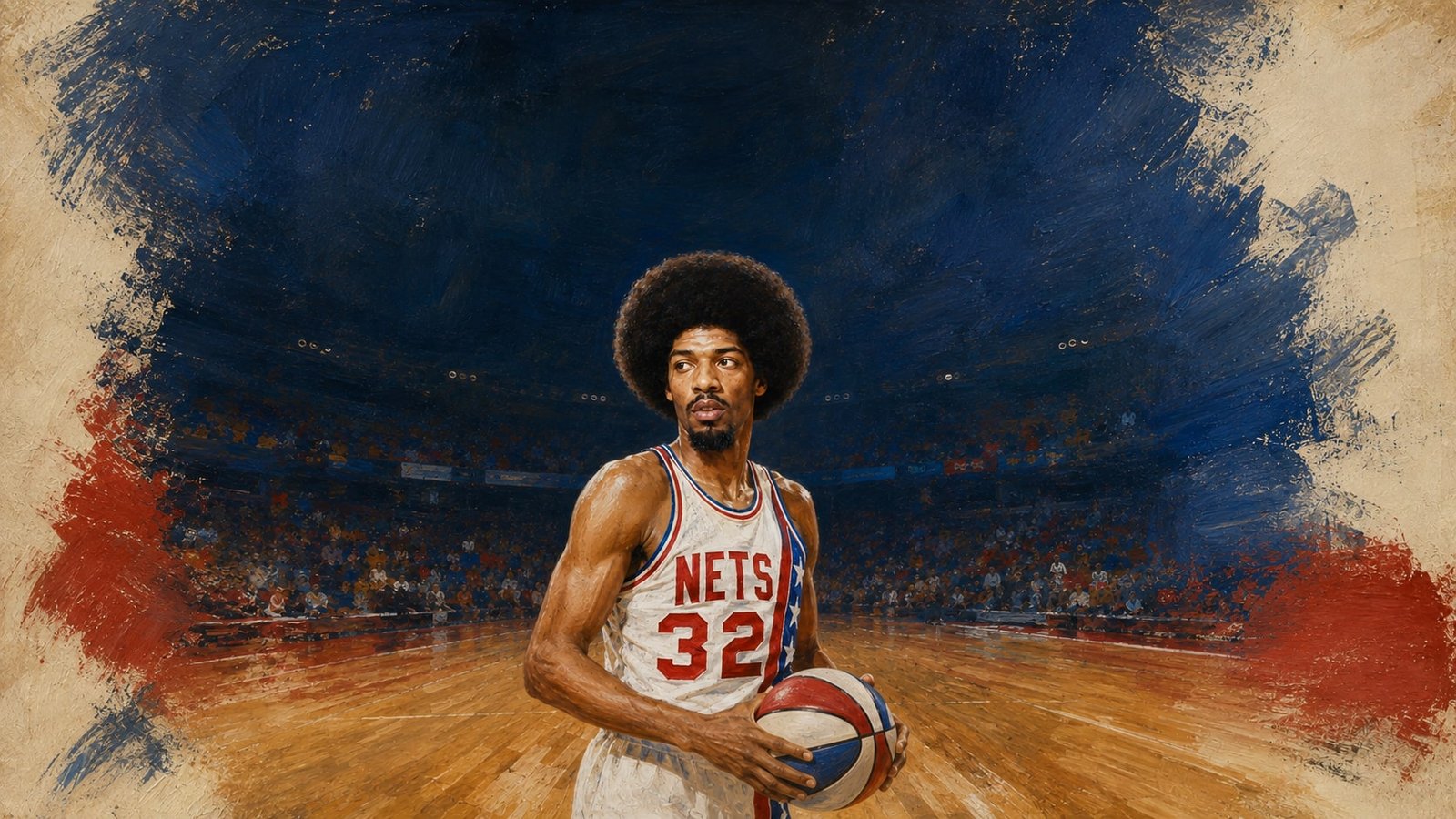
Kevin Loughery coached for more than two decades. His favorite stretch belonged to Julius Erving and the New York Nets—a partnership measured in two championships and remembered through trust.
Kevin Loughery had coached the New York Nets for four months when Julius Erving arrived. The coach was 33. The player was 23. Neither needed an introduction to professional basketball, but each was beginning something new.
The Nets had hired Loughery on April 23, 1973, after a 30–54 season. On August 1 they acquired Erving from the Virginia Squires. The transaction joined a newly hired coach to the most arresting player in the American Basketball Association. It also placed Erving in the largest market of his young career, on a team that had just lost 54 games.1
Three seasons later the partnership was over. In between came 168 regular-season victories, three Most Valuable Player awards for Erving and two ABA championships for New York. Both careers continued far beyond the Nets. Erving played eleven years in Philadelphia, won an NBA MVP award and another title, and became one of basketball’s defining figures. Yet when Loughery looked back, he chose the short period before all of that: “the most enjoyable three years I had in basketball was coaching Doctor J.”2
Two arrivals
Loughery was not handed a finished champion. He inherited a team that had followed a 44-win season by losing 54 games. Lou Carnesecca returned to St. John’s after three years as the Nets’ coach. Loughery had ended his playing career as Philadelphia’s interim player-coach only months earlier; New York gave him his first full season in charge.
Erving’s route was no less unsettled. He had averaged 31.9 points for Virginia in 1972–73, but the Squires operated in a small market and under financial pressure. A year earlier he had attempted to move to the Atlanta Hawks, only to be returned to Virginia by court order. When the Squires traded him and Willie Sojourner to New York, the Nets obtained a scorer already recognized as extraordinary and a star still looking for stable ground.3
The fit was not automatic. Larry Kenon was a rookie. Billy Paultz and Brian Taylor were established contributors. Bill Melchionni, who had directed the club’s earlier success, was nearing the end of his career. Erving needed the ball without turning four teammates into spectators; Loughery needed authority without confusing control for coaching.
The surviving record does not give us a cinematic first practice between them. It gives us something firmer: a team that changed quickly. New York won 55 games, twenty-five more than the year before. Erving averaged 27.4 points, 10.7 rebounds and 5.2 assists. He won the first of three consecutive ABA MVP awards. The Nets beat Virginia, swept Kentucky and defeated Utah in five games for the 1974 championship.4
Erving: 27.4 PPG · 10.7 RPG · 5.2 APG
The public evidence
A coach-player relationship can be reduced too easily to chemistry, a word broad enough to hide whatever the record does not show. In this case, the public evidence is unusually plain. Under Loughery, Erving did not have to choose between individual range and team success.
He led the ABA in scoring in their first season together, but scoring did not exhaust his work. He ranked among the league leaders in assists, steals and blocked shots. The Nets did not merely clear a side and wait. They ran with Taylor, rebounded with Kenon and Paultz, and put the league’s most versatile player in enough space to affect every possession. New York finished first in the East and went 12–2 in the playoffs.
Loughery’s role is easiest to see in what he did not do. He did not sand away the improvisation that made Erving difficult to guard. He did not demand that his young star perform leadership as a daily display of dominance. The player could take over without treating every moment as a test of rank.
This is where Loughery’s later description matters. He remembered Erving as easier to coach than Michael Jordan, whom he coached as a Chicago rookie a decade later. The comparison was not a ranking of talent or character. It was an account of different temperaments. Jordan, in Loughery’s telling, pressed teammates relentlessly. Erving could “blend in”—not by disappearing, but by allowing the room to function without announcing that it belonged to him.5


The year without a parade
The second season kept the partnership from becoming a fable in which every year ended the same way. The 1974–75 Nets improved to 58–26, the best record of their three-year run. Erving averaged 27.9 points, 10.9 rebounds and 5.5 assists. He shared the MVP award with Indiana’s George McGinnis.6
Then the Spirits of St. Louis, a 32–52 team, eliminated New York in the opening playoff series. A club that had won twenty-six more regular-season games than its opponent lost four games to one. The upset belongs in the center of this story, not in a footnote. It is the strongest evidence that talent and trust did not remove the ordinary dangers of a season.
Loughery’s interview offers a recollection that fits such stretches without pretending to identify one. After what he remembered as a couple of poor games, he told Erving before practice that he planned to ride him hard. The rest of the roster had grown complacent, he believed, and correcting the best player would make everybody else attentive. Erving accepted the arrangement.
No date, opponents or next result accompanied the story. It should not be turned into a reconstructed scene, and it does not prove that one difficult practice fixed a team. What it reveals is the permission between coach and star. Loughery could use Erving’s standing as an instrument because Erving trusted the purpose and did not require public exemption.
Erving: 27.9 PPG · 10.9 RPG · 5.5 APG
Trust without ceremony
The same permission ran in the other direction. Loughery remembered nights when his plan was failing and he dispensed with the usual performance of certainty. His instruction to Erving was brief: “My game plan stinks tonight. Bail us out, Julius.”7
There is humor in the line, but it is not self-deprecation for its own sake. A coach was admitting what the players could already see. More important, he knew which player could be given an unscripted problem. Erving’s improvisation was not a break from the offense in those moments. It was the emergency offense.
This arrangement required judgment from both men. If Loughery asked too often, freedom became abandonment. If Erving treated every possession as permission, the other four Nets ceased to matter. Their results suggest that the boundary generally held. Over three seasons, New York won exactly two-thirds of its regular-season games.
The third season brought the strongest test. By 1975–76 the ABA was down to nine teams, several of them in financial distress. The league played without divisions. Its merger with the NBA, discussed for years, was moving toward completion. Every Nets game occurred inside a competition whose future was running out.
Erving responded with his best New York scoring season. He averaged 29.3 points and won a third straight MVP award. At the All-Star Game in Denver he won the league’s first slam-dunk contest with a leap from the foul line. In the postseason he averaged 34.7 points. The Nets eliminated San Antonio, then met Denver in the last series the ABA ever played.8
New York won in six games. The championship did not erase the previous spring; it completed the argument of the three seasons. The Nets had arrived quickly, failed publicly and returned to the top before the league disappeared.
Erving: 29.3 PPG · 34.7 playoff PPG
The last ABA team
The final horn did not preserve the club. The NBA admitted the Nets, Denver Nuggets, Indiana Pacers and San Antonio Spurs for 1976–77. New York owed an entry fee to the NBA and a separate territorial payment to the Knicks. Erving, meanwhile, was in a salary dispute with the Nets. Twenty-four hours before the new season began, the team sold his contract to Philadelphia for $3 million.9
The transaction split the partnership without a basketball decision. Loughery remained with the Nets. Erving joined a Philadelphia roster that already included McGinnis, Doug Collins, Darryl Dawkins and Lloyd Free. The circumstances make Loughery’s later phrase unusually exact. The enjoyable years were not a loose era. They were a self-contained three-season team, bordered by two transactions.
Loughery also believed NBA audiences did not see quite as much of the “real” Doctor J as ABA crowds had. His point makes sense as a coach’s memory of the player at maximum offensive latitude, but it needs a qualification. Erving did not vanish in Philadelphia. He adapted to a crowded roster, reached the NBA Finals in his first season, became league MVP in 1981 and won a championship in 1983. The NBA saw a different allocation of his gifts, not an imitation of the player who had been in New York.10


What the record can say
Statistics cannot tell us whether a coach enjoyed a season. Memory cannot, by itself, settle every historical detail. Here the two forms of evidence do different jobs.
The record establishes the scale: 168 wins in 252 regular-season games; three MVP awards; three trips to the playoffs; two championships. It shows that Loughery and Erving won immediately, stumbled in the middle, and won again. The interview explains how the coach understood the partnership half a century later. He remembered a star secure enough to be corrected in front of teammates and gifted enough to receive a broken game plan as an assignment.
That distinction keeps the story from asking too much of either source. Loughery’s recollections are not proof of what every Net thought. The standings are not proof of private affection. Together they explain why these seasons remained separate in his mind from the many that followed.
Erving did not need Loughery to make him spectacular, and Loughery did not win by standing aside. Their achievement was more specific. The coach gave a singular player room without surrendering the team; the player accepted coaching without making obedience his public identity.
Three years. Two titles. One partnership brief enough to end cleanly—and successful enough that Kevin Loughery never stopped measuring the rest of his basketball life against it.
Notes
- Brooklyn Nets, “Nets History Timeline: From 1967 to Today.” The timeline dates Loughery’s hiring and the Erving transaction and gives the 1972–73 record. Basketball-Reference, “1972–73 Philadelphia 76ers roster and statistics,” records Loughery’s player-coach season immediately before the Nets hired him. ↩
- Kevin Loughery interview, user-supplied video and transcript, 00:34:14–00:34:20; NBA.com, “Legends profile: Julius Erving.” The recording was made available to The Sporting Page as reporting material; it is not redistributed in this package. ↩
- NBA.com, “Legends profile: Julius Erving,” September 13, 2021. Published accounts differ on the exact cash component of the Virginia trade, so no amount is stated. ↩
- Brooklyn Nets, “1974 ABA Champions”; NBA.com, “Legends profile: Julius Erving.” ↩
- Loughery interview, 00:34:02–00:34:51. The Jordan comparison and “blend in” description are Loughery’s retrospective opinions, not presented here as an objective ranking of the players. ↩
- Basketball-Reference, “1974–75 ABA leaders”; NBA, “Official ABA Guide”; Brooklyn Nets, “1976 ABA Champions.” ↩
- Loughery interview, 00:35:11–00:36:07. The practice episode and game-plan line are presented as Loughery’s recollections. No opponent, date or subsequent result was supplied, so none is inferred. ↩
- NBA.com, “Legends profile: Julius Erving”; Brooklyn Nets, “1976 ABA Champions.” ↩
- NBA.com, “Legends profile: Julius Erving”; Brooklyn Nets, “Nets History: Herb.” ↩
- Loughery interview, 00:34:44–00:34:51; NBA.com, “Legends profile: Julius Erving”; Naismith Memorial Basketball Hall of Fame, “Julius Erving.” ↩
About the reporting
This article was rebuilt from a supplied draft, a user-supplied Kevin Loughery interview and its timestamped transcript, official NBA and Nets histories, the official ABA guide, Basketball-Reference season records and the Naismith Memorial Basketball Hall of Fame. Anecdotes without dates are identified as recollections rather than reconstructed as scenes. An unverified Game 6 statistical line and superlative in the earlier draft were removed. Supplied Getty/NBAE and otherwise uncleared photographs are not reproduced; the two images used here carry explicit Creative Commons licenses and depict Erving after the ABA years.