TSP COLUMN · NBA GOVERNANCE
Adam Silver has punished the Clippers. Punishing one club does not answer for the system around it.
Those are different jobs. A commissioner can take away draft picks, suspend an owner and produce a spectacular afternoon of headlines without settling the larger question: how consistently does his league police the money surrounding its players?
On September 2, the NBA fined Los Angeles $30 million, stripped five first-round picks and suspended Steve Ballmer for a year over salary-cap circumvention. Kawhi Leonard must pay $700,000; no playing suspension was announced. The Clippers reject the findings. The league’s announcement is severe enough that calling this “no enforcement” would be absurd.
But calling it proof that the NBA has its house in order would be premature.
The case is bigger than a slogan
The league’s investigators, Wachtell, Lipton, Rosen & Katz, describe more than an owner exchanging telephone numbers. Their report says the Clippers helped arrange Leonard’s deals with Aspiration, Boingo, Daktronics and Lockton, using team business as an inducement. It also says Ballmer approved a Forum-related agreement knowing it was a condition for Aspiration’s Leonard deal.
Those are investigators’ findings, disputed by the team—not criminal convictions. They deserve examination, not either automatic acceptance or a wave of the hand.
Leonard’s position also deserves accuracy. Through agent Harrison Gaines, he accepted responsibility for lapses by people around him while denying knowledge of an intention to evade the cap, the Associated Press reported. That is not the same as admitting he knowingly designed a scheme.
There is no need to turn him into a cartoon villain to take the rules seriously.
Ballmer has a lawyer—and an argument
Ballmer’s identified counsel is David N. Kelley of O’Melveny & Myers. Kelley is a former U.S. attorney for the Southern District of New York, serving from 2003 to 2005. His résumé includes major fraud prosecutions and corporate investigations. This is not a defense being conducted solely through an owner’s indignation.
In a letter to Silver released September 2, Kelley argued that the investigation had shifted from an alleged agreement to funnel Aspiration money to Leonard toward sponsor introductions the defense considers permissible. He also alleged inadequate notice and no fair opportunity to respond before publication.
“We are exploring every legal remedy to address this gross injustice.”
That is Kelley’s pledge, alongside the Clippers’ organizational rejection of the findings. It is not a court ruling, and a challenge to these new sanctions had not been verified as filed at publication.
The most consequential dispute is over the line between ordinary introductions and arranging extra compensation. Wachtell says existing rules permit a team to answer a sponsor’s inquiry with contact information, but prohibit actively initiating or facilitating the player’s business. Kelley disputes the league’s application of that line. The two sides even disagree about the status of an earlier, 2019 investigation: the defense describes a matter concluded without a finding; the report says it remained open.
That clash belongs at the centre of the story. “Ballmer personally funneled money” and “the team improperly facilitated outside income” are not interchangeable claims. Failure to establish one would not, by itself, dispose of the other.
The appeal history is not a free pass
The Clippers’ desire for an independent hearing does not establish a right to one. The NBA and players’ union have agreed the penalties are final and binding. The collective bargaining agreement generally makes the league and union—not an individual club—the parties that initiate system arbitration. Securing another forum is a hurdle, not a procedural formality.
The NBA has lost important disciplinary fights: in 2004, a federal judge upheld an arbitrator’s reduction of Jermaine O’Neal’s suspension from 25 games to 15. But that was a player-discipline dispute, not an owner’s cap-circumvention case. In the closer Joe Smith comparison, arbitrator Kenneth Dam upheld Stern’s authority to void Smith’s two previous Minnesota contracts in November 2000. Both episodes occurred under David Stern, not Silver.
There is an even closer warning against treating the rules as newly invented: in 2015, the NBA fined these same Clippers $250,000 over a third-party endorsement opportunity presented to DeAndre Jordan. The league said the opportunity was prohibited even though it had no impact on Jordan’s decision to re-sign.
A serious defense can challenge proof, procedure and proportionality. It cannot safely be reduced to “this always gets overturned.”
The owner who helped close the Sterling chapter
There is an unmistakable historical turn here. Ballmer arrived in 2014 as the buyer who could get the Clippers out of the Donald Sterling crisis. In May, the NBA said Silver’s preference had been a voluntary sale. In August, it announced the transfer to Ballmer had closed after a California court confirmed Shelly Sterling’s authority to sell.
Ballmer was useful to the league at a moment when it badly needed that chapter closed. That does not establish a bargain for future leniency. It does make today’s relationship worth remembering: the reassuring new owner of one crisis is the suspended owner of another.
Neither yesterday’s gratitude nor today’s embarrassment should set the standard of proof.
Rubin, nineteen months, and a different kind of exposure
In March 2024, former Sixers minority owner Michael Rubin described the conflicts that came with building Fanatics while holding an NBA stake. At the MIT Sloan conference, he said he had been “violating every rule the NBA had”. The discussion encompassed betting and NBA players investing in his company. Rubin had sold his ownership stake in 2022.
That remark was not an adjudicated finding that he literally violated every rule. It was, however, a remarkably casual way to describe the collision of ownership, athlete business and gambling. We revisited his comments here.
Roughly nineteen months later, on October 23, 2025, federal prosecutors unsealed two separate cases: one involving alleged insider-information sports betting, the other allegedly rigged poker games. Six defendants were charged in the first and 31 in the second, with three appearing in both: 34 unique people.
The chronology matters as context, not as an accusation. Rubin was not accused in either case. Neither those prosecutions nor his comments establish wrongdoing by Ballmer or Leonard. And the cases cannot all be described as unresolved allegations: Damon Jones pleaded guilty in both in April 2026. Other defendants’ guilt must be judged individually.
The institutional question is what the league does before another scandal becomes public—not whether unrelated people can be made to look guilty by sharing a paragraph.
Silver’s responsibility does not end in Los Angeles
The NBA did not merely tolerate the commercial growth of betting. It helped market it. Its 2021 expansion of partnerships with DraftKings and FanDuel gave the companies broader access to league branding, content and official data.
Legal sponsorship is not illegal wagering. Endorsements are not automatically cap evasion. Those distinctions are precisely why the league needs credible, visible boundaries—not a business culture in which everything is celebrated as innovation until a reporter or prosecutor makes it an emergency.
If the Clippers’ claim that comparable introductions are commonplace is wrong, the NBA should demonstrate why. If it is right, the public deserves to know how consistently comparable conduct has been reviewed. That question does not require publishing every private contract. It requires explaining the standard, the inspection process and whether the same scrutiny reaches every ownership group.
Silver should publish clearer examples of permitted and prohibited sponsor arrangements, explain how the league audits overlapping team–player business, and report meaningful compliance results. Fans should not have to infer the strength of the system from the size of its latest punishment.
The Clippers must answer the evidence against them. The NBA must answer for the rules and supervision it sells as protection for the competition.
A league can have a thick rulebook and still feel like the Wild West when its boundaries become visible chiefly through spectacular disputes.
Silver has delivered a punishment. Now he owes the public an account of the policing.
About the reporting
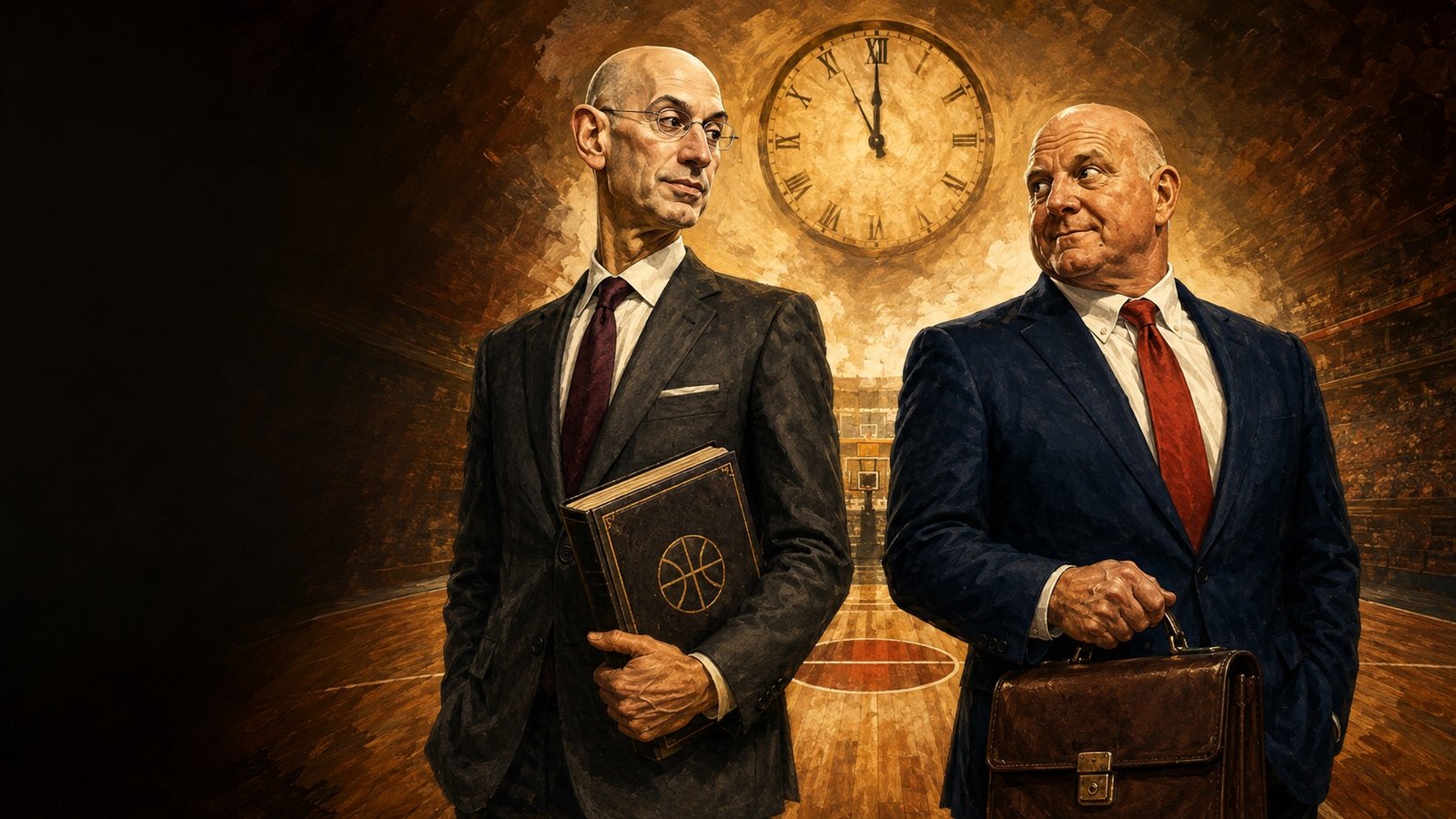
This is a reported opinion column based on the NBA’s September 2 announcement, Wachtell Lipton’s published report, the Clippers’ response and Kelley’s letter, the collective bargaining agreement, contemporaneous reporting and the historical records linked above. It distinguishes the league’s findings, the defense’s assertions and this publication’s analysis. No new interview with the parties is represented here. The cover is an editorial illustration, not a photograph of an actual encounter.