
OCTOBER 13, 1960: A LOW-MARGIN PENNANT WINS THE HIGHEST-LEVERAGE GAME
A data-driven look at the 1960 Pittsburgh Pirates, their +54 run differential, Game 7 walk-off win, and why they defied statistical expectations.
BASEBALLHISTORYMLB
2/24/20263 min read
On October 13, 1960, at Forbes Field, the Pittsburgh Pirates defeated the New York Yankees, 10–9, to win the World Series.[1] Bill Mazeroski’s leadoff home run in the bottom of the ninth inning ended Game 7. It remains the only Game 7 in World Series history to conclude with a walk-off home run.[1] The final swing closed a Series in which New York outscored Pittsburgh 55–27.[1]
The Pirates’ championship gains clarity when viewed against their regular-season profile. Pittsburgh finished 95–59–1 and won the National League pennant with a +54 run differential (734 runs scored, 680 allowed).[2] Among National League pennant winners from 1950 through 1969, that +54 was the lowest run differential of the span.[3] In an era when league champions frequently exceeded +100, Pittsburgh advanced with comparatively narrow separation.
Their statistical identity was balanced rather than overpowering. Dick Groat batted .325 and was voted National League Most Valuable Player.[2] Roberto Clemente hit .314.[2] Vern Law went 20–9 with a 3.08 ERA; Bob Friend won 18 games.[2] The Pirates ranked second in the league in team batting average (.276).[2] They did not lead the league in home runs or strikeouts.
Advanced expectation models reinforce that modest profile. Pittsburgh’s Pythagorean record, derived from runs scored and allowed, projected approximately 90–64—five wins below their actual total.[2] The Pirates outperformed their run-based expectation. In one-run games, they went 26–22.[4] Their bullpen usage reflected a leverage-oriented design. Roy Face appeared in 68 games and threw 114⅔ innings.[2] In the World Series, Face finished Games 1, 4, and 5, each decided by four runs or fewer.[5]
The Yankees entered October with a structurally different shape. New York finished 97–57 with a +193 run differential (746 scored, 553 allowed), leading the American League in runs scored and allowing the fewest runs in the league.[6] Their Pythagorean expectation closely mirrored their actual record, indicating that their margin reflected sustained dominance rather than situational variance.[6] In one-run games, the Yankees went 22–16.[7] Betting markets installed New York as clear favorites, commonly around 2-to-1.[8] The regular-season differential gap between the clubs was 139 runs.[2][6]
The Series displayed that imbalance numerically. In Game 2, the Yankees won 16–3.[9] In Game 3, they won 10–0.[10] In Game 6, they prevailed 12–0.[11] Those three games produced 38 of New York’s 55 runs—69 percent of their total Series scoring.[1] Through seven games, the Yankees held a cumulative +28 run advantage.[1]
Pittsburgh’s victories were compressed into leverage windows. They won Game 1, 6–4; Game 4, 3–2; and Game 5, 5–2.[5] Each required late-inning management rather than sustained separation. Face’s appearances in those contests preserved narrow leads.[5]
Game 7 followed the same distribution. Pittsburgh trailed 7–6 entering the bottom of the eighth inning when catcher Hal Smith hit a three-run home run off Jim Coates to give the Pirates a 9–7 advantage.[1] The Yankees responded in the ninth, scoring twice to tie the game at 9–9.[1] Mazeroski then led off the bottom half against Ralph Terry. On a 1–0 pitch, he drove the ball over the left-field wall.[1]
The Pirates had won four games; the Yankees had scored 28 more runs.
Within the 1950–1969 National League context, Pittsburgh’s +54 regular-season differential was an outlier on the low end.[3] Their season record slightly exceeded their run-based projection.[2] Their opponent’s profile reflected cumulative superiority.[6] The Series outcome did not contradict those numbers; it redistributed them. New York’s dominance was concentrated in three games. Pittsburgh’s effectiveness was concentrated in four.
The 1960 Pirates did not overwhelm the Yankees across seven games. They secured the games they won through leverage conversion consistent with their regular-season construction.[4][5] In a short series, margin accumulation and margin conversion operate differently. Pittsburgh’s championship illustrates that distinction with numerical precision.[1][2][6]
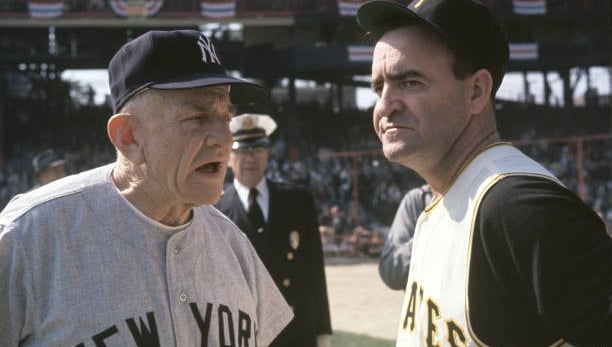
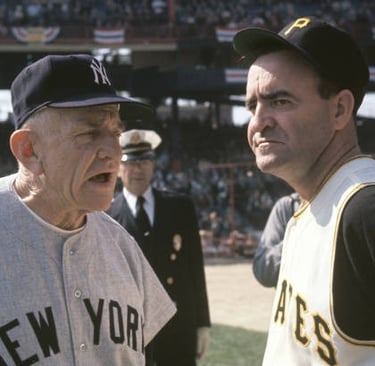
Casey Stengel (left) and Danny Murtaugh before Game 7 of the 1960 World Series at Forbes Field. © Bettmann / Contributor via Getty Images.
OCTOBER 13, 1960: A LOW-MARGIN PENNANT WINS THE HIGHEST-LEVERAGE GAME
Notes
Baseball-Reference.com, “1960 World Series,” Game 7 box score and Series totals (October 13, 1960).
Baseball-Reference.com, “1960 Pittsburgh Pirates Team Statistics & Results.”
Baseball-Reference.com, National League season pages, 1950–1969 pennant winners (run differentials).
Baseball-Reference.com, “1960 Pittsburgh Pirates Schedule and Results” (one-run game record).
Baseball-Reference.com, “1960 World Series Game 1, 4, 5 Box Scores” (Roy Face appearances).
Baseball-Reference.com, “1960 New York Yankees Team Statistics & Results.”
Baseball-Reference.com, “1960 New York Yankees Schedule and Results” (one-run game record).
The New York Times, World Series preview and betting lines, October 1960.
Baseball-Reference.com, “1960 World Series Game 2 Box Score.”
Baseball-Reference.com, “1960 World Series Game 3 Box Score.”
Baseball-Reference.com, “1960 World Series Game 6 Box Score.”