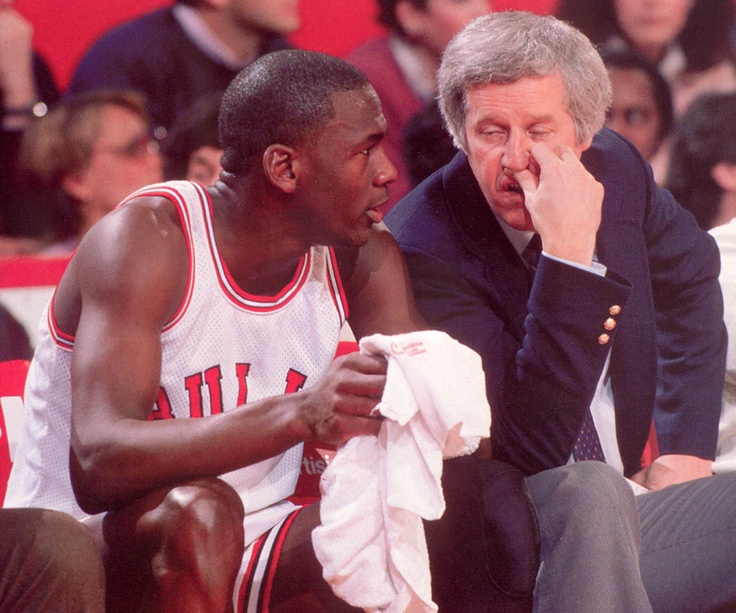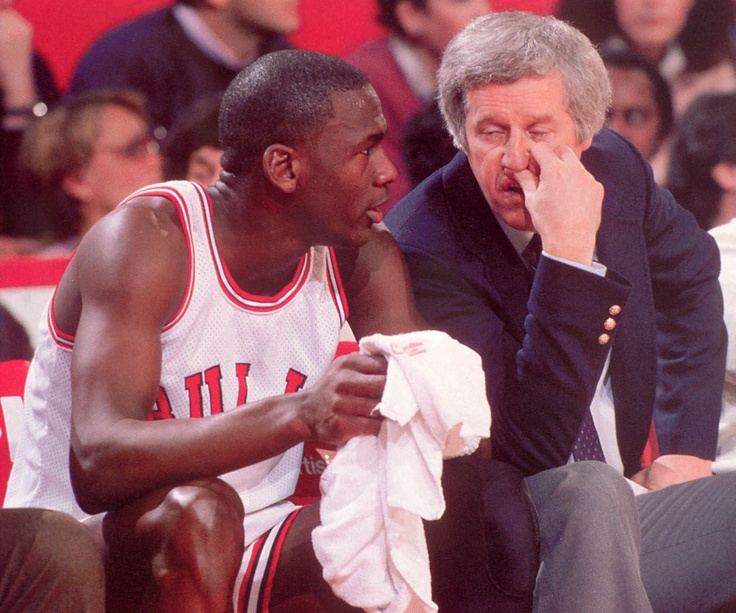
Kevin Loughery on Erving vs Jordan
Kevin Loughery coached Julius Erving’s ABA champion Nets and rookie Michael Jordan’s Bulls. Hear why he calls Doc “easier to coach” than MJ in this rare comparison.
When Kevin Loughery appeared on Mad Dog Unleashed in February 2026, he arrived as one of the few coaches who had steered both Julius Erving’s Nets and Michael Jordan’s rookie Bulls.¹ By the time he reached that studio, Loughery had already survived the 9–73 Philadelphia 76ers, ridden shotgun on two ABA titles with Erving’s New York Nets, and watched a rookie named Jordan tear apart his first Chicago Bulls practice.²³¹³ Few coaches have seen as many versions of professional basketball—or as many tests of temperament—as he has.
So when the conversation turned to Jordan versus Erving, Loughery didn’t reach for another barbershop GOAT ranking. He drew a different line.
“The difference is, in my opinion, Doc was easier to coach than Michael. And I love Michael. I love both of them,” he said.¹ What followed was not a top‑five list but a structural comparison: two superstars, two leadership models, shaped by personality and context.
From Bronx Guard to Every Corner of the League
Loughery’s authority on the subject began long before he held a clipboard. A Bronx native and St. John’s product, he entered the NBA with the expansion Chicago Packers in 1962 and soon found a home with the Baltimore Bullets.¹¹ He was a 6‑foot‑3 guard with a scorer’s mentality, averaging 15.3 points, 3.7 assists, and 3.0 rebounds across 11 seasons with the Pistons, Bullets, 76ers, and Hawks.¹¹¹²
In Baltimore, he became a mainstay. Over eight seasons, he averaged 16.6 points per game and helped the Bullets reach five postseasons and the 1971 NBA Finals.¹¹ In a 1965 playoff series against St. Louis, he put up more than 20 points per game with solid rebounding and playmaking, a reminder that his game rose with the stakes.¹¹
By 1972, that career was winding down. A trade sent him to Philadelphia, where he walked into a franchise in free fall.¹² The 1972–73 76ers finished 9–73, still the worst record in NBA history.¹³ Loughery served as a player‑coach for the final 31 games, going 5–26 while presiding over a roster that cycled through desperation lineups and long losing streaks.¹³ A later oral history would label them “the worst team ever,” and Loughery would insist that, talent‑wise, they were better than their record.¹³
The more consequential decision came that summer. Loughery had verbally agreed to a three‑year contract to remain with the 76ers but never signed it.¹³ When the ABA’s New York Nets called with a five‑year offer to be their head coach, he jumped leagues.¹¹ It was, in retrospect, a hinge moment: a route out of infamy and into a partnership with the era’s most electric player.
Young Coach, Young League, Young Doctor
Loughery took over the Nets in April 1973.¹¹ The franchise had just acquired Julius Erving the previous year and was still figuring out how to build around him. Contemporary stories cast both as ascending forces: “Erving is young. So is his coach, Kevin Loughery. If they can stay together, the Nets will become as great as their talent allows.”¹⁴
They did not have to wait long. In Loughery’s first full season, 1973–74, the Nets went 55–29 and beat the Utah Stars in the ABA Finals.² Erving averaged well over 25 points, double‑digit rebounds, and around five assists, winning the first of his three ABA MVP awards.⁶ In 1974–75, the Nets improved to 58–26 but were upset in the playoffs.² In 1975–76, their final ABA season, they finished 55–29 and recaptured the title.²
The clinching game of that last ABA Finals showed what Loughery meant when he later called it “the best he had ever seen any basketball player ever play.”¹¹ On May 13, 1976, at Nassau Coliseum, the Nets hosted the Denver Nuggets in Game 6 with a 3–2 series lead. Erving scored 31 points, grabbed 19 rebounds, and added 5 assists, controlling the game from tip to final horn.⁷ He attacked the rim in transition, posted smaller defenders, and repeatedly broke Denver’s defensive schemes. Late in the fourth quarter, with the Nuggets threatening, he scored on back‑to‑back drives and then drew a double‑team before hitting a cutting teammate for a layup—a three‑play sequence that effectively ended the last competitive ABA series.⁷
Within that spectacle, Loughery noticed something quieter: how Erving handled the responsibilities of being both star and stabilizer.
“Doc would get along with everybody,” he told Mad Dog Unleashed.¹ In a financially shaky league, that mattered. With teams folding and relocating, and rumors swirling about a merger, Erving’s presence gave the Nets credibility with both fans and teammates.¹⁴
Loughery recounted one stretch when the Nets drifted after a pair of flat performances. “Now when we have a couple of bad games… I get to practice the next day… I said, ‘Doc, I’m gonna get on your ass in practice today. I have to do it… Guys are starting to get complacent.’ And I said I’m gonna get on your ass, ’cause I know if I get on his back, everyone else is gonna pop up. You couldn’t do that with Michael. You could do that with Doc. That’s how he blended in.”¹
Erving accepted the plan. Teammates saw the league’s best player challenged in front of them. Complacency had nowhere to hide. Leadership, in this case, stabilized the structure rather than overturning it.
From 9–73 to the Next Phenomenon
The ABA’s collapse after the 1975–76 season reshuffled Loughery’s world again. The Nets bought their way into the NBA, but to pay entry fees and debts, ownership sold Erving’s contract to the Philadelphia 76ers.¹¹¹⁵ Loughery remained, but the team and league around him were different.
By 1983, he had moved on to Chicago.¹¹ The Bulls were a big‑market franchise with little recent success—28–54 in 1982–83 and 27–55 in 1983–84.³ They needed a new axis. That summer, they drafted Michael Jordan third overall out of North Carolina, where he had been a three‑time All‑American, ACC Player of the Year, and the author of the 1982 NCAA championship‑winning jumper.¹⁶ He arrived fresh off a starring role on the gold‑medal 1984 Olympic team.¹⁶
Loughery, with his ABA experience and championship background, was tasked with steering the franchise into a new era. He wanted to know whether Jordan could be not just a scorer, but the kind of guard who could handle the basketball and take it anywhere on the floor.¹⁵
Within days, he had his answer.
“That Jordan Kid Was Embarrassing the Entire Team”
In interviews years later, Loughery has described Jordan’s first training camp as an immediate shock to the system. During early one‑on‑one drills, he said, “we found out he could do that extremely well. And that’s when we knew we had a star.”¹⁵
Scrimmages only heightened that realization. Loughery and other observers recalled having to change or cut practices because Jordan was embarrassing the entire team, slicing through veteran defenders and stacking bucket after bucket.¹⁵¹⁶ “Once we started scrimmaging, there was no doubt about his competitiveness,” Loughery told one interviewer. “The players weren’t happy with Michael in a way because he demanded that they play as hard as he played in every practice and every game. He never took a day off.”¹⁵
On Mad Dog Unleashed, Loughery revisited a scrimmage that distills those dynamics. “He’s on one team’s side in practice, he wouldn’t let up… we are playing to 10 each side. It’s about 7–1 and I said, ‘Michael, change your jersey.’ He’d take the jersey off and beat the team and he was six points up. He was steaming at me for that… He wants to win. He wouldn’t let up.”¹
The point was not that the score mattered—it was a practice game. The point was that Jordan treated the adjustment as a fresh challenge and, simultaneously, as a slight. He had dominated once, and now he would dominate again, all while resenting the idea that he needed to be redistributed for balance.
The season translated that mentality into numbers. Jordan averaged 28.2 points, 6.5 rebounds, 5.9 assists, and 2.4 steals per game on 51.5 percent shooting.⁴ He finished third in the league in scoring behind Bernard King and Larry Bird, ranked among the league leaders in steals, and ended the season sixth in MVP voting.⁴⁵ The Bulls improved from 27–55 to 38–44 and returned to the playoffs.³
One early statement game offers a snapshot. In an autumn matchup with the San Antonio Spurs during his rookie year, Jordan poured in 45 points on blistering efficiency, adding double‑digit rebounds, a handful of assists, and multiple steals in a comfortable Bulls win.¹⁶ He attacked the lane relentlessly, hammered mid‑range jumpers, and turned a veteran Spurs defense into props for his emergence. For a fan base that had slogged through back‑to‑back 50‑loss seasons, the shift in energy was obvious. Local writers described the building as “looking for a reason to care again,” and Jordan gave them one almost every night.¹⁶¹⁷
Loughery saw the same thing in smaller spaces. “I played cards with Michael… I’d tell Mike, ‘Boy, you’d cheat just to win,’ kiddingly. You know he wouldn’t cheat. And you played golf with him… that’s just the way he is, he never lets up.”¹
His leadership model, in other words, imposed a constant competitive climate.
Two Stars in Two Systems: A Snapshot
The statistical outlines of Erving’s and Jordan’s key transition seasons underscore how their greatness interacted with their environments.²⁴⁶⁸
Table 1 – Erving and Jordan in Transition Seasons
Julius Erving, 1975–76 Nets – ABA – Age 25 – 29.3 PPG – 11.0 RPG – 5.0 APG – Team 55–29 – Fast, free‑flowing ABA.²⁶⁷
Julius Erving, 1976–77 76ers – NBA – Age 26 – 21.6 PPG – 8.1 RPG – 3.7 APG – Team 50–32 – Slower, structured NBA.⁹¹⁰
Michael Jordan, 1984–85 Bulls – NBA – Age 21 – 28.2 PPG – 6.5 RPG – 5.9 APG – Team 38–44 – Pace up vs prior Bulls.³⁴
Erving’s statistical dip from the ABA to the NBA coincided with a change in league pace and role; he moved from do‑everything engine to high‑usage co‑star on a deep Philadelphia roster.⁸⁹¹⁰ Jordan, by contrast, arrived into a vacuum and filled it, immediately becoming Chicago’s offensive center of gravity.³⁴
Two Leagues, Two Contexts
Loughery’s comparison would feel incomplete without the structures around his stars. “That’s why I don’t think we seen the real Dr. J in the NBA as much as we did in the ABA,” he said.¹
The ABA of the mid‑1970s ran faster than the NBA. Pace‑adjusted analyses suggest that ABA teams played several possessions more per game and embraced higher‑variance strategies—early three‑pointers, aggressive trapping defenses, and run‑outs off misses.⁸ In that environment, Erving’s skill set—rebounding, initiating breaks, finishing above the rim—was perfectly leveraged.⁶⁷
When he joined the 1976–77 76ers under Gene Shue, he encountered a more deliberate league. Philadelphia finished 50–32 and reached the NBA Finals in his first season, leaning on a lineup that featured George McGinnis, Doug Collins, Lloyd Free, and Henry Bibby.⁹ Erving’s scoring average dropped into the low‑20s, but his efficiency remained strong, and he assumed a larger defensive and rebounding load.¹⁰ A local columnist noted that he “never complained about touches, never aired grievances through the press; he simply kept filling gaps.”¹⁸
Jordan’s NBA context was different. The league had already absorbed much of the ABA’s flair. Pace had ticked up slightly from the mid‑70s low point, and television contracts were expanding the game’s reach.⁸ Yet within that broader stage, the Bulls were still a struggling franchise. Jordan’s arrival did not ask him to blend into an already‑efficient system; it demanded that he build one.³¹⁶
Loughery’s Two Models
After decades of toggling between disaster and contention, Loughery looked at his two most famous pupils and saw not an argument to be won but a set of mechanisms to be understood.
Jordan’s leadership, in his accounting, operates like a force of acceleration. It raises the temperature of every environment—practice, games, side competitions—and forces teammates either to rise or to peel away. It can create friction, exhaust those who cannot match it, and, at times, require coaches to manage relationships as much as schemes. It also has a way of dragging an organization’s standards upward until multiple championships feel inevitable.¹⁵¹⁶¹⁷
Erving’s leadership acts more like a stabilizing current. It holds structures together in unstable conditions: an ABA on the verge of collapse, a franchise navigating a merger, a deep 76ers team trying to integrate stars without fracturing the locker room. His willingness to be publicly challenged, to adapt his role, and to “get along with everybody” allowed coaches to use him as both star and glue.¹¹¹⁴¹⁷
Loughery’s own résumé—player in the old NBA, player‑coach for the worst record, champion in a rival league, mentor to Jordan’s rookie year—gives him a rare vantage point from which to see both models. He has, quite literally, been everywhere.
“They are two great players and I love both of them. I play golf with both of them,” he said, refusing to weaponize his experience in service of a ranking.¹
For the coach who watched Erving close down the ABA and Jordan blow up his first Bulls practice, greatness is less a single mountaintop than a set of temperaments that can carry a team through different kinds of storms.
Notes
Kevin Loughery interview, Mad Dog Unleashed, SiriusXM, February 2026.
New York Nets season records, 1973–74 through 1975–76, Basketball‑Reference.com.
Chicago Bulls season records, 1983–84 and 1984–85, Basketball‑Reference.com.
1984–85 NBA scoring leaders and Michael Jordan rookie statistics, Basketball‑Reference.com.
1984–85 NBA Most Valuable Player voting results, Basketball‑Reference.com.
Julius Erving ABA regular‑season statistics and Most Valuable Player awards, Basketball‑Reference.com.
Game 6, 1976 ABA Finals (New York Nets vs. Denver Nuggets) box score and game accounts.
ABA versus NBA pace statistics and stylistic differences, mid‑1970s, pace‑adjusted research.
1976–77 Philadelphia 76ers season page and roster details, Basketball‑Reference.com.
Julius Erving 1976–77 NBA statistics and subsequent Philadelphia seasons, Basketball‑Reference.com.
Kevin Loughery biography and career overview, including player and coaching stints.
Kevin Loughery player statistics and Baltimore Bullets tenure, various statistical archives.
Accounts of the 1972–73 Philadelphia 76ers’ 9–73 season and Loughery’s role as player‑coach.
Contemporary commentary on Loughery and Erving’s Nets partnership and 1975–76 title run.
Interviews with Kevin Loughery on coaching Michael Jordan as a rookie, including practice anecdotes and competitiveness.
Reports on early Michael Jordan performances during the 1984–85 season and Chicago media reflections on his impact.
Julius Erving as viewed by his contemporaries—leadership, adaptability, and off‑court presence.
Contemporary Philadelphia coverage of Erving’s role and adaptability with the 76ers.
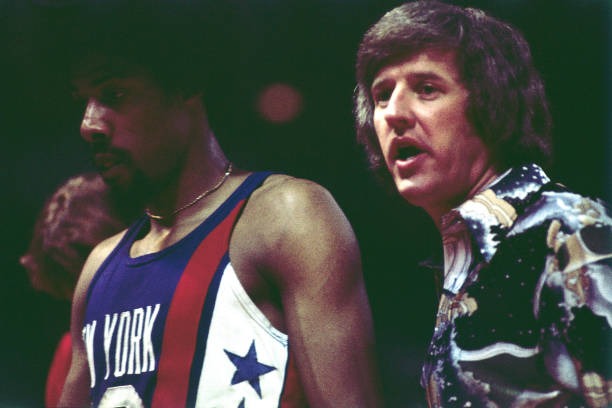
Julius Erving and head coach Kevin Loughery of the New York Nets (photo: Focus on Sport/Getty Images)
“He’s Been Everywhere”: Kevin Loughery, Julius Erving, Michael Jordan, and Two Temperaments of Greatness